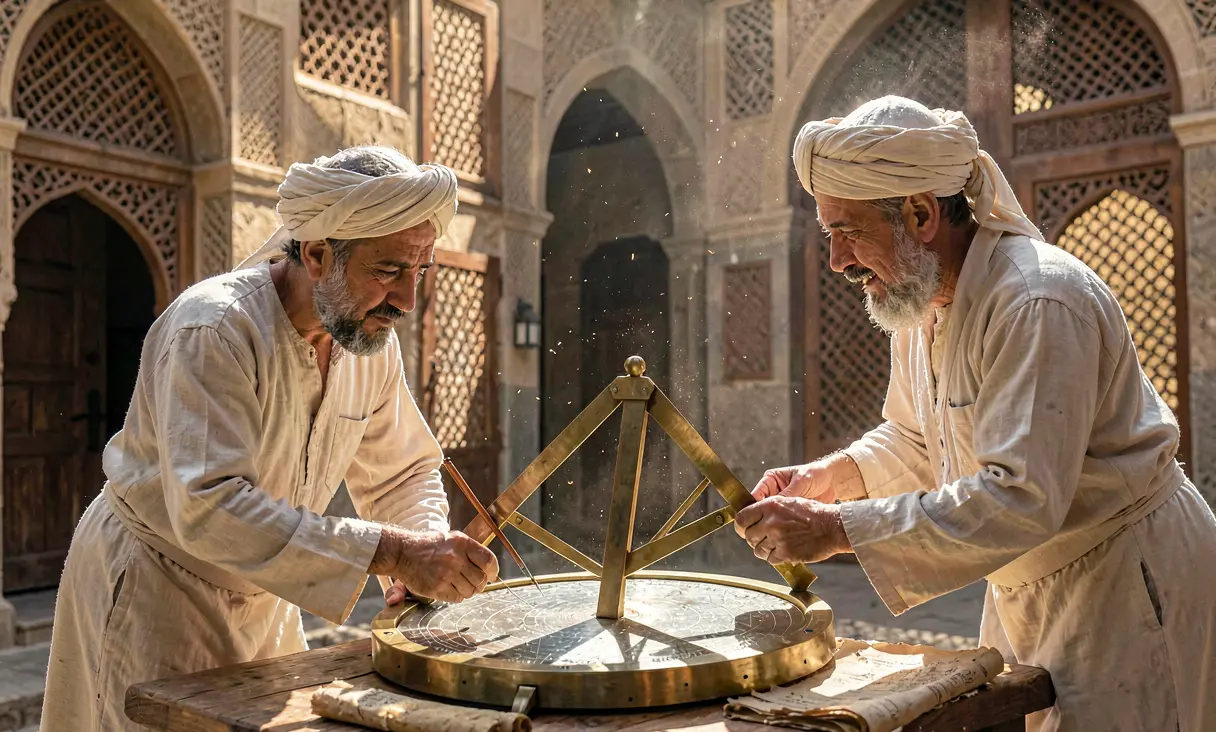
Refinement of the Astrolabe by Islamic Astronomers
Islamic astronomers around 900 CE transformed the Greek astrolabe into a precision instrument that revolutionized navigation, prayer timing, and global scientific exchange.
Greek Foundations and the Islamic Golden Age
The genesis of the astrolabe lies in Hellenistic antiquity, with early prototypes attributed to figures such as Hipparchus and Ptolemy in the second century CE. However, it was the translation movement in Baghdad during the 8th and 9th centuries that catalyzed its transformation from a theoretical tool into a precision instrument of daily life. As the Abbasid Caliphate established the House of Wisdom (Bayt al-Hikmah), scholars systematically translated Greek astronomical treatises, including Ptolemy's Almagest, into Arabic. This intellectual influx provided the mathematical framework necessary to refine the planispheric astrolabe, adapting its stereographic projection to solve problems specific to Islamic religious observance and navigation.
The Refinement of the Planispheric Astrolabe
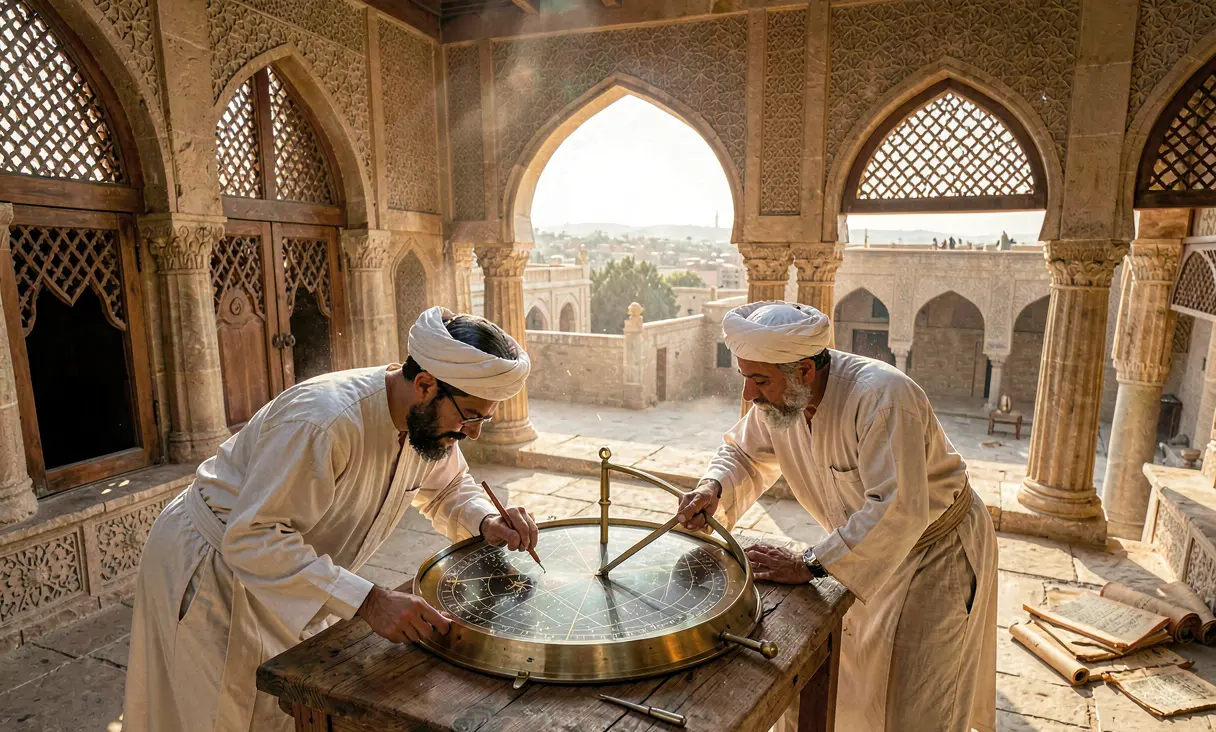
By circa 900 CE, the astrolabe had evolved from a rudimentary device into a sophisticated brass computer capable of solving complex spherical geometry problems without calculation. Islamic engineers perfected the mechanism by introducing multiple interchangeable plates (tara'if), each calibrated for specific latitudes, allowing the instrument to function accurately across the vast expanse of the Islamic world, from Cordoba to Samarkand. The addition of intricate engravings, including zodiacal signs and star charts, alongside a rotating rete that simulated the celestial sphere, allowed users to determine time by day or night with unprecedented accuracy. This era marked the transition of the astrolabe from an astronomical curiosity to an essential tool for determining prayer times (salat) and finding the Qibla direction toward Mecca.
Pioneers: Al-Fazari, Al-Sufi, and Al-Biruni
While Muhammad al-Fazari is often credited with constructing the first astrolabe in the Islamic world during the late 8th century, it was later scholars who achieved its zenith. Around 900 CE, Abd al-Rahman al-Sufi authored the seminal 'Book of Fixed Stars,' which corrected Ptolemy's star catalog and refined the astrolabe's star positions. Following this, the polymath Al-Biruni (973–1048) would later push the boundaries further with his treatise on the subject, describing how to construct a universal astrolabe that could function at any latitude. These figures did not merely copy Greek models; they innovated by adding new scales for shadow calculations and developing methods to determine the time of day based on the sun's altitude, integrating rigorous mathematics with practical craftsmanship.
From Theory to Practice: Navigation and Timekeeping
The utility of the refined astrolabe extended far beyond the observatory. For the merchant and traveler traversing the Silk Road or crossing the Indian Ocean, the instrument was a lifeline for navigation, allowing them to determine their latitude by measuring the altitude of Polaris or other known stars. In urban centers, it regulated the rhythm of society; muezzins used it to calculate the precise moments for the five daily prayers and the beginning of fasting during Ramadan. The device also facilitated land surveying and the calculation of lunar months, embedding itself into the administrative and religious fabric of medieval Islamic civilization. Its portability and versatility made it indispensable for both the scholar in his study and the sailor on the open sea.
Transmission to Europe and Global Impact
The legacy of these refinements was cemented when the knowledge of the astrolabe migrated westward, primarily through Al-Andalus (Islamic Spain) and Sicily during the 12th century. Latin translations of Arabic treatises by scholars such as Adelard of Bath introduced European astronomers to the sophisticated designs developed in Baghdad and Persia. The instrument became a staple of medieval European universities, serving as a primary tool for astronomy and navigation until the advent of the telescope and modern chronometers. This transmission was not merely a transfer of technology but a conduit for mathematical concepts that would later underpin the Scientific Revolution.
Enduring Symbol of Scientific Synthesis
The refinement of the astrolabe around 900 CE stands as a defining moment in the history of science, representing the successful synthesis of Greek theory, Indian mathematics, and Persian craftsmanship. It demonstrated how scientific inquiry could be driven by both spiritual necessity and practical exploration. The surviving examples of these instruments, often crafted from brass with intricate filigree, remain testaments to the high level of metallurgical skill and astronomical knowledge achieved in the medieval Islamic world. They serve as a historical bridge connecting antiquity to the modern era, illustrating how the pursuit of celestial mechanics shaped human understanding of time, space, and our place within the cosmos.
The refined astrolabe was the preeminent navigational tool of the medieval world, enabling accurate celestial navigation and timekeeping.

Where it happened
Baghdad, Iraq — see it on the interactive map →
Explore related history
 ScienceConstruction of El Caracol Observatory at Chichen Itzac. 850 CE · Chichen Itza, MexicoMaya astronomers build a circular observatory aligned with Venus cycles.
 ScienceComposition of the Mitakshara Law Codec. 1100 CE · Kalyan (modern Karnataka/India)Vijnaneshwara writes the Mitakshara, a seminal commentary on Hindu law that influences legal systems across India.
 ScienceMaya Astronomical Tables in the Dresden Codexc. 1200 CE · Yucatán Peninsula, MexicoMaya astronomers record precise calculations for Venus cycles and eclipses.
 DisasterCollapse of Classic Maya Civilizationc. 900 CE · Tikal and Calakmul, Guatemala/MexicoMajor Maya city-states are abandoned due to drought, warfare, and ecological collapse during the Terminal Classic period.
 DisasterEcological Collapse and Drought Leading to Maya Declinec. 900 CE · Petén Basin, GuatemalaSevere drought and deforestation cause the collapse of Classic Maya civilization.
 WarViking Siege of Paris885 CE · Paris, FranceViking raiders led by Sigfred besiege Paris for over a year, testing the defenses of West Francia.
Discussion
Loading…