
Archimedes Formulates the Law of the Lever
Archimedes proved mathematically that a small force can move immense weight via leverage, establishing the foundational principles of statics and torque that underpin modern engineering.
The Intellectual Climate of Hellenistic Syracuse
In the mid-3rd century BCE, Syracuse stood as a preeminent cultural and political hub in Magna Graecia, ruled by King Hiero II. While the city was often embroiled in the geopolitical struggles between Rome and Carthage, its intellectual atmosphere was equally vibrant, fostering a unique synthesis of theoretical mathematics and practical mechanics. Archimedes of Syracuse, born around 287 BCE, operated within this milieu, deeply influenced by the teachings of Euclid's students in Alexandria yet grounded in the engineering realities of his native Sicily. Unlike many of his contemporaries who viewed pure mathematics as distinct from physical application, Archimedes sought to demonstrate that abstract geometric principles could explain and predict mechanical phenomena.
The Formulation of the Law of the Lever
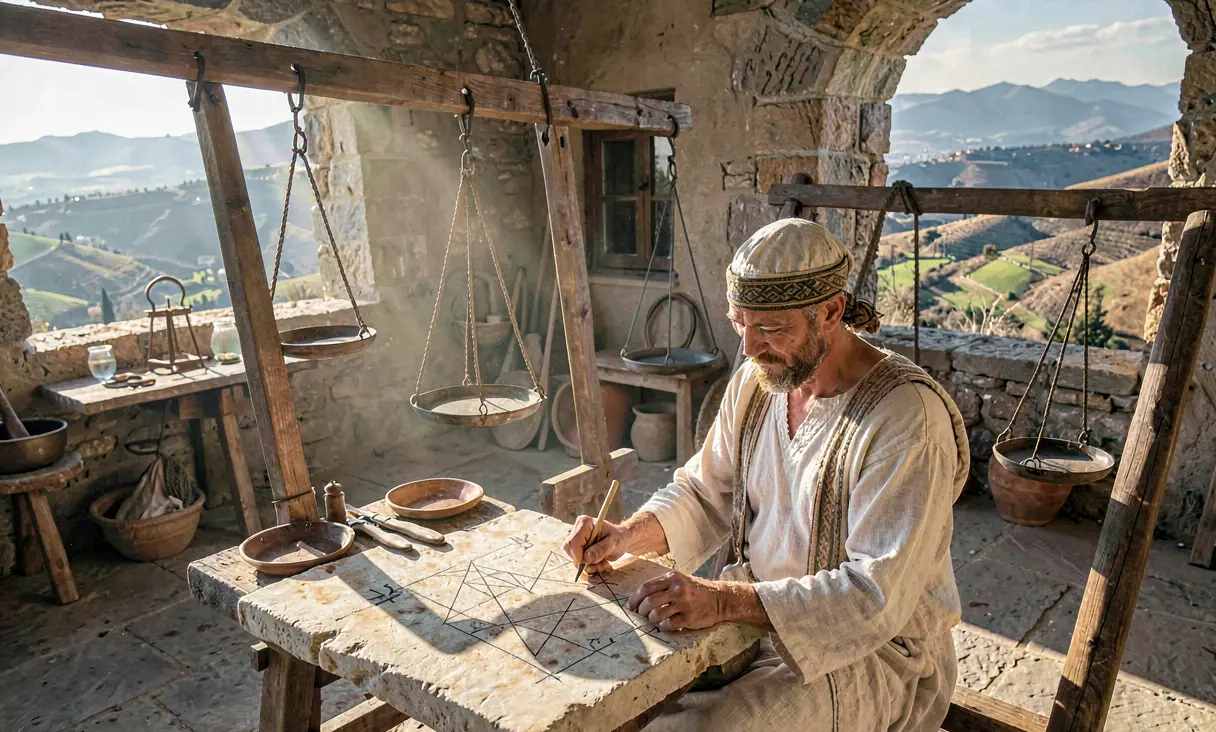
Around 250 BCE, Archimedes composed his seminal treatise, *On the Equilibrium of Planes* (Book I), wherein he rigorously derived the mathematical law governing the lever. He postulated that for a system to be in equilibrium, the weights must be inversely proportional to their distances from the fulcrum. This was not merely an observation but a deductive proof based on seven axioms, establishing that equal weights at equal distances are in equilibrium, and unequal weights at equal distances will tilt toward the heavier weight. By generalizing this relationship, he demonstrated that any two weights could be balanced if their distances from the fulcrum were adjusted according to the ratio of their masses, effectively quantifying mechanical advantage for the first time in recorded history.
The Hypothetical Power: Moving the Earth
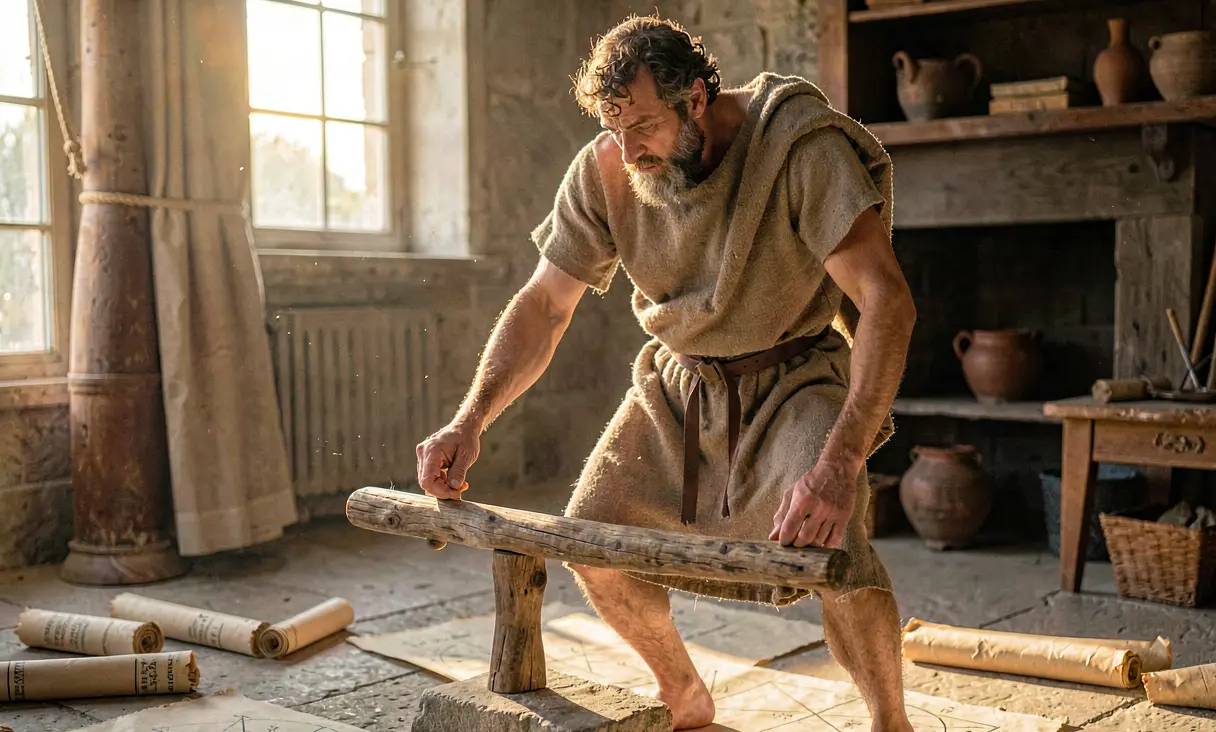
The implications of this discovery were so profound that Archimedes reportedly declared to King Hiero II, 'Give me a place to stand, and I shall move the earth.' This famous assertion was not mere hyperbole but a logical extrapolation of his mathematical model. If a sufficiently long lever arm could be constructed and a fulcrum placed appropriately, even an infinitesimal force applied at one end could balance or move an immense mass at the other. Historical accounts by Plutarch suggest that Archimedes demonstrated this principle practically by using compound pulleys to single-handedly launch a massive merchant ship from the harbor of Syracuse, proving that the theoretical mechanics he had derived could indeed overcome immense physical resistance.
Bridging Theory and Engineering
While the Law of the Lever was a triumph of pure geometry, its formulation occurred alongside Archimedes' other major discoveries, such as the principle of buoyancy. The context of his work in Syracuse was one where theoretical inquiry directly addressed civic needs; the need to defend the city against Roman sieges and manage its harbors drove much of his engineering innovation. His ability to translate geometric proofs into functional machines, including war engines like the Claw of Archimedes and advanced screw pumps, set him apart from earlier Greek thinkers who often shunned manual labor. This synthesis established a new paradigm where mathematics became the language of physical force.
Transmission and Preservation
Following Archimedes' death during the Roman siege of Syracuse in 212 BCE, his manuscripts were preserved by Roman scholars like Cicero, who famously rediscovered his neglected tomb. The *On the Equilibrium of Planes* survived through Greek commentaries and was later translated into Arabic during the Islamic Golden Age, where scholars such as Al-Haytham further refined mechanical theories. These texts eventually re-entered European consciousness in the 12th century, fueling the Renaissance of mechanics that would lead to the work of Leonardo da Vinci and Galileo Galilei. The survival of these specific geometric proofs ensured that the quantitative understanding of force was not lost to antiquity.
Enduring Legacy in Modern Physics
The Law of the Lever remains a foundational pillar of classical mechanics, serving as an early example of the concept of torque and rotational equilibrium. It provided the conceptual framework for statics, allowing engineers to design complex structures, bridges, and machinery with mathematical precision. In modern physics education, the lever is often the first introduction to the conservation of energy and mechanical advantage, illustrating that work input equals work output in an ideal system. Archimedes' insight that nature obeys mathematical laws governing force and distance fundamentally shaped the scientific method, proving that the physical world could be understood through rigorous logical deduction.
His mathematical proofs established the theoretical basis for modern mechanical engineering and hydrostatics.
Where it happened
Syracuse, Sicily — see it on the interactive map →
Explore related history
 ScienceEstablishment of the Babylonian Astronomical Observatoriesc. 747 BCE · Babylon, IraqBabylonian priests begin systematic nightly recording of planetary movements and eclipses.
 ScienceCompilation of Ashurbanipal's Royal Libraryc. 650 BCE · Nineveh (Mosul), IraqKing Ashurbanipal assembles the largest collection of cuneiform tablets in the ancient world.
 ScienceRefinement of the Maya Long Count Calendar Systemc. 361 BCE · Chiapa de Corzo, MexicoMaya scholars formalize the Long Count calendar for tracking deep historical time.
 ReligionAshoka Propagates Dharma via Rock Edictsc. 250 BCE · Sarnath, IndiaEmperor Ashoka spreads Buddhist ethics and non-violence across the Mauryan Empire through inscribed stone pillars.
 PoliticsBurial of the Lord of Sipánc. 250 BCE · Huaca Rajada, Lambayeque, PeruThe Moche ruler is buried with immense wealth and sacrificial victims.
 TechnologyInnovation of Roman Hydraulic Concrete (Opus Caementicium)c. 250 BCE · Rome, ItalyRoman engineers develop underwater-set concrete using volcanic ash and lime.
Discussion
Loading…