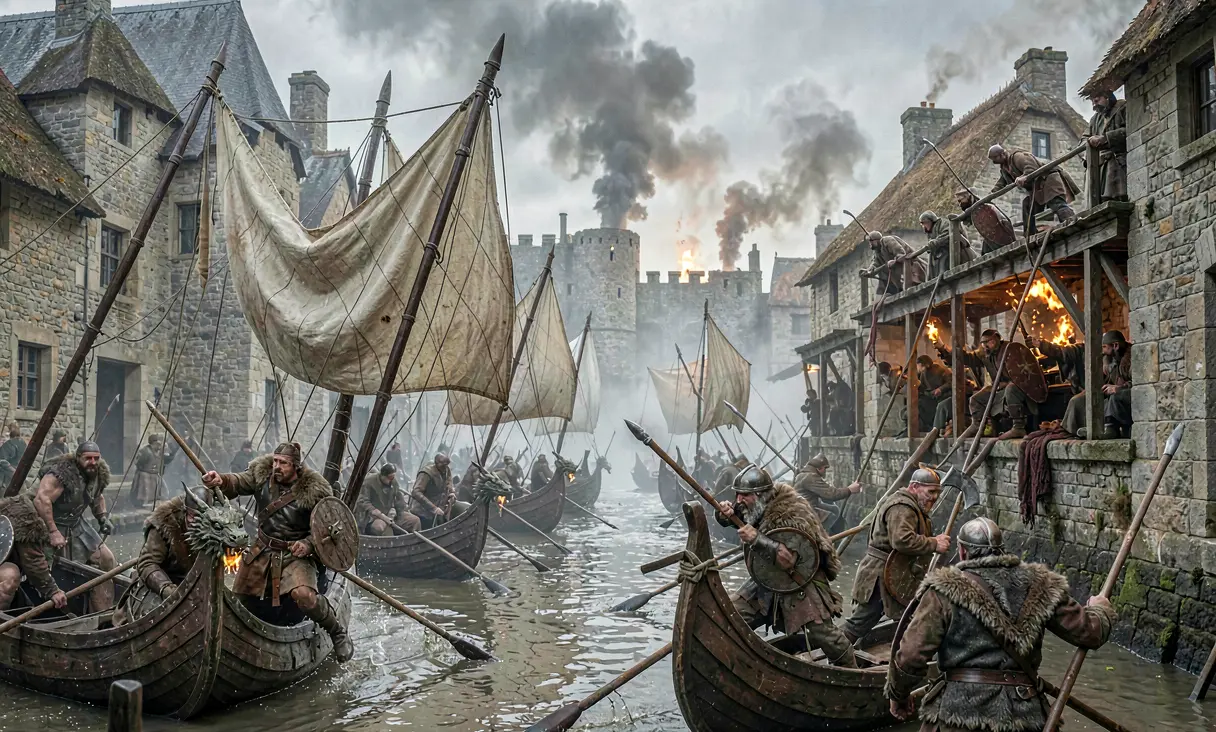
Viking Siege of Paris
In 885 CE, Count Odo and Bishop Gozlin heroically repelled a massive Viking fleet at the Siege of Paris, exposing imperial weakness and catalyzing the rise of the French monarchy.
A Kingdom in Crisis
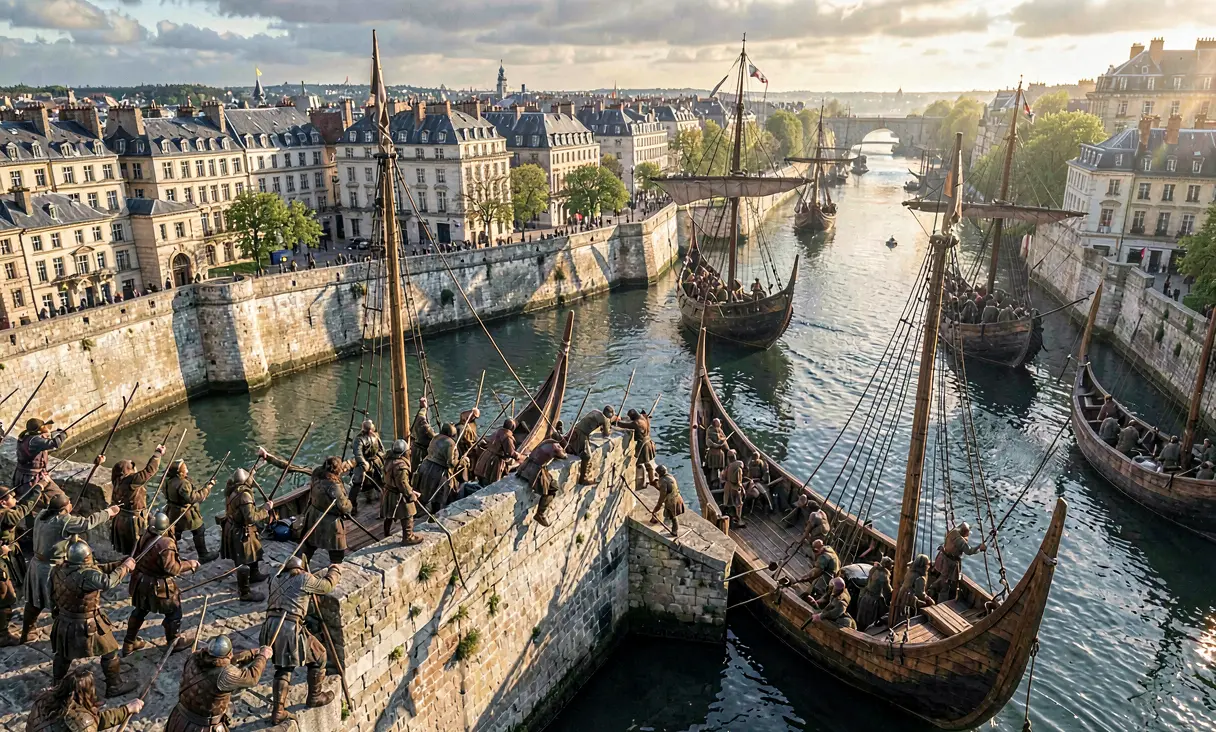
By the late ninth century, the Carolingian Empire, fractured by civil war and succession disputes, faced an existential threat from Norse raiders who had evolved into a formidable military force. The year 885 CE marked a turning point as a massive Viking armada, estimated by contemporary chronicler Abbo of Saint-Germain-des-Prés to number between 300 and 700 ships carrying roughly 40,000 warriors, ascended the Seine River. Their objective was not mere plunder but the subjugation of Paris, a strategic stronghold guarding the river's approach to the heart of West Francia. The city, then centered on the Île de la Cité, relied on two stone towers flanking a wooden bridge connecting it to the right bank, representing one of the few remaining vestiges of Roman-era fortification in a landscape increasingly dominated by feudal fragmentation.
The Defenders: Odo and Gozlin
The defense of Paris was orchestrated by an unlikely but formidable duo: Count Odo, a nobleman of the Robertian dynasty who would later become King of West Francia, and Bishop Gozlin, a man of immense spiritual and political influence. While Frankish nobility often engaged in internal power struggles, these two united the city's populace, including clergy and commoners, against the pagan invaders. Odo commanded the military strategy, organizing the militia and reinforcing the precarious wooden bridge with iron chains and barricades, while Gozlin provided moral fortitude, leading processions and rallying the defenders with the promise of martyrdom. Their leadership transformed a potential rout into a protracted siege that would test the limits of medieval warfare.
The Siege Unfolds
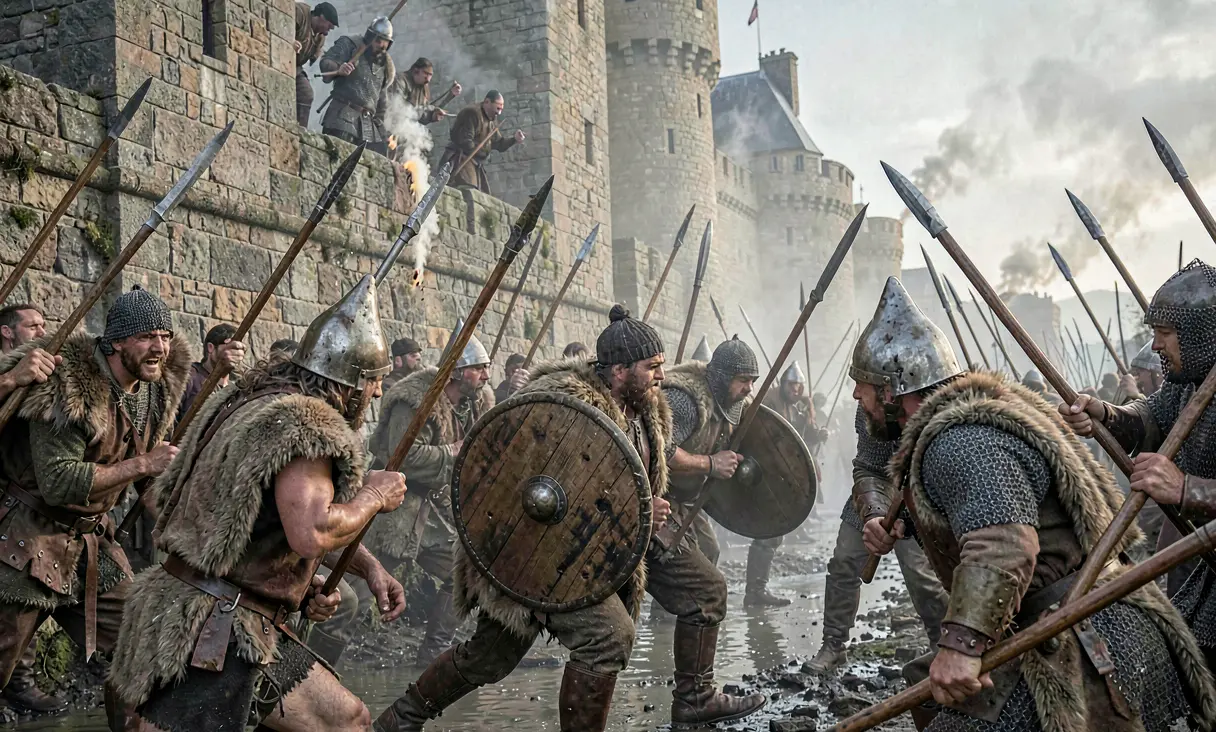
The siege began in November 885, as the Vikings attempted to breach the city's defenses with battering rams and scaling ladders. The defenders repelled these initial assaults with devastating effectiveness, utilizing Greek fire—a mysterious incendiary weapon of Byzantine origin that could burn on water—to destroy Viking longships and demoralize their crews. When the river froze over in January 886, allowing the Vikings to bypass the bridge by land, they constructed massive siege towers and earthworks to assault the stone towers directly. Despite suffering heavy casualties from Frankish archers and boiling oil, the Norse forces maintained a tight blockade for nearly a year, starving the city of supplies while Odo managed daring sorties to secure food and reinforcements.
The Turning Point
The stalemate was broken not by the fall of Paris, but by the arrival of Emperor Charles the Fat in July 886. Instead of engaging the Vikings in battle or lifting the siege through force, Charles negotiated a payment of 700 livres of silver to allow the Norsemen to sail upriver and raid Burgundy, which was currently undefended. This decision, viewed by many contemporaries as cowardly and treacherous, effectively abandoned Paris to its fate while rewarding the aggressors. The Vikings, having failed to take the city by storm but unwilling to continue a costly siege without a guaranteed victory, accepted the bribe and departed in August 886, leaving behind a devastated countryside but an intact Île de la Cité.
Aftermath and Political Repercussions
The resolution of the siege had immediate and profound political consequences for West Francia. The populace's perception of Emperor Charles the Fat plummeted; he was seen as weak and incompetent, having failed to protect his subjects from a pagan enemy while rewarding them with tribute. In contrast, Count Odo emerged as a national hero, his successful defense of Paris cementing his reputation as a capable leader. Within two years, in 888, the Frankish nobility deposed Charles the Fat and elected Odo as King, marking the end of the Carolingian dynasty's dominance in West Francia and the rise of the Robertians, who would eventually evolve into the Capetian kings.
Legacy and Strategic Evolution
The Siege of Paris fundamentally altered the military landscape of medieval Europe. It demonstrated that fortified stone cities could withstand superior numbers if led by determined commanders, shifting the paradigm from open-field battles to static defense. The event accelerated the feudalization of Frankish society, as local lords realized that centralized imperial protection was unreliable and that they must build their own castles and maintain private armies. Furthermore, the siege highlighted the vulnerability of riverine trade routes, forcing a reevaluation of urban planning and defensive architecture across the continent. Paris itself became a symbol of resilience, its survival ensuring it would remain a central political hub in France for centuries to come.
It demonstrated the resilience of Parisian defenses and accelerated the rise of the Capetian dynasty.
Where it happened
Paris, France — see it on the interactive map →
Explore related history
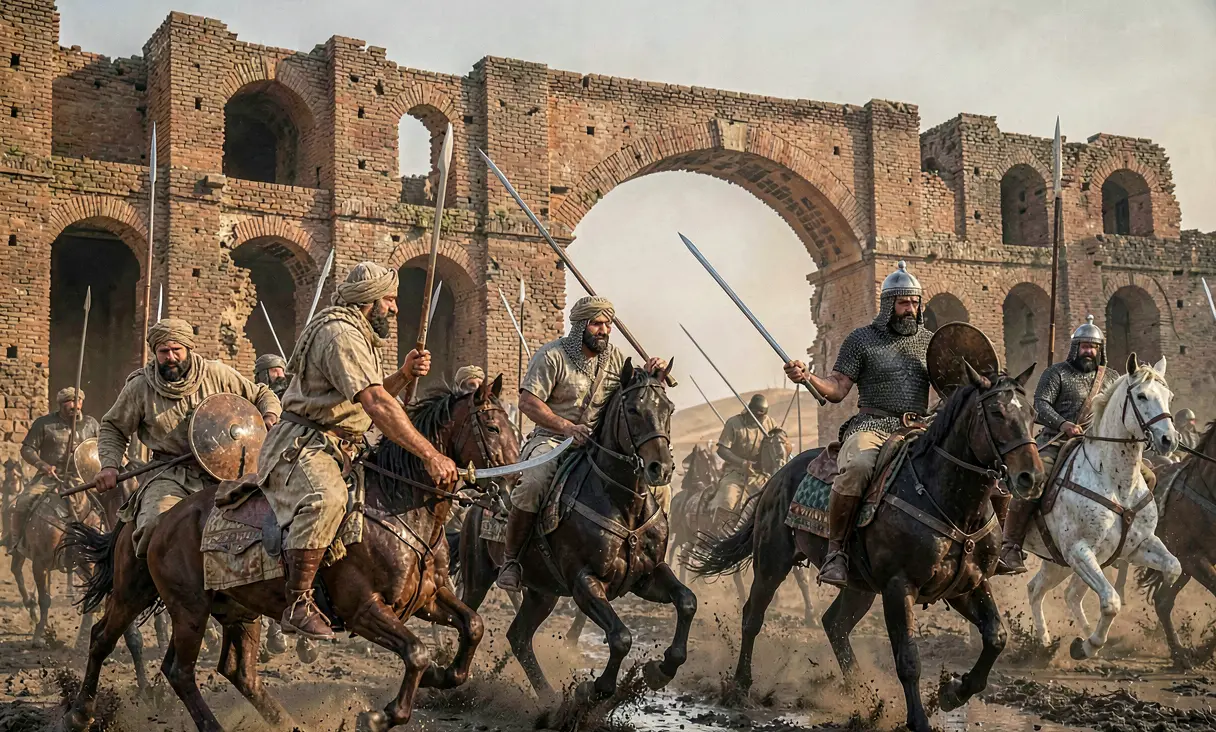 WarIslamic Conquest of the Sasanian Empire637 CE · Ctesiphon, Iraq (Persia)Arab Muslim forces defeat the Sasanian Empire at the Battle of al-Qadisiyyah, ending centuries of Persian rule.
 WarChola Conquest of Sri Lankac. 993 CE · Anuradhapura, Sri LankaRajaraja Chola launches a massive amphibious invasion of Sri Lanka, defeating the Sinhalese kingdom and annexing the island.
 WarRajendra Chola I's Ganges Expeditionc. 1025 CE · Bengal to Ganges Delta, IndiaRajendra Chola I leads a northern expedition reaching the Ganges River, defeating Pala kings and bringing holy water back to Thanjavur.
 ExplorationViking Settlement of Iceland874 CE · Reykjavik, IcelandNorse explorers led by Ingólfr Arnarson settle Iceland, establishing the first permanent European community in the North Atlantic.
 DisasterCollapse of Classic Maya Civilizationc. 900 CE · Tikal and Calakmul, Guatemala/MexicoMajor Maya city-states are abandoned due to drought, warfare, and ecological collapse during the Terminal Classic period.
 ScienceRefinement of the Astrolabe by Islamic Astronomersc. 900 CE · Baghdad, IraqPersian and Arab scholars perfect the astrolabe for navigation and timekeeping.
Discussion
Loading…