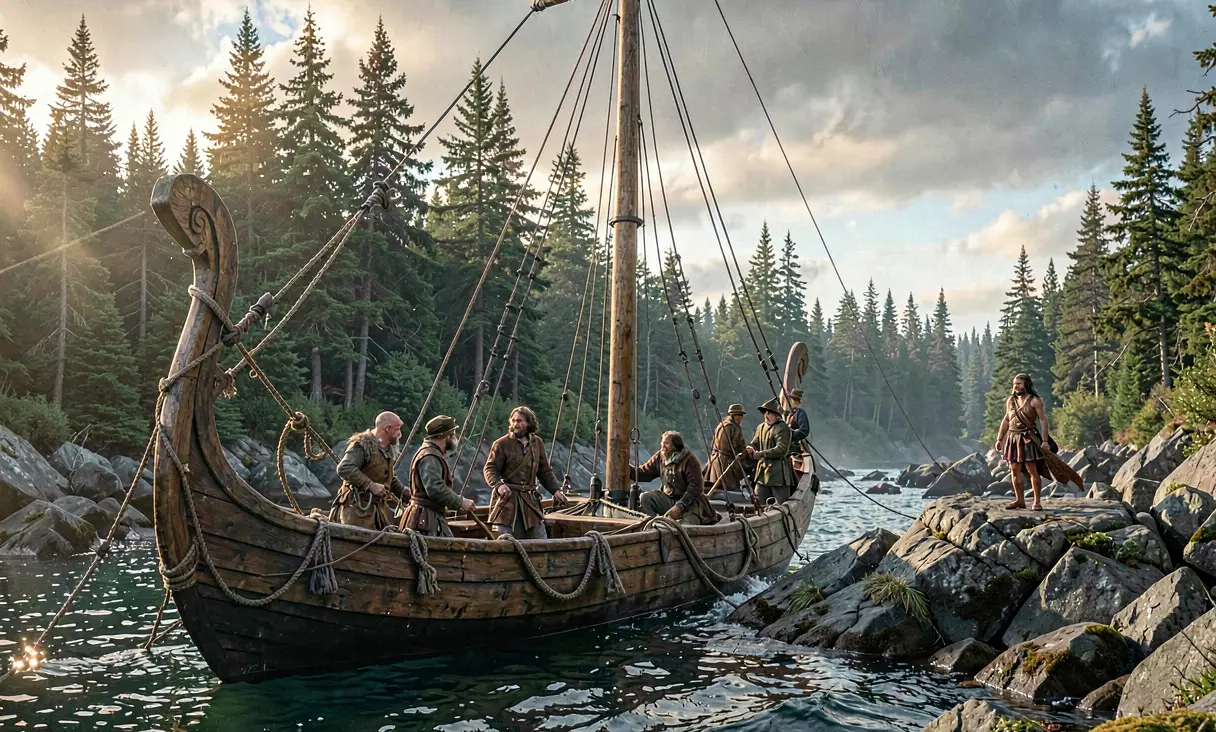
Leif Erikson's Voyage to Vinland
Circa 1000 CE, Leif Erikson led the first confirmed European expedition to North America, establishing a short-lived settlement at L'Anse aux Meadows and proving trans-Atlantic navigation was possible
The Greenlandic Prelude
By the late 10th century, Norse expansion across the North Atlantic had established a precarious foothold in Iceland and Greenland. Erik the Red, exiled from Iceland for manslaughter, founded the Eastern Settlement on Greenland's southwestern coast around 985 CE. These settlements, though isolated, thrived through a mix of pastoral farming and maritime hunting, yet they remained dependent on supply ships from Norway. The maritime culture of these Norsemen was exceptionally advanced; their clinker-built longships, capable of withstanding the treacherous North Atlantic swells, were driven by a combination of square sails and oars, allowing for exploration far beyond established trade routes. It was within this context of aggressive expansion and navigational confidence that Leif Erikson, son of Erik the Red, prepared to push further westward.
The Voyage West
Circa 1000 CE, Leif Erikson set sail from the Brattahlíð estate in Greenland with a crew of approximately thirty-five men. His journey was not entirely original; he likely purchased an unfinished ship from Bjarni Herjólfsson, who had previously sighted land to the west but been blown off course without landing. Following Bjarni's reported coordinates and utilizing the sunstone for navigation during overcast days, Leif charted a direct course toward the unknown. He first encountered a flat, forested land he named Helluland (Stone Slab Land), likely Baffin Island. Sailing south, he reached a wooded coast with white sandy beaches, which he dubbed Markland (Forest Land), generally identified as the Labrador Peninsula. Continuing further south, they finally made landfall on a region of abundant resources, characterized by mild winters and wild grapes.
The Discovery of Vinland
This final destination, which Leif named Vinland (Wineland), marked the first confirmed European contact with the North American continent. The name derived from the 'wild vines' or grapes observed by the crew, though modern botanists suggest these may have been wild currants or cranberries, as true grapes do not grow in Newfoundland. To facilitate further exploration and resource extraction, Leif established a temporary base camp at what is now known as L'Anse aux Meadows on the northern tip of Newfoundland. The site featured at least eight turf-walled structures, including dwellings and workshops, constructed using traditional Norse techniques adapted to local materials. Evidence of iron smelting found at the site confirms that the Norse brought their metallurgical knowledge with them, utilizing bog iron or scrap metal to repair tools and weapons.
Encounters and Conflict
The Norse presence in Vinland was not without peril. The sagas, particularly the Saga of the Greenlanders and the Saga of Erik the Red, describe encounters with indigenous peoples whom the Norse termed 'Skrælings,' a derogatory term implying weakness or wailing. Initial interactions involved trade, with the Norse offering milk products in exchange for furs. However, relations quickly deteriorated into violence when a Norseman killed an indigenous man who attempted to steal weapons. The subsequent attacks by larger groups of indigenous warriors forced the Norse to retreat to their fortified encampment. Realizing they were vastly outnumbered and unable to sustain a prolonged conflict in such a remote location, Leif Erikson and his crew abandoned Vinland after less than a year, returning to Greenland with timber and grapes.
The Archaeological Confirmation
For centuries, the existence of Norse America remained a subject of scholarly debate, dismissed by many as myth until 1960. That year, Norwegian explorer Helge Ingstad and his wife, archaeologist Anne Stine Ingstad, discovered the ruins at L'Anse aux Meadows. Excavations revealed a precise match to the descriptions in the Icelandic sagas: turf houses with stone foundations, a smithy containing slag from iron working, and artifacts such as a bronze ring-headed pin and a soapstone spindle whorl, confirming a mixed-gender Norse presence. Radiocarbon dating firmly places the occupation between 990 and 1050 CE, aligning perfectly with the saga narratives. While L'Anse aux Meadows was likely a staging post rather than a permanent colony, it stands as irrefutable proof of pre-Columbian trans-oceanic contact.
Legacy and Historical Significance
Leif Erikson's voyage represents a pivotal moment in global history, shattering the notion that Christopher Columbus was the first European to reach the Americas. Although the Norse settlements were ultimately ephemeral due to logistical challenges and hostilities with indigenous populations, they demonstrated the feasibility of trans-Atlantic navigation centuries before the Age of Discovery. The failure to establish a permanent foothold meant that the knowledge of Vinland did not lead to immediate colonization or widespread cultural exchange; the Americas remained largely isolated from Europe until 1492. Nevertheless, Leif Erikson's achievement remains a testament to human curiosity and maritime prowess, bridging two worlds across an ocean that had previously seemed impassable.
It represents the first known European contact with North America, predating Columbus by 500 years.
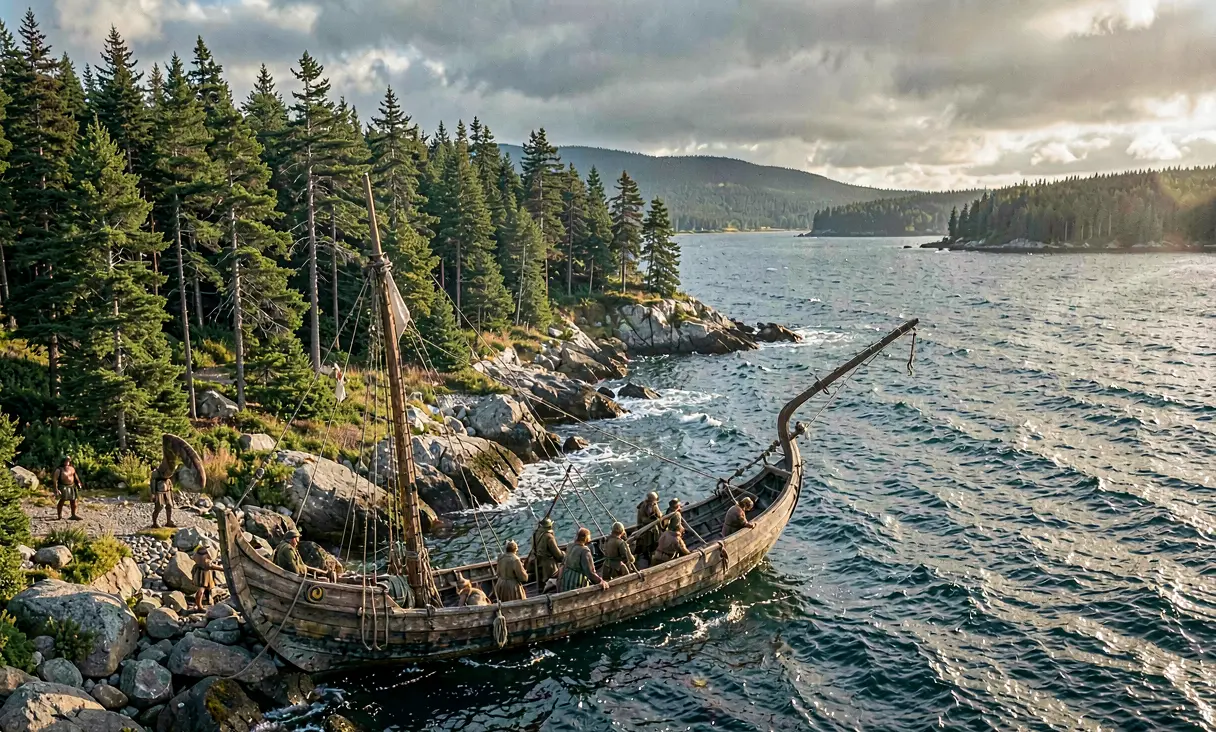

Where it happened
L'Anse aux Meadows, Newfoundland, Canada — see it on the interactive map →
Explore related history
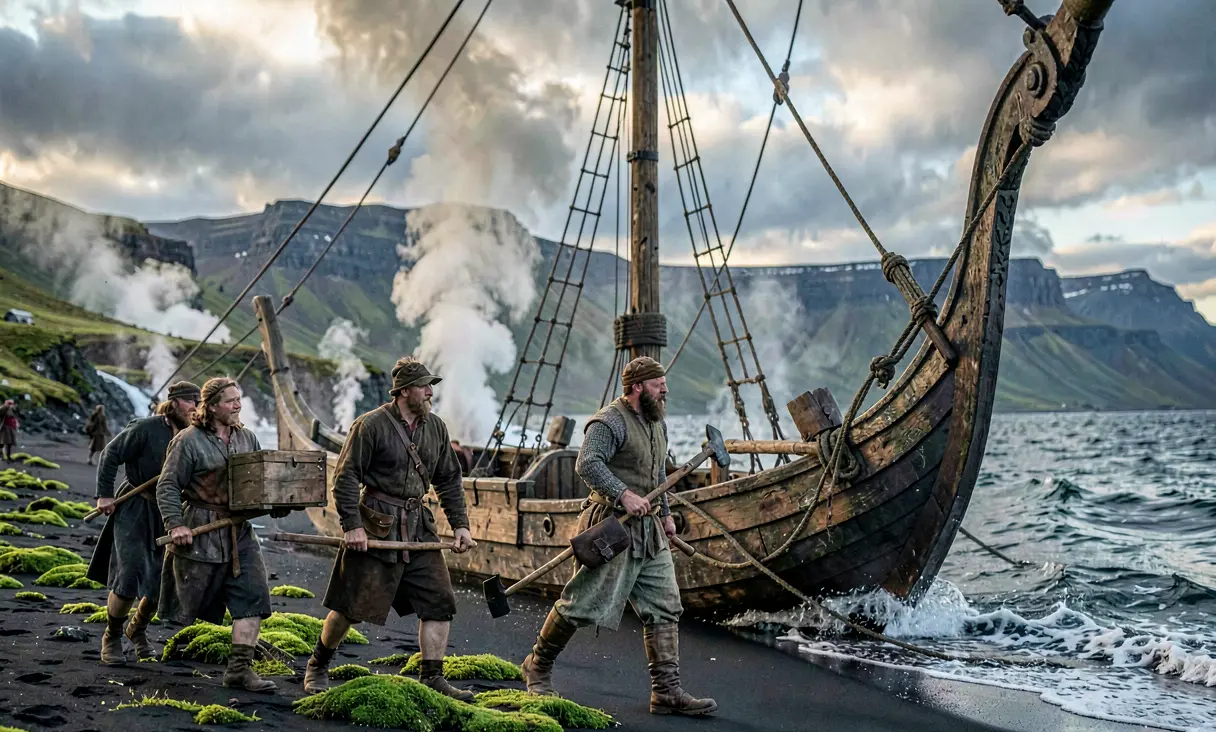 ExplorationViking Settlement of Iceland874 CE · Reykjavik, IcelandNorse explorers led by Ingólfr Arnarson settle Iceland, establishing the first permanent European community in the North Atlantic.
 ExplorationKorean Tribute Trade with China918 CE · Sungnyemun Gate (Kaesong), KoreaGoryeo establishes formal tributary relations with the Song Dynasty.
 ExplorationChola Naval Expedition to Southeast Asia1025 CE · Java and Sumatra (Modern Indonesia)Chola fleet raids coastal cities across the archipelago.
 PoliticsSrivijaya at its Zenithc. 1000 CE · Palembang, Sumatra (Modern Indonesia)Srivijaya controls the Strait of Malacca and dominates regional trade.
 TechnologyUse of Astrolabes for Celestial Navigation by Arab Sailorsc. 1000 CE · Jeddah, Saudi ArabiaArab navigators utilize refined astrolabes to cross the Indian Ocean.
 WarChola Conquest of Sri Lankac. 993 CE · Anuradhapura, Sri LankaRajaraja Chola launches a massive amphibious invasion of Sri Lanka, defeating the Sinhalese kingdom and annexing the island.
Discussion
Loading…