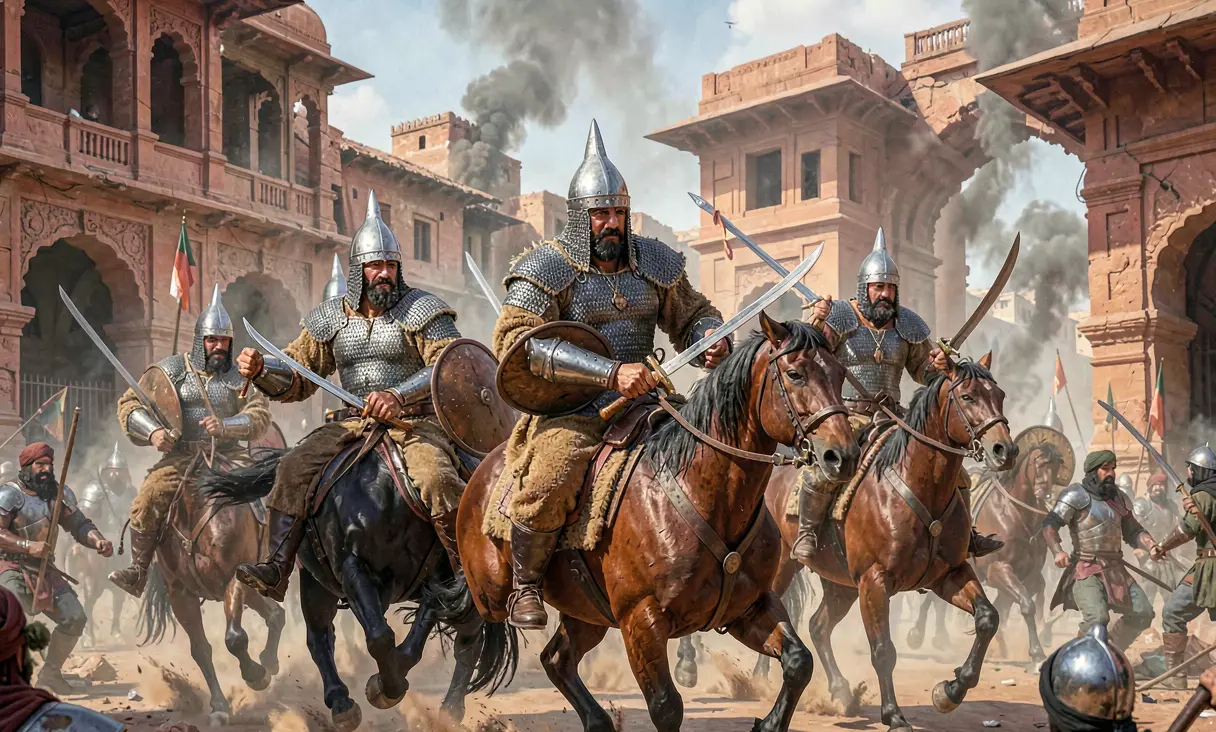
Rise of Timur (Tamerlane) and Conquest of Delhi
In 1398, Timur's devastating invasion shattered the Tughlaq dynasty, sacking Delhi and leaving a power vacuum that ultimately facilitated the future rise of the Mughal Empire.
The Shadow of the Steppe
By the late 14th century, the Delhi Sultanate, founded by Qutb al-Din Aibak and expanded under the mighty Iltutmish, had entered a period of severe decline. The Tughlaq dynasty, once a beacon of centralized power, was fracturing under the weight of internal dissent and administrative overreach. Sultan Mahmud Shah Tughlaq, often described by contemporary chroniclers as weak and indecisive, struggled to maintain control over a realm that stretched from the Himalayas to the Deccan. Into this vacuum of power stepped Timur, the Turco-Mongol warlord who had spent two decades forging an empire in Central Asia. Unlike Genghis Khan, whose lineage he claimed through marriage rather than blood, Timur sought to restore the Mongol legacy of conquest while positioning himself as a champion of Islam. His ambition was not merely territorial but existential; he aimed to cleanse the 'infidel' lands of India and replenish his treasury with the legendary wealth of the subcontinent.
The March Across the Hindu Kush
In the spring of 1398, Timur mobilized a formidable force estimated at over 90,000 cavalrymen, comprising Mughal veterans, Turkic archers, and war elephants captured from previous campaigns. The march from Samarkand to Delhi was a logistical masterpiece of pre-modern warfare. Crossing the treacherous Hindu Kush mountains in late autumn, Timur's army faced freezing temperatures and rugged terrain that tested their resolve. Despite these hardships, the discipline of the Timurid forces remained unbroken. As they descended into the Punjab region, local governors offered little resistance, either fleeing or submitting to avoid destruction. The sheer scale of Timur's advance sent shockwaves through the Indian political landscape, yet Sultan Mahmud Shah failed to unify the fractious nobility of Delhi. Instead of a coordinated defense, the Tughlaq court was paralyzed by infighting, with powerful amirs like Mallu Iqbal Khan and Nusrat Khan maneuvering for personal advantage rather than national survival.
The Battle of Panipat
On December 17, 1398, the two armies met near the historic battlefield of Panipat, a site that would later witness other pivotal clashes in Indian history. Timur's forces faced the Tughlaq army, which, despite being numerically superior with over 40,000 infantry and a massive contingent of war elephants, suffered from poor command cohesion. The Tughlaqs deployed their elephants at the front line, hoping to trample the Timurid cavalry. However, Timur had anticipated this tactic; his engineers constructed spiked wooden barriers and filled the battlefield with caltrops to impede the beasts. When the elephants charged, they were met with a barrage of arrows and fire-arrows that caused panic among the animals. The panicked elephants turned back, trampling their own ranks and creating chaos in the Tughlaq lines. Seizing the moment, Timur's cavalry launched a coordinated flanking maneuver, encircling the disorganized Indian forces. Within hours, the battle was decided; thousands of Tughlaq soldiers were slaughtered, and Sultan Mahmud Shah fled the field, abandoning his capital to its fate.
The Sack of Delhi
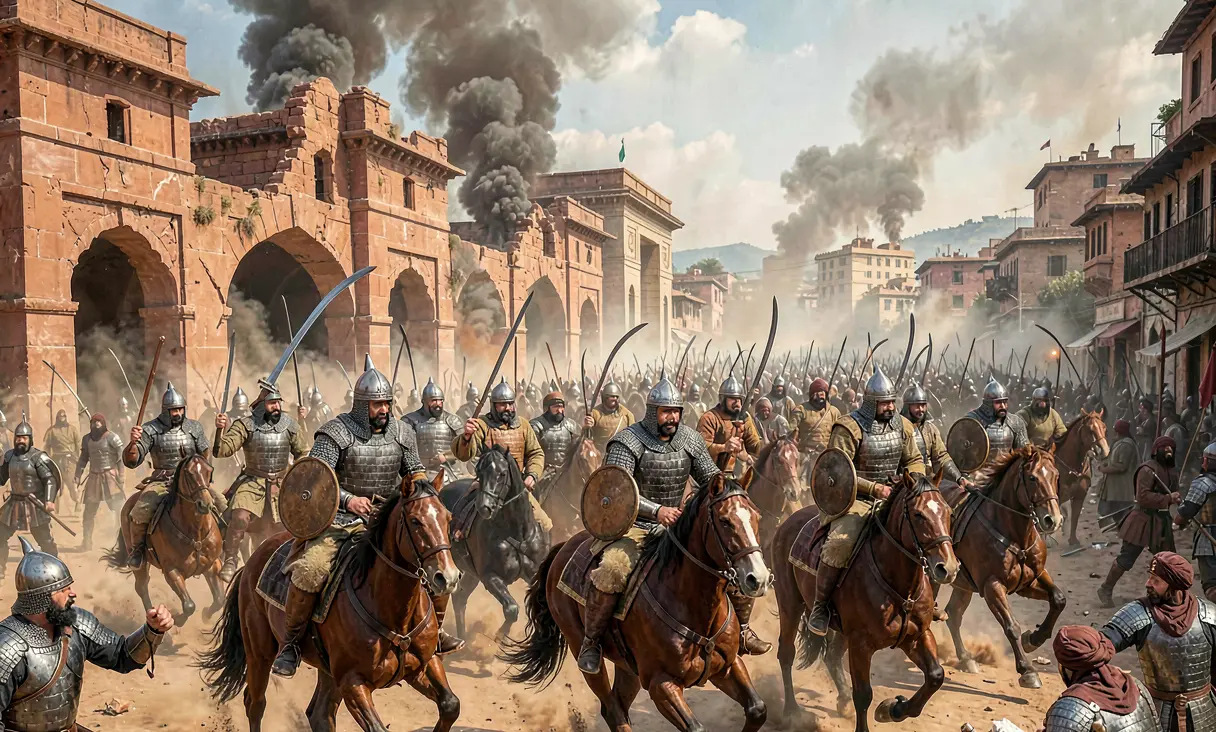
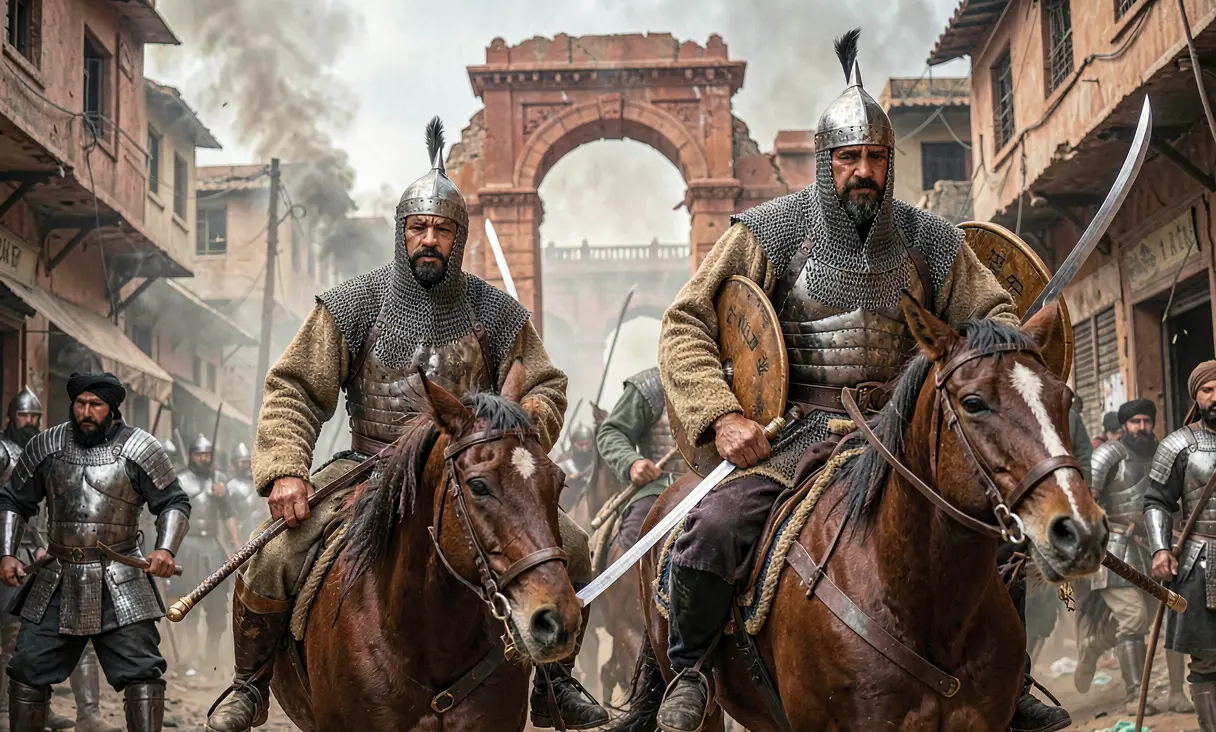
Following the victory at Panipat, Timur marched unopposed into Delhi on December 17, 1398. The city, once a glittering metropolis of the Tughlaqs, fell under a reign of terror that would last for weeks. Timur, adhering to his policy of using fear as a weapon of conquest, ordered the execution of over 100,000 prisoners taken during the battle, many of whom were Hindu and Muslim soldiers alike. The subsequent sack of the city was systematic and brutal. For three days, Timur's troops looted homes, temples, and mosques, stripping the city of its immense wealth. Gold, silver, precious stones, and intricate artworks were loaded onto thousands of camels for transport to Samarkand. The architectural splendor of Delhi was marred by fire and destruction; the great Jama Masjid and other monuments suffered significant damage. Contemporary accounts, such as those by Nizamuddin Ahmad, describe a city reduced to ashes, with rivers running red and the air thick with smoke and the cries of the dying.
Retreat and Regional Collapse
By January 1399, Timur had secured enough plunder to fund his empire for decades. With Delhi in ruins and the Tughlaq authority shattered, he began his retreat northward toward Samarkand. The withdrawal was not a rout but a calculated disengagement; Timur left behind a puppet governor but ensured that no organized resistance could rise immediately. The invasion had effectively decapitated the Delhi Sultanate. In the power vacuum that followed, the central government collapsed into regional warlordism. Former governors and local chieftains declared independence, fragmenting India into numerous competing states. The Tughlaq dynasty lingered in name only, its influence reduced to a small enclave around Delhi until it was eventually absorbed by the rising Sayyid dynasty. Timur's departure marked the end of an era for the Sultanate, leaving a civilization vulnerable and traumatized.
Legacy and the Mughal Connection
The invasion of 1398 stands as a watershed moment in South Asian history, fundamentally altering the region's political trajectory. The devastation inflicted by Timur weakened the Delhi Sultanate so profoundly that it never fully recovered its former hegemony, paving the way for the eventual rise of the Mughal Empire. Centuries later, Babur, a descendant of both Timur and Genghis Khan, would cite this invasion as a precedent for his own conquest of India in 1526, viewing himself as the rightful heir to Timur's legacy in the subcontinent. The event cemented Timur's reputation in history not just as a conqueror, but as a force of nature whose campaigns reshaped the demographic and cultural map of Asia. While the immediate aftermath was one of blood and ruin, the long-term consequence was the introduction of Central Asian military tactics and administrative styles that would eventually define the Mughal golden age.
It devastated Northern India but accelerated the decline of the Delhi Sultanate and shifted power dynamics in South Asia.
Where it happened
Delhi, India — see it on the interactive map →
Explore related history
 WarIslamic Conquest of the Sasanian Empire637 CE · Ctesiphon, Iraq (Persia)Arab Muslim forces defeat the Sasanian Empire at the Battle of al-Qadisiyyah, ending centuries of Persian rule.
 WarViking Siege of Paris885 CE · Paris, FranceViking raiders led by Sigfred besiege Paris for over a year, testing the defenses of West Francia.
 WarChola Conquest of Sri Lankac. 993 CE · Anuradhapura, Sri LankaRajaraja Chola launches a massive amphibious invasion of Sri Lanka, defeating the Sinhalese kingdom and annexing the island.
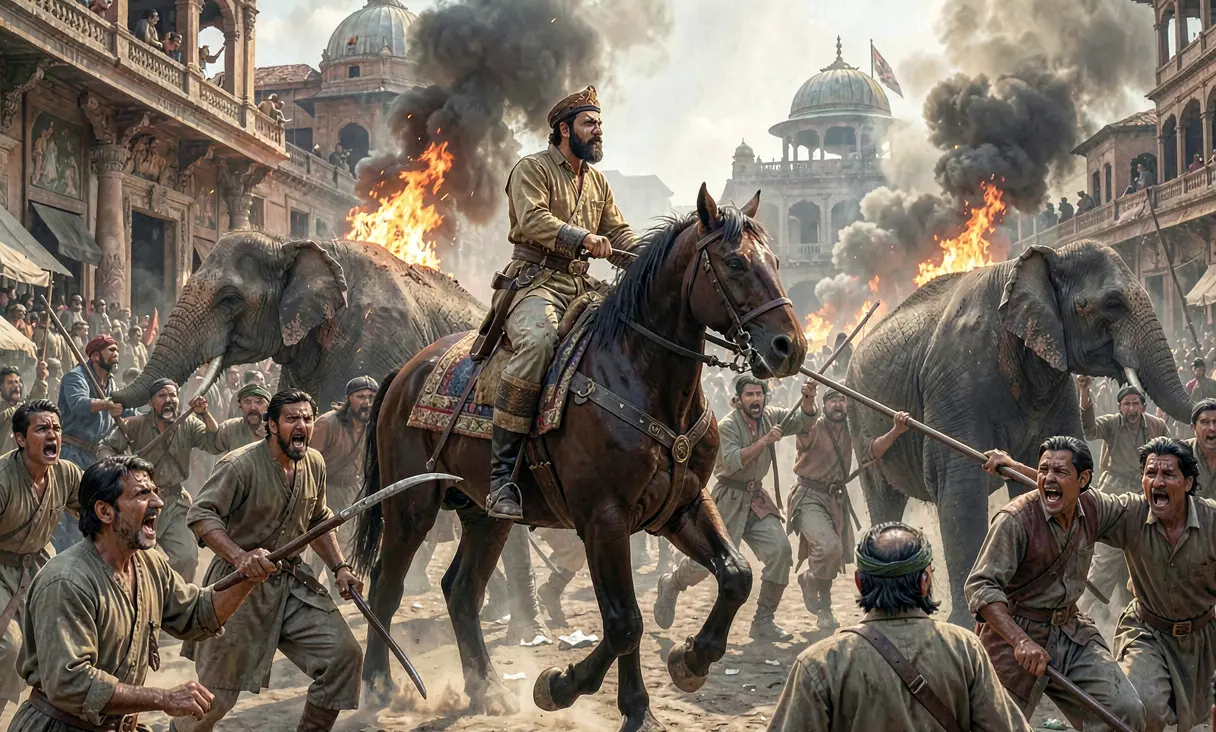 WarTimur's Sack of Delhic. 1398 CE · Delhi, IndiaTimur (Tamerlane) invades the Delhi Sultanate, defeating the Tughlaqs and massacring the city's population before retreating.
 ExplorationZheng He's First Voyage BeginsJuly 11, 1405 CE · Nanjing, ChinaChinese admiral leads massive fleet to Southeast Asia and Africa projecting Ming power.
 WarMing Conquest of Dai Viet (Fourth Era)1407 CE · Hanoi (Thang Long), VietnamMing forces capture the Ho Dynasty and annex Vietnam.
Discussion
Loading…