Discovery of Gunpowder by Tang Dynasty Alchemists
In 850 CE, Tang Dynasty alchemists accidentally invented gunpowder while seeking immortality, sparking a technological revolution that transformed warfare and reshaped global history forever.
The Quest for Immortality
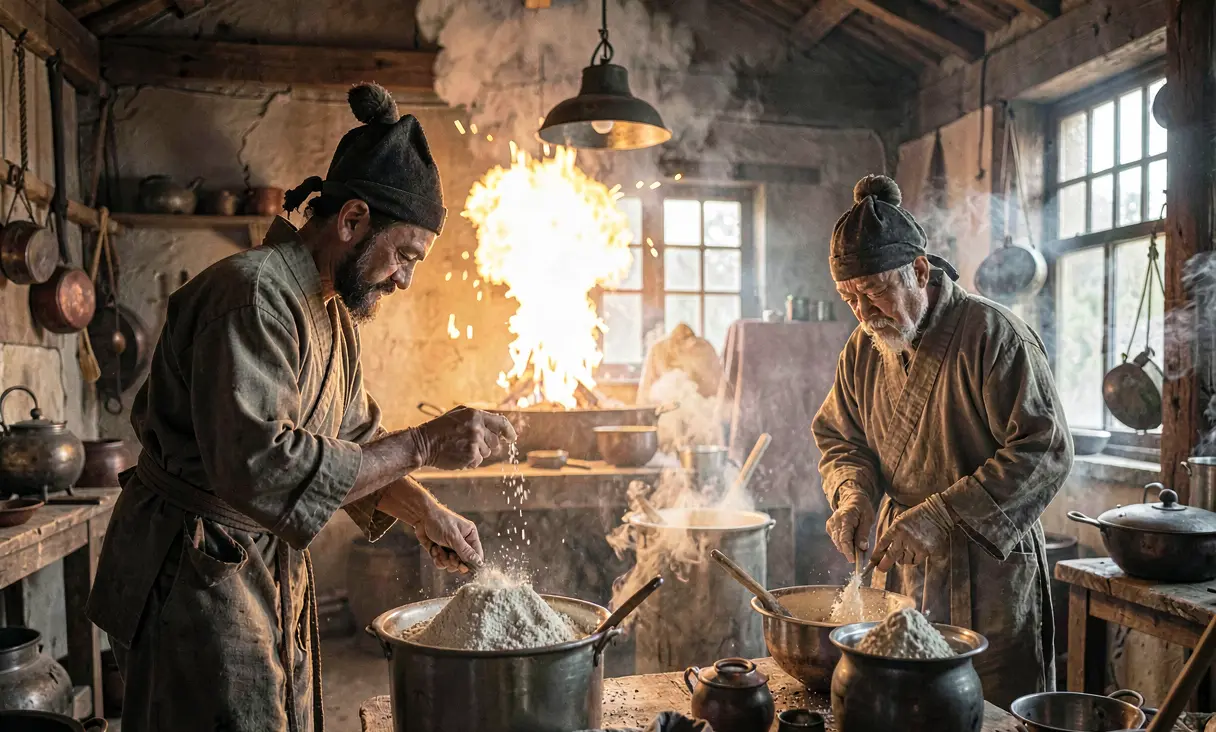
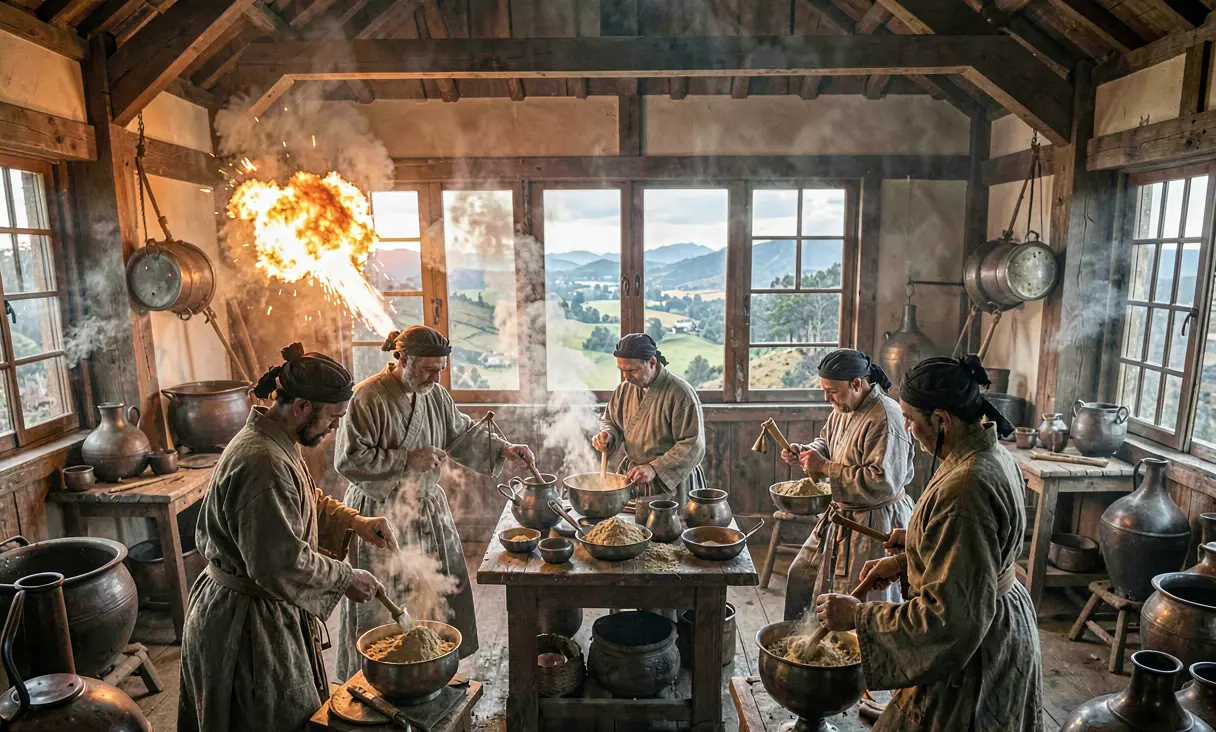
In the mid-ninth century, the Tang Dynasty stood as a pinnacle of Chinese civilization, yet its imperial court was deeply entangled in the spiritual pursuits of Daoism. Emperors, particularly those of the later Tang period such as Emperor Wuzong (r. 840–846), were fervent patrons of alchemy, seeking the *elixir of life* (*waidan*) that would grant eternal youth and divine power to the throne. In the bustling capital of Chang'an, Daoist masters operated in secluded laboratories, meticulously blending minerals like cinnabar, lead, and mercury with organic substances. Their goal was not warfare, but transcendence; they believed that by replicating the cosmic processes of nature within a crucible, they could distill the essence of immortality for the emperor.
The Accidental Synthesis
Around 850 CE, during these rigorous experiments in Chang'an, alchemists inadvertently combined three distinct ingredients: saltpeter (potassium nitrate), sulfur, and charcoal. While individually known for their medicinal or ritualistic properties, their mixture created a substance of terrifying volatility. Historical records indicate that the alchemists were startled when the concoction ignited with a violent flash and a deafening roar, rather than producing a soothing elixir. This was not a calculated invention but a catastrophic failure in the pursuit of divinity, marking the first documented instance of gunpowder's creation. The mixture, initially termed 'fire medicine' (*huoyao*), possessed a chemical potential that would soon shatter the paradigms of global conflict.
The Zhenyuan Miaodao Yaolue Record
The first definitive written account of this discovery appears in the text *Zhenyuan miaodao yaolue* (Essentials of the Mysterious Dao of the True Origin), attributed to the alchemist Sun Simiao or a disciple of his school, though modern scholarship often dates the specific compilation to c. 850 CE. The text explicitly warns against mixing sulfur and saltpeter with honey and charcoal, describing how such an experiment causes 'burning of hands and face' and destroys the laboratory. It serves as a cautionary tale rather than a manual for war, yet it preserves the precise recipe that would alter human history. This document stands as the earliest surviving evidence of gunpowder's composition, proving that by the mid-9th century, the chemical formula was known, if not yet weaponized on a massive scale.
From Alchemy to Incendiary Warfare
The transition from alchemical curiosity to military application was gradual but inevitable. By the late Tang and early Song dynasties (10th century), the state began to harness this volatile mixture for practical defense. The 'flying fire arrow' (*feihuo jian*), a bamboo tube filled with gunpowder attached to an arrow shaft, became one of the earliest incendiary projectiles. These devices were used not just to burn enemy fortifications but to create psychological terror through sudden explosions and smoke. Unlike traditional siege engines that relied on kinetic impact or fire pots thrown by catapults, gunpowder weapons offered a new dimension of destruction, capable of penetrating armor and igniting dry timber with unprecedented speed.
The Silk Road and Global Diffusion
The technology did not remain confined to China for long. Through the extensive networks of the Silk Road, knowledge of gunpowder traveled westward into the Islamic world by the 13th century, where Arab scholars refined the formulas and developed early cannons known as *madfa*. From there, it reached Europe via Mongol invasions and trade routes, fundamentally changing the nature of medieval warfare. By the time European powers mastered the casting of bronze and iron barrels in the 14th century, the era of the armored knight and stone castle was beginning to wane. The explosive force that originated in a Daoist lab in Chang'an would eventually render feudal fortifications obsolete and reshape the geopolitical map of the entire world.
A Legacy of Destruction and Progress
The discovery of gunpowder represents one of the most profound turning points in human history, often cited alongside the invention of the printing press as a catalyst for the modern era. It democratized violence, allowing smaller armies to defeat larger ones through technological superiority rather than sheer manpower or feudal hierarchy. While it facilitated the rise of centralized nation-states and global exploration, it also ushered in an age of unprecedented industrial-scale slaughter. The alchemists of Tang China sought life but found a tool that would define the boundaries of death for centuries to come, leaving a legacy where the line between scientific advancement and military devastation became increasingly blurred.
The accidental invention of gunpowder revolutionized global military history and reshaped geopolitical power dynamics for centuries.

Where it happened
Chang'an, China — see it on the interactive map →
Explore related history
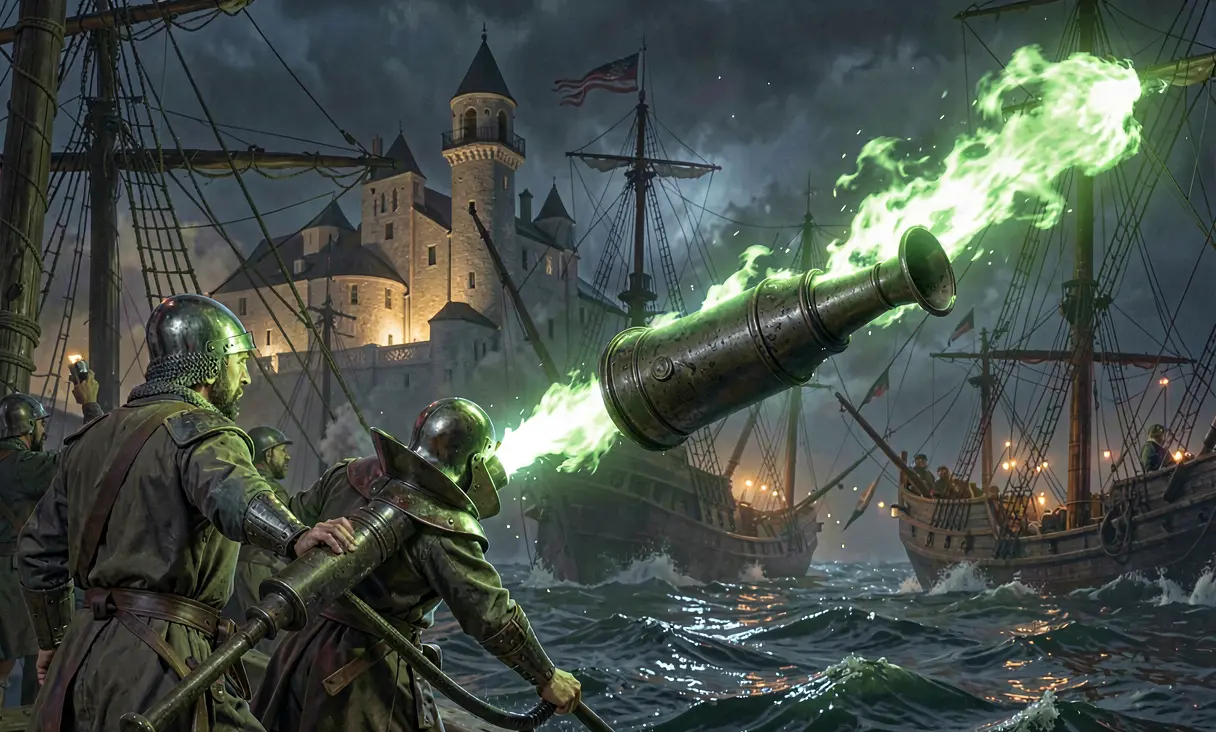 TechnologyInvention of Greek Fire by Kallinikosc. 673 CE · Constantinople, TurkeyByzantine engineers develop a liquid incendiary weapon that burns on water.
 TechnologyUse of Astrolabes for Celestial Navigation by Arab Sailorsc. 1000 CE · Jeddah, Saudi ArabiaArab navigators utilize refined astrolabes to cross the Indian Ocean.
 TechnologyMagnetic Compass Application for Navigation in Song Chinac. 1040 CE · Kaifeng, ChinaSong dynasty engineers create the first magnetic compass for maritime navigation.
 ScienceConstruction of El Caracol Observatory at Chichen Itzac. 850 CE · Chichen Itza, MexicoMaya astronomers build a circular observatory aligned with Venus cycles.
 ReligionEnd of Byzantine Iconoclasm843 CE · Constantinople, TurkeyEmpress Theodora restores the veneration of icons in the Byzantine Empire, ending a century-long theological conflict.
 ExplorationViking Settlement of Iceland874 CE · Reykjavik, IcelandNorse explorers led by Ingólfr Arnarson settle Iceland, establishing the first permanent European community in the North Atlantic.
Discussion
Loading…