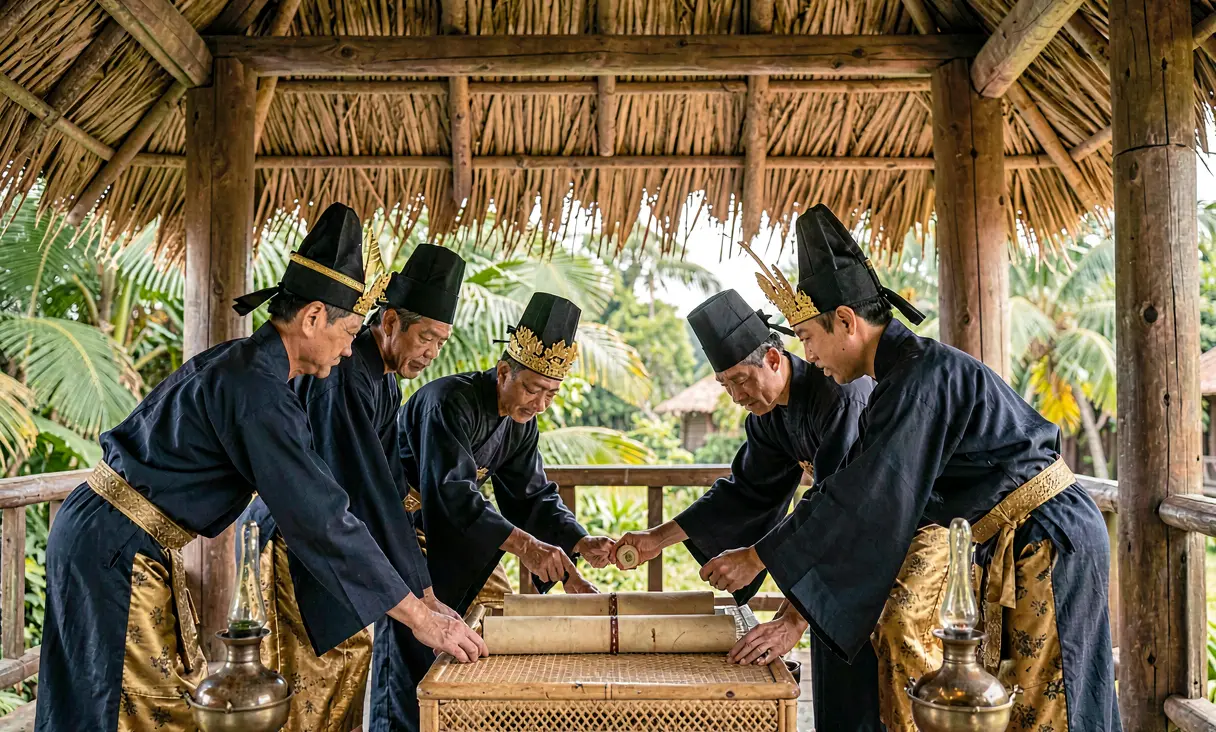
Srivijaya-Song Peace Treaty
The 990 CE treaty between Song China and Srivijaya secured safe passage through the Strait of Malacca, unlocking centuries of massive spice trade and cementing Southeast Asia's role as the vital bridg
The Maritime Crossroads of the Late Tenth Century
By the late tenth century, the Indian Ocean trade network had evolved into a complex web connecting the markets of Guangzhou with the ports of Gujarat and the Red Sea. At the heart of this system lay Srivijaya, a thalassocratic empire centered in Palembang on the island of Sumatra. Controlling both the Sunda Strait and the strategic Strait of Malacca, Srivijaya acted as the indispensable gatekeeper for maritime commerce between East Asia and the West. Simultaneously, the Song Dynasty (960–1279) had consolidated power in China following the fragmentation of the Five Dynasties and Ten Kingdoms period. Under Emperor Taizu and his successors, the Song court aggressively pursued economic revitalization, recognizing that maritime trade could generate revenue surpassing traditional land taxes. However, the safety of these sea lanes was precarious, often threatened by piracy and regional conflicts, necessitating a stable diplomatic framework to protect Chinese merchant fleets.
The Diplomatic Initiative of 990 CE
In 990 CE, a pivotal moment in Indo-Chinese relations occurred when the court of Emperor Taizu formally recognized the ruler of Srivijaya as a legitimate sovereign king. This was not merely an exchange of courtesies but a calculated political maneuver that established formal tributary relations between the two powers. The Song Dynasty, adhering to its worldview where all foreign states were expected to acknowledge Chinese suzerainty through tribute, found in Srivijaya a willing and capable partner. In return for this recognition, which legitimized the Srivijayan ruler's authority both domestically and on the international stage, the empire pledged to ensure the safety of Chinese vessels navigating the treacherous waters of the Malay Archipelago. The treaty effectively transformed the Strait of Malacca from a zone of potential conflict into a protected corridor for commerce.
Key Actors and the Flow of Envoys
The primary architect of this relationship on the Chinese side was Emperor Taizu, whose reign marked the beginning of Song economic dominance. On the Srivijayan side, the ruler at the time is historically identified as Sri Cudamani Warmadewa, a monarch who skillfully navigated the complex geopolitics of Southeast Asia. The diplomatic mechanism relied heavily on the dispatch of envoys; historical records from the Song Shi (History of Song) document multiple missions sent by Srivijaya to Kaifeng, the Song capital. These envoys brought lavish tribute consisting of ivory, rhinoceros horn, tortoise shells, and exotic spices such as cloves and nutmeg. In exchange, the Song court bestowed upon them silk, porcelain, and gold, items highly prized in the archipelago. This reciprocal gift-giving was the tangible manifestation of the treaty's terms, binding the two states in a cycle of mutual economic benefit.
Economic Transformation and Trade Volumes
The immediate aftermath of the 990 CE agreement was a dramatic surge in trade volume. With the guarantee of safe passage, Chinese merchant fleets began to sail with unprecedented frequency through the Strait of Malacca. The influx of goods was substantial; Srivijaya became the primary conduit for spices from the Maluku Islands and aromatic woods like agarwood destined for Chinese markets. Conversely, the export of Song ceramics and silk to Southeast Asia reached new heights, fundamentally altering local consumption patterns and economies. This trade was not limited to state-sponsored missions but extended to private merchants who operated under the protective umbrella of the treaty. The resulting wealth fueled the urbanization of Palembang and solidified Srivijaya's status as a cosmopolitan hub where Chinese, Indian, Arab, and Austronesian cultures intersected.
Strategic Legacy and Centuries of Stability
The significance of the 990 CE treaty extended far beyond its immediate economic gains. It established a diplomatic precedent that endured for centuries, setting the template for how Southeast Asian maritime powers would interact with China throughout the Song, Yuan, Ming, and Qing dynasties. The relationship proved remarkably resilient, surviving political upheavals in both regions. By institutionalizing the tributary system, the treaty allowed Srivijaya to maintain its hegemony over the region's trade routes without direct military confrontation with the massive Chinese empire. Instead of a rival, China became a patron, while Srivijaya served as the essential intermediary between the Chinese market and the broader Indian Ocean world, facilitating the flow of goods that connected the economies of Asia.
Historical Assessment
While not a global event on the scale of the fall of Rome or the World Wars, the Srivijaya-Song Peace Treaty represents a defining moment in the history of Asian maritime integration. It demonstrated the power of diplomacy to secure economic prosperity and regional stability in an era often characterized by fragmentation. The treaty highlighted the sophistication of Southeast Asian statecraft, proving that local powers could leverage their geographic advantages to negotiate favorable terms with superpowers. Ultimately, this agreement laid the groundwork for the vibrant trade networks that would define the medieval Indian Ocean world, ensuring that the Strait of Malacca remained a critical artery of global commerce for the next millennium.
It stabilized maritime trade routes in Southeast Asia for over a century.
Where it happened
Palembang, Sumatra (Modern Indonesia) — see it on the interactive map →
Explore related history
 PoliticsRise of Srivijaya as Maritime Hegemon683 CE · Palembang, Sumatra (Modern Indonesia)Srivijaya emerges as the dominant maritime empire controlling the Strait of Malacca.
 PoliticsEmperor Xuanzong Ascends the Tang Throne712 CE · Chang'an, ChinaEmperor Xuanzong begins his reign, ushering in the High Tang golden age.
 PoliticsFounding of Heian-kyo794 CE · Kyoto, JapanEmperor Kammu moves the capital to Heian-kyo, beginning the Heian period.
 WarChola Conquest of Sri Lankac. 993 CE · Anuradhapura, Sri LankaRajaraja Chola launches a massive amphibious invasion of Sri Lanka, defeating the Sinhalese kingdom and annexing the island.
 PoliticsRajaraja I's Naval Campaigns against the Cholasc. 985 CE · Thanjavur, Tamil Nadu, IndiaRajaraja Chola I ascends the throne and initiates a massive naval expansion that will soon dominate the Bay of Bengal.
 medicineEstablishment of the Bimaristan Hospital System in Baghdadc. 982 CE · Baghdad, IraqThe Al-Adudi Hospital introduces specialized wards and medical record-keeping.
Discussion
Loading…