
Magnetic Compass Application for Navigation in Song China
The Song Dynasty's 1044 documentation of the magnetic 'south-pointing fish' enabled open-ocean navigation, catalyzing global trade networks and making the Age of Exploration possible centuries before
Navigational Stagnation and the Song Maritime Surge
Prior to the mid-11th century, maritime navigation in East Asia relied heavily on celestial observation and coastal piloting. Mariners were tethered to the coastline or forced to halt voyages during overcast nights when stars were obscured, limiting the scope of trade and military projection. The Song Dynasty (960–1279), however, faced unique geopolitical pressures; the loss of northern territories to the Liao and Jin dynasties necessitated a strategic pivot toward the sea. With the capital established in Kaifeng, the state aggressively promoted maritime commerce to generate revenue, fostering an environment where technological innovation became a matter of national security and economic survival.
The Wujing Zongyao and the First Documented Compass
The watershed moment for magnetic navigation occurred in 1044 CE with the publication of the *Wujing Zongyao* (Collection of the Most Important Military Techniques), commissioned by Emperor Renzong. Compiled by military scholars Zeng Gongliang and Yang Weide, this text provided the world's first written description of a magnetic compass used for practical orientation. The device described was not the dry compass later seen in Europe, but a 'south-pointing fish' (nan yu). This consisted of an iron needle, shaped like a fish to reduce drag, which had been magnetized by rubbing it with lodestone and floating on water within a bowl. When placed in still water, the fish would align itself with the Earth's magnetic field, pointing south regardless of weather conditions.
From Military Signal to Maritime Tool
Initially, the application of this technology was strictly military, intended for night-time signaling and orientation during campaigns where visibility was compromised. The *Wujing Zongyao* details its use by soldiers to maintain formation in darkness or fog. However, the rapid transition from terrestrial warfare to naval application was almost immediate given the Song's maritime ambitions. By the reign of Emperor Shenzhou (1067–1085), the technology had migrated from the battlefield to the merchant fleet and navy. The floating needle allowed captains to determine their heading with unprecedented reliability, decoupling navigation from the whims of the weather and enabling voyages that extended far beyond the visual range of land.
The Age of Open Ocean Exploration
The integration of the magnetic compass revolutionized Chinese maritime capabilities, ushering in an era of open-ocean travel. Prior to this innovation, ships hugged the coastlines to avoid getting lost; with the 'south-pointing fish,' vessels could traverse the South China Sea and Indian Ocean with confidence. This technological leap facilitated the explosion of trade during the Southern Song period (1127–1279), where the capital moved further south to Lin'an (modern Hangzhou) to be closer to the ports. Chinese junks, already superior in hull design and watertight bulkheads, now possessed the navigational precision to establish direct trade links with Southeast Asia, India, Persia, and East Africa, creating a vast economic network that dwarfed contemporary European efforts.
Global Diffusion and the Transformation of Commerce
The impact of this Chinese invention rippled outward through the Silk Road and maritime routes. By the late 12th century, Arab traders had adopted the magnetic compass, referring to it as *al-kibla* or 'the needle,' integrating it into their own sophisticated navigation systems. It was not until the early 13th century that the technology reached Europe, appearing in Alexander Neckam's writings around 1190 and later becoming standard on European vessels by the 14th century. This transmission fundamentally altered the trajectory of global history; without the compass, the Age of Discovery led by Columbus and da Gama would have been logistically impossible, as their trans-oceanic voyages relied entirely on magnetic direction finding.
Legacy: The Compass as a Catalyst for Modernity
The application of the magnetic compass in Song China stands as one of the most pivotal technological inflection points in human history. It did not merely improve navigation; it shrank the world, enabling the first true global exchange of goods, ideas, and cultures. The economic prosperity generated by Song maritime trade laid the groundwork for the Yuan Dynasty's even more expansive networks under the Pax Mongolica. Ultimately, this innovation broke the geographical constraints that had bound human civilization to local horizons for millennia, setting the stage for the interconnected modern world. As Francis Bacon later noted, it was one of the three inventions (along with gunpowder and printing) that changed the face of the world.
The magnetic compass transformed maritime navigation, enabling the Age of Discovery and connecting distant civilizations.


Where it happened
Kaifeng, China — see it on the interactive map →
Explore related history
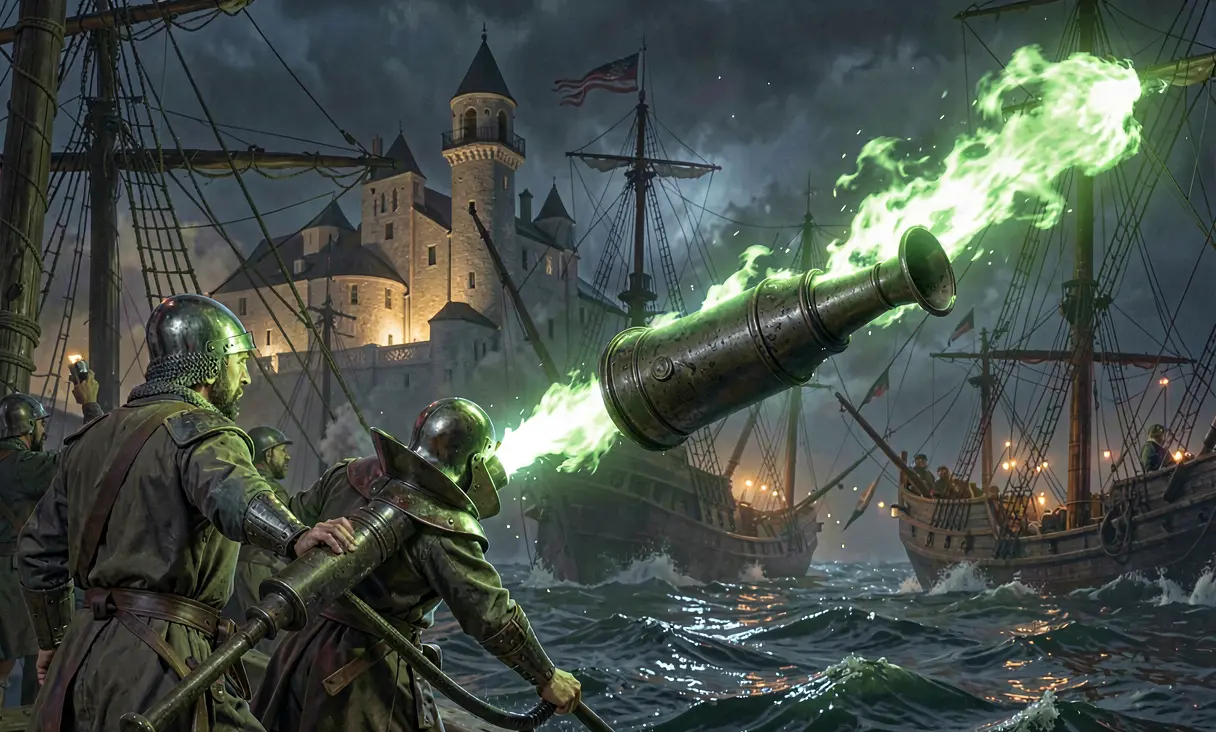 TechnologyInvention of Greek Fire by Kallinikosc. 673 CE · Constantinople, TurkeyByzantine engineers develop a liquid incendiary weapon that burns on water.
 TechnologyDiscovery of Gunpowder by Tang Dynasty Alchemistsc. 850 CE · Chang'an, ChinaTang alchemists accidentally discover gunpowder while seeking an elixir of immortality.
 TechnologyUse of Astrolabes for Celestial Navigation by Arab Sailorsc. 1000 CE · Jeddah, Saudi ArabiaArab navigators utilize refined astrolabes to cross the Indian Ocean.
 PoliticsPost-Chola War Reorganization1035 CE · Palembang, Sumatra (Modern Indonesia)Srivijaya reorganizes its administration after Chola raids.
 DisasterSealing of the Dunhuang Library Cavec. 1035 CE · Dunhuang, ChinaMonks seal a cave containing thousands of ancient manuscripts for protection.
 WarMahmud of Ghazni's Sack of Somnathc. 1026 CE · Somnath, Gujarat, IndiaMahmud of Ghazni leads a raid on the Somnath Temple, destroying the structure and looting its immense wealth to fund his empire.
Discussion
Loading…