
Standardization of the Quranic Text
Caliph Uthman's standardization of the Quran around 650 CE unified the expanding Islamic empire by eliminating textual variants, establishing a single authoritative text that remains unchanged to this
Context of Fragmentation
By the mid-7th century, the rapid expansion of the Islamic empire had stretched beyond the Arabian Peninsula into Syria, Iraq, and Persia. While the Quran was preserved through a robust tradition of oral recitation (hifz) and scattered written fragments on parchment, palm leaves, and shoulder blades, regional dialects began to influence pronunciation and textual nuance. The death of Caliph Umar ibn al-Khattab in 644 CE left the community vulnerable to these divergences. As new converts from diverse linguistic backgrounds embraced Islam, disputes arose regarding the correct recitation of specific verses, threatening the theological unity of the nascent state.
The Catalyst for Action
The immediate catalyst for standardization occurred during the military campaigns in Armenia and Azerbaijan around 650 CE. Hudhayfah ibn al-Yaman, a prominent companion who had served as an inspector of the troops, observed soldiers from Syria and Iraq arguing violently over their recitations. They claimed their respective readings were superior, echoing the sectarian divisions that had fractured earlier Jewish and Christian communities. Alarmed by this potential schism, Hudhayfah urgently petitioned Caliph Uthman ibn Affan to intervene before the Muslim community (Ummah) was torn apart by textual inconsistencies.
The Commission of Zayd
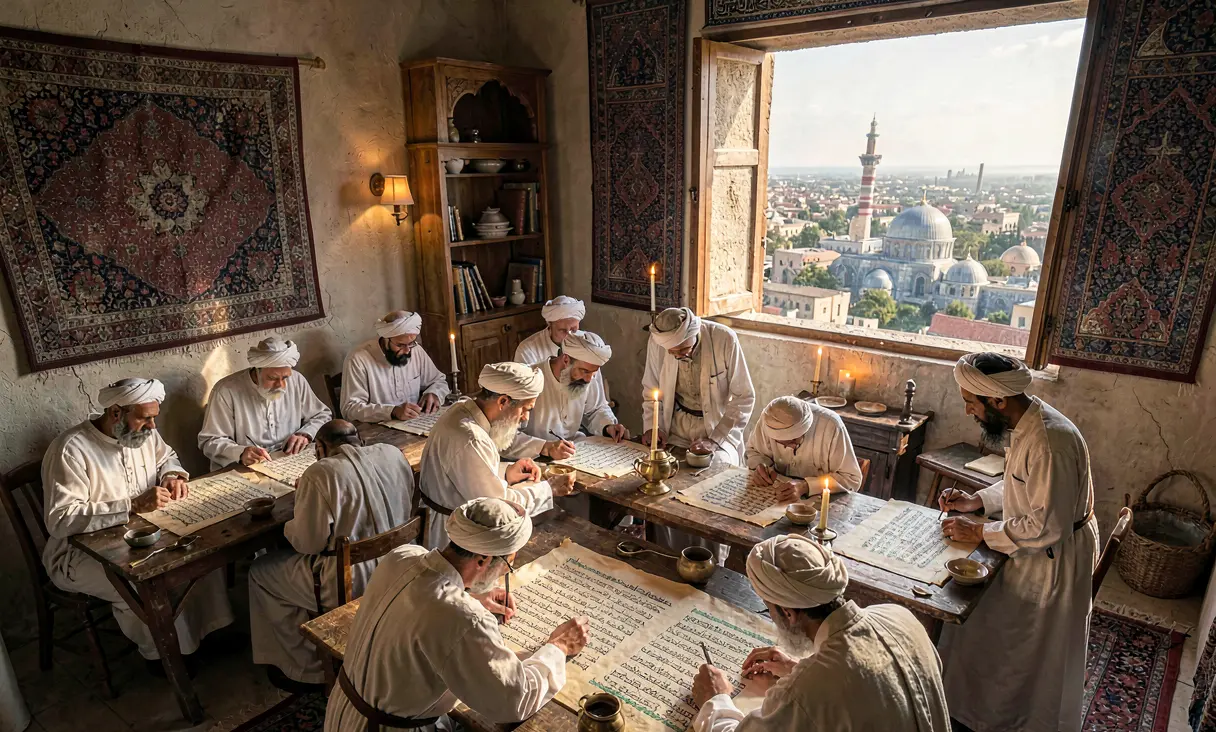
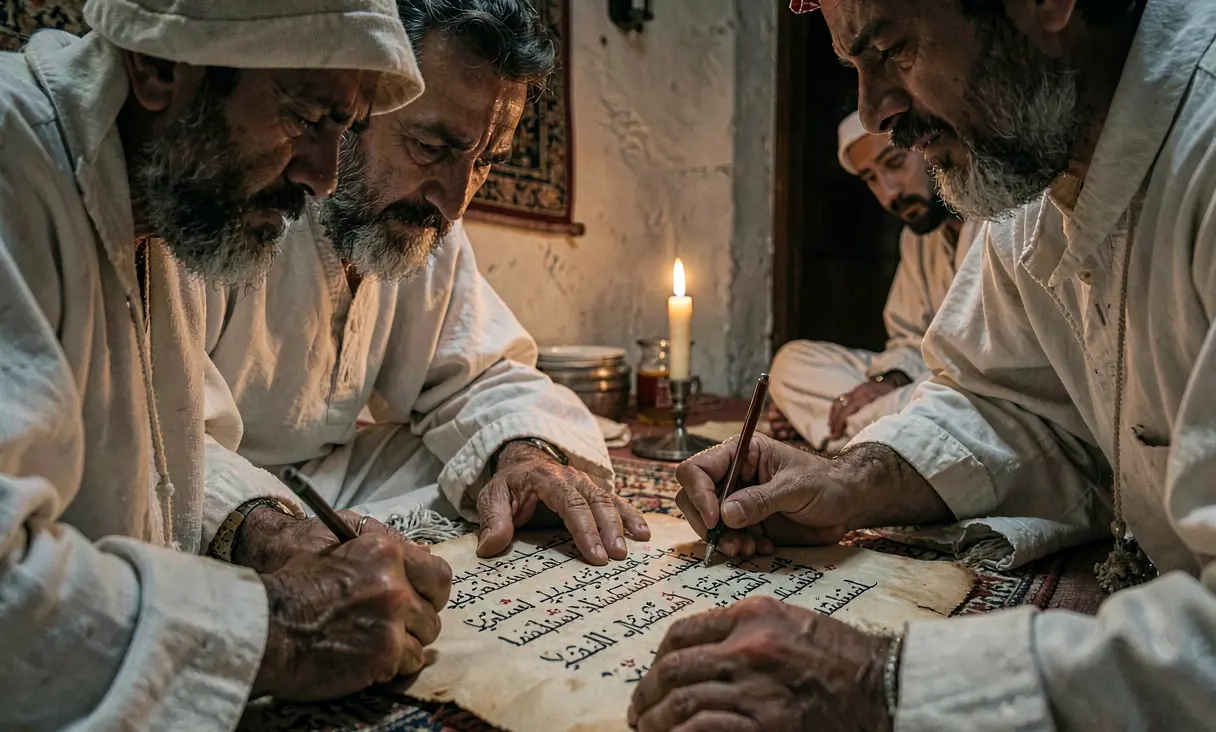
In response, Caliph Uthman convened a committee led by Zayd ibn Thabit, the primary scribe who had originally compiled the Quran under Caliph Abu Bakr. The commission was tasked with producing a single, authoritative codex (mushaf) based on the Qurayshi dialect—the language of Muhammad—and cross-referencing it with fragments held by Hafsa bint Umar, one of the Prophet's widows, and other reliable memorizers. Zayd insisted that no verse be written down unless verified by two witnesses who had heard it directly from the Prophet, ensuring an unbroken chain of transmission (isnad) for every word.
Standardization and Distribution
Once the master codex was completed in Medina around 652–653 CE, Uthman ordered the creation of exact copies to be dispatched to the major provincial capitals: Kufa, Basra, Damascus, Mecca, Bahrain, and Egypt. To enforce uniformity, he commanded that all other existing collections—whether personal scrolls or regional variants written in different dialects—be destroyed. This decisive, albeit controversial, act eliminated competing textual traditions. The copies were written in the early Kufic script, which lacked diacritical marks (dots) and vowel signs, relying entirely on the oral tradition of trained reciters to preserve the precise pronunciation.
Consolidation of Authority
The standardization process fundamentally altered the political and religious landscape of the empire. By centralizing the text in Medina under Uthman's authority, the Caliph reinforced the concept of a unified Islamic identity that transcended tribal and regional loyalties. However, this move also generated significant resentment among those who felt their local recitations were being suppressed, contributing to the growing political tensions that eventually led to Uthman's assassination in 656 CE. Despite the violence surrounding his death, the text he standardized remained intact, becoming the immutable reference point for all future Islamic scholarship.
Enduring Legacy
The 'Uthmanic Codex' stands as one of the most significant textual achievements in human history. Unlike many ancient scriptures that evolved through multiple redactions, the Quran has remained textually stable for nearly fourteen centuries. The absence of diacritics in the original copies necessitated a rigorous oral tradition, creating a dual system of preservation where written and spoken forms mutually reinforced one another. Today, every printed Quran globally adheres to this standardized text, serving as the bedrock of Islamic law, theology, and liturgy, and ensuring that a Muslim in Jakarta recites the exact same words as a Muslim in Cairo.
Uthman's codification preserved the integrity of the Islamic holy book and unified the Muslim community under a single scripture.
Where it happened
Medina (and Damascus), Arabia/Syria — see it on the interactive map →
Explore related history
 ReligionHijra of Prophet MuhammadSeptember 24, 622 CE · Medina, Saudi ArabiaMuhammad migrates to Medina establishing the first Muslim community and calendar.
 ReligionEnd of Byzantine Iconoclasm843 CE · Constantinople, TurkeyEmpress Theodora restores the veneration of icons in the Byzantine Empire, ending a century-long theological conflict.
 ReligionJayavarman VII Converts to Mahayana Buddhism1181 CE · Angkor Thom, CambodiaJayavarman VII adopts Mahayana Buddhism and builds Bayon.
 WarIslamic Conquest of the Sasanian Empire637 CE · Ctesiphon, Iraq (Persia)Arab Muslim forces defeat the Sasanian Empire at the Battle of al-Qadisiyyah, ending centuries of Persian rule.
 TechnologyInvention of Greek Fire by Kallinikosc. 673 CE · Constantinople, TurkeyByzantine engineers develop a liquid incendiary weapon that burns on water.
 ArtBurial of the Sutton Hoo Shipc. 625 CE · Suffolk, EnglandAn Anglo-Saxon king is buried with a magnificent helmet and gold artifacts.
Discussion
Loading…