
Polynesian Expansion into the Society Islands
The c. 300 BCE settlement of the Society Islands established a vital cultural hub that launched the final wave of Polynesian voyages to Hawaii, Easter Island, and New Zealand.
The Maritime Crucible of the Pacific
By approximately 300 BCE, the Lapita cultural complex, which had swept across Island Southeast Asia and Melanesia over millennia, reached a critical pivot point in human history. While earlier voyagers had colonized Fiji, Tonga, and Samoa by 1200 BCE, the Society Islands remained uncharted territory beyond the horizon of known settlement. This era marked the transition from the Western Polynesian sphere to the Eastern Polynesian expansion, a demographic explosion that would eventually populate the vast triangle defined by Hawaii, Rapa Nui (Easter Island), and Aotearoa (New Zealand). The Society Islands, particularly the windward group of Tahiti and the leeward group centered on Raiatea, offered a unique combination of fertile volcanic soils, reliable rainfall, and strategic positioning that made them an ideal staging ground for further exploration.
The Arrival and Settlement
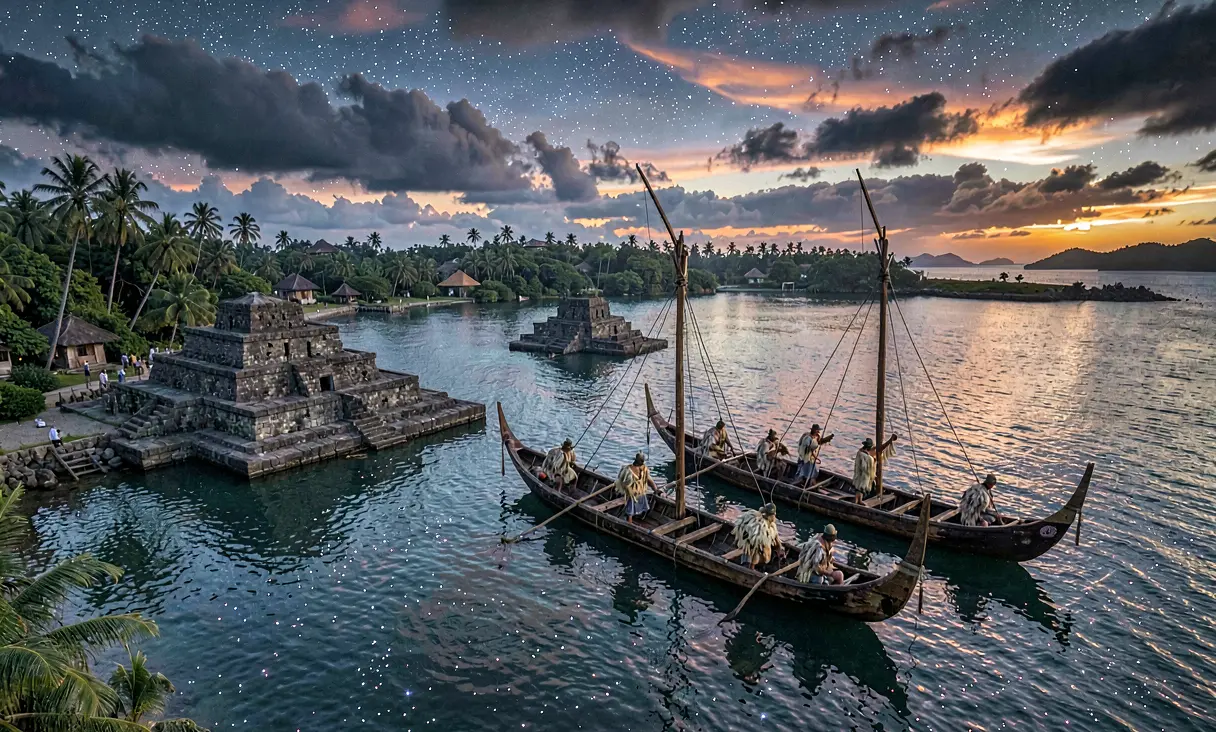
Archaeological evidence, including radiocarbon-dated charcoal from hearths and the introduction of Polynesian crops such as taro (Colocasia esculenta) and breadfruit (Artocarpus altilis), confirms that settlers arrived in the Society Islands around 300 BCE. These pioneers likely departed from the ancestral homeland of Samoa or Tonga, navigating double-hulled voyaging canoes known as wa'a kaulua across open ocean swells of over 2,500 kilometers. Unlike previous island-hopping migrations where land was visible for much of the journey, this voyage required advanced non-instrument navigation techniques. The settlers did not merely survive; they thrived rapidly, establishing permanent villages that would evolve into complex chiefdoms within a few centuries.
The Rise of Raiatea and the Marae System
Among the settled islands, Raiatea (anciently known as Havai'i) emerged as the spiritual and political nucleus of Eastern Polynesia. The settlers constructed elaborate stone temple complexes known as marae, which served as centers for religious worship, social hierarchy, and astronomical observation. The Taputapuatea Marae on Raiatea would later become the most significant religious site in Polynesia, acting as a unifying sanctuary for chiefs from across the Pacific. This architectural innovation reflected a shift toward stratified society, where high-ranking ali'i (chiefs) claimed divine descent from gods like A'o and Tane, legitimizing their rule through control of land and ritual resources.
Navigational Mastery and Agricultural Intensification
The success of the Society Islands settlement hinged on a sophisticated synthesis of agricultural innovation and celestial navigation. The settlers developed intensive wetland agriculture in the broad valleys of Tahiti, utilizing irrigation systems to maximize taro yields, which supported a rapidly growing population. Simultaneously, they refined the art of wayfinding, memorizing star paths, ocean swells, cloud formations, and bird migrations to locate distant islands without instruments. This knowledge was not static; it was codified in oral traditions and practiced by specialized navigators (pou) who could detect the subtle refraction of light on the horizon caused by a hidden island's lagoon.
The Society Islands as the Launchpad
By 500 CE, the Society Islands had transformed into the primary departure point for the final phase of Polynesian expansion. From this hub, voyaging fleets radiated outward in three distinct directions: northwest toward the Hawaiian archipelago, southeast to Rapa Nui, and southwest to Aotearoa. The cultural model established in Tahiti and Raiatea—characterized by the marae system, specific genealogical structures, and a shared pantheon of deities—became the template for these new societies. The islands acted as a demographic pressure valve; as populations swelled due to agricultural surplus, organized expeditions were launched to claim new territories, effectively completing the peopling of the world's largest ocean.
Legacy and Historical Significance
The settlement of the Society Islands represents one of the most remarkable feats of human exploration in pre-modern history. It established a cultural continuum that linked islands separated by thousands of miles of open ocean, creating a shared Eastern Polynesian identity that persisted for over a millennium until European contact. The region's role as the 'cradle' of this expansion is evidenced by linguistic uniformity and archaeological parallels found from Hawaii to New Zealand. Without this pivotal settlement in c. 300 BCE, the subsequent discovery and colonization of the remote corners of the Pacific would likely have been delayed or never occurred, fundamentally altering the demographic map of Oceania.
The Society Islands became the strategic launchpad for the colonization of the most remote islands in the world, including Hawaii and Rapa Nui.

Where it happened
Society Islands, French Polynesia — see it on the interactive map →
Explore related history
 ExplorationSettlement of Rapa Nui (Easter Island)c. 800 CE · Rapa Nui (Easter Island), ChilePolynesian navigators reach the remote Rapa Nui and establish a unique island society.
 ExplorationEstablishment of Malaca (Malaga) by Phoeniciansc. 770 BCE · Malaga (Malaca), SpainPhoenician traders establish a major colony on the Iberian Peninsula for salt and metal trade.
 ExplorationSettlement of the Hawaiian Islandsc. 400 BCE to 800 CE · Hawaii (Big Island), USAPolynesian voyagers from the Marquesas and Society Islands settle the isolated Hawaiian archipelago.
 ReligionBurial of the Royal Tombs at Sipán (Later Phase)c. 300 CE · Sipán, PeruElite Moche burials continue with elaborate rituals involving human sacrifice and gold offerings.
 WarMauryan Conquest of Gandharac. 305 BCE · Peshawar Valley, Gandhara, PakistanChandragupta Maurya defeats Seleucus Nicator, securing the vital Gandhara region and expanding the Mauryan Empire westward to the Hindu Kush.
 TechnologyConstruction of the Aqua Appia: Rome's First Aqueduct312 BCE · Rome, ItalyAppius Claudius Caecus builds the first aqueduct to supply fresh water to Rome.
Discussion
Loading…