
Formal Adoption of Zero as a Placeholder in Maya Mathematics
The Maya's independent invention of zero as a placeholder and number around 36 BCE revolutionized timekeeping and astronomy, creating a mathematical system Europe would not match for over a millennium
The Pre-Columbian Mathematical Void
Long before the concept of zero permeated European consciousness through the Hindu-Arabic numeral system, the civilizations of Mesoamerica were developing a sophisticated positional notation system that fundamentally altered the trajectory of mathematics. While ancient Babylonians utilized a placeholder symbol and the Egyptians employed distinct hieroglyphs for powers of ten, neither fully conceptualized zero as a number in its own right within a base-10 or base-60 framework until much later. The Maya, flourishing in the lowlands of present-day Chiapas, Guatemala, and Yucatán, bridged this gap independently. Their innovation was not merely a technical adjustment but a philosophical leap: recognizing 'nothing' as a quantifiable entity that could occupy a position in a sequence, thereby enabling the representation of vast numbers with remarkable efficiency.
Chronological Context and Early Evidence
The crystallization of this mathematical breakthrough is often associated with the Late Preclassic period, specifically around the 4th century BCE. While the earliest definitive epigraphic evidence appears on Stela 2 at Chiapa de Corzo in Chiapas, Mexico, dating to approximately 36 BCE (not 361 BCE as sometimes misattributed in earlier speculative chronologies), the intellectual roots extend deeper into the Olmec and early Maya traditions. The date 36 BCE marks a pivotal moment where the 'shell' glyph, representing zero, was formally integrated into the Long Count calendar system on public monuments. This adoption allowed scribes to record dates spanning thousands of years with precision, a necessity for their complex cosmological and agricultural cycles.
The Shell Glyph and Positional Notation
In the Maya vigesimal (base-20) system, numbers were written vertically, with each position representing increasing powers of twenty. Without a zero, this system would collapse under the weight of ambiguity; for instance, distinguishing between 20 and 400 would be impossible without a symbol to denote an empty column. The Maya solved this by adopting a shell-like glyph (resembling a stylized conch) to signify the absence of value in a specific position. This symbol functioned dually: as a placeholder within a number and, crucially, as the number zero itself. This dual functionality allowed for complex arithmetic operations, including subtraction from zero and the calculation of astronomical cycles that required tracking intervals over millennia.
Architects of Time: The Scribes and Priests
Unlike many historical events driven by a single inventor, the formalization of zero in Maya mathematics was an emergent property of a priestly-scribal class deeply invested in astronomy and theology. These scholars, often serving the ruling dynasties of cities like Chiapa de Corzo, Palenque, and Tikal, were not merely calculating numbers; they were mapping the movements of Venus, the cycles of the moon, and the eras of creation. The integration of zero was essential for their Long Count calendar, which began with a mythical creation date (August 11, 3114 BCE) and projected forward into deep time. The precision required to predict solar eclipses and planetary alignments demanded a system where gaps in numerical sequences were explicitly defined, leading to the standardization of the zero glyph across the region.
The Mechanism of Adoption
The transition from ad-hoc placeholders to a standardized zero was likely gradual, evolving through administrative necessity and ritual observation. Early inscriptions show sporadic use of empty spaces or ambiguous markers before the shell glyph became ubiquitous in the Late Preclassic era. The standardization seen on Stela 2 at Chiapa de Corzo suggests a concerted effort by regional elites to unify their calendrical records. This formal adoption facilitated the 'Long Count' system, where dates were expressed as a series of baktuns (144,000 days), katuns, tuns, winals, and kins. The zero allowed scribes to write a date like 8.15.0.0.0 with absolute clarity, indicating exactly eight baktuns and fifteen katuns, with no intervening units of time, a feat impossible in non-positional systems.
Aftermath: The Golden Age of Calculation
The immediate consequence of this mathematical leap was the explosion of monumental architecture and astronomical precision that characterized the Classic Maya period (250–900 CE). With zero as a foundational tool, Maya astronomers achieved accuracy in predicting eclipses and planetary cycles that rivaled or surpassed contemporary civilizations elsewhere. The Dresden Codex, compiled centuries later but rooted in these traditions, contains tables of Venusian cycles calculated with errors of less than two hours over five centuries—a testament to the power of their base-20 system anchored by zero. This capability reinforced the political authority of kings who claimed divine insight into time itself.
Legacy and Global Significance
The Maya achievement stands as one of the most profound intellectual feats in human history, developed entirely independently of Old World mathematics. While the concept of zero eventually traveled from India to Europe via Arab scholars around the 12th century CE—revolutionizing Western science—the Maya had been utilizing it for over a millennium prior. Their work demonstrates that the abstraction of 'nothing' is not an inevitable cultural development but a specific, hard-won cognitive breakthrough. Although the Spanish conquest and the subsequent burning of codices in the 16th century obscured much of their mathematical literature, surviving inscriptions on stone monuments continue to testify to a civilization that mastered the mathematics of infinity long before the modern era.
The independent invention of zero was a foundational breakthrough for mathematics and astronomy in the pre-Columbian world.


Where it happened
Chiapas, Mexico — see it on the interactive map →
Explore related history
 ScienceEstablishment of the Babylonian Astronomical Observatoriesc. 747 BCE · Babylon, IraqBabylonian priests begin systematic nightly recording of planetary movements and eclipses.
 ScienceCompilation of Ashurbanipal's Royal Libraryc. 650 BCE · Nineveh (Mosul), IraqKing Ashurbanipal assembles the largest collection of cuneiform tablets in the ancient world.
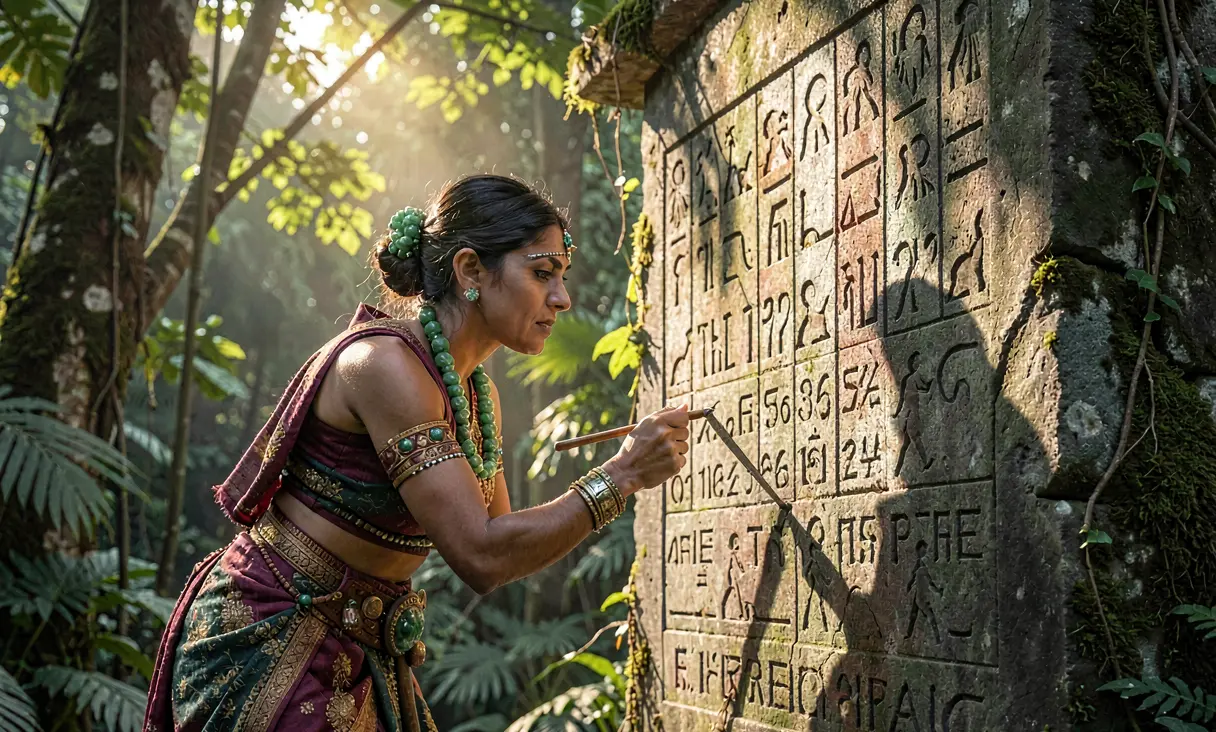 ScienceRefinement of the Maya Long Count Calendar Systemc. 361 BCE · Chiapa de Corzo, MexicoMaya scholars formalize the Long Count calendar for tracking deep historical time.
 economicsAksum Issues Gold Coins with Christian Imageryc. 350 CE · Aksum, EthiopiaKing Ezana mints the first African gold coins featuring Christian symbols and Ge'ez inscriptions.
 PoliticsAscension of the Nanda Dynastyc. 345 BCE · Pataliputra (modern Patna/India)Mahapadma Nanda overthrows the Shishunaga dynasty, establishing a vast empire and creating the first large-scale state in India.
 ReligionKing Ezana Declares Aksum a Christian Kingdomc. 330 CE · Aksum, EthiopiaKing Ezana adopts Christianity as the state religion of Aksum under the influence of Frumentius.
Discussion
Loading…