
Creation of the Dresden Codex
Created circa 1200 CE in Chichen Itza, the Dresden Codex is the most scientifically advanced surviving Maya text, preserving precise astronomical tables for Venus cycles and eclipses that demonstrate
The Fragile Legacy of the Postclassic Scribes
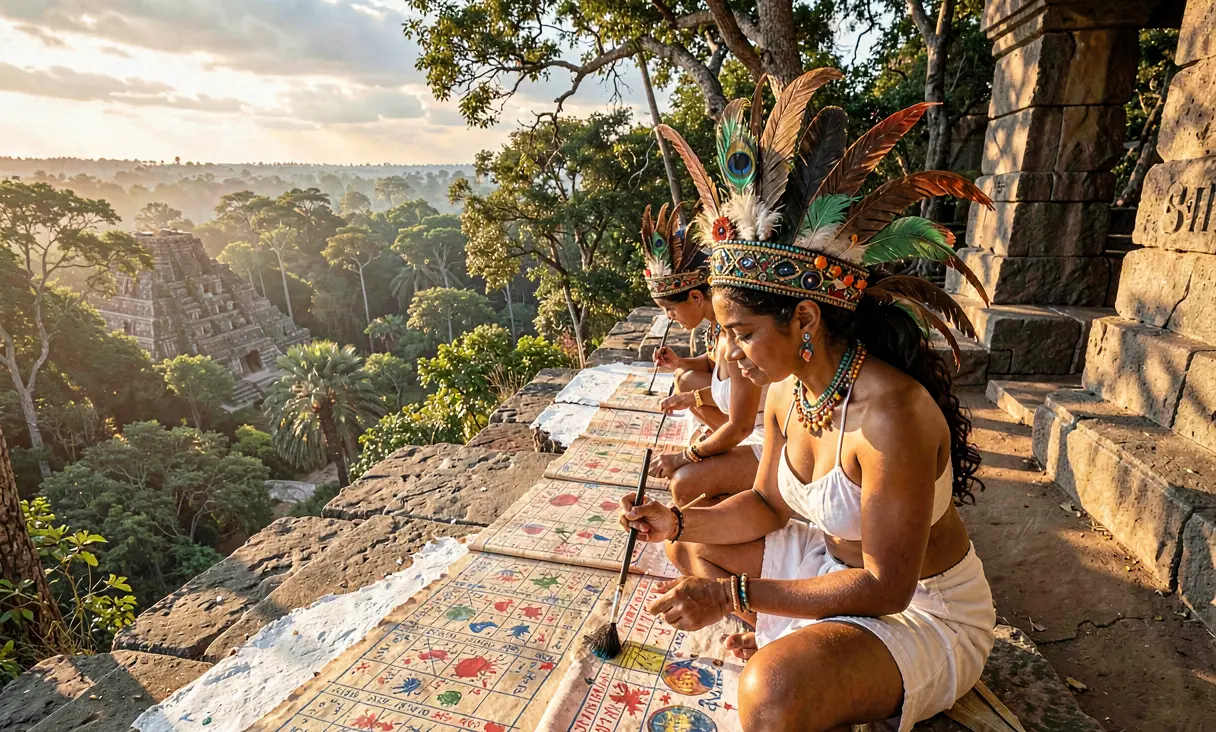
In the twilight of the Classic Maya collapse and the rise of powerful city-states like Chichen Itza, a unique intellectual tradition flourished in the Yucatán Peninsula. By circa 1200 CE, during the Postclassic period, Maya scribes were synthesizing centuries of astronomical observation into codices—folding books made from the bark of the fig tree (amate) coated with a white lime stucco to create a smooth writing surface. The Dresden Codex stands as the most complete and scientifically advanced of these surviving texts, representing a pinnacle of Pre-Columbian scientific achievement. Unlike the stone stelae that commemorated kings, this book was a functional tool for priests and astronomers, designed to predict celestial events with mathematical precision.
The Architecture of Time: Astronomical Mastery
The core of the Dresden Codex is its sophisticated astronomical data, organized into intricate tables that reveal a profound understanding of celestial mechanics. The most famous section details the cycles of Venus, tracking its appearances as the Morning and Evening Star over a period of 104 years with an error margin of only two hours per cycle. Furthermore, the codex contains eclipse tables that allow for the prediction of solar and lunar eclipses by calculating the synodic month to within a fraction of a day. These calculations demonstrate that Maya astronomers had determined the length of the solar year (365.2420 days) with an accuracy surpassing contemporary European calendars, utilizing complex base-20 mathematics and the concept of zero long before it appeared in the Old World.
The Scribes and the Ritual Calendar
While the specific identity of the scribe who compiled the final version remains anonymous, the text reflects the work of a highly organized guild of priest-astronomers operating out of major centers like Chichen Itza or Mayapan. The manuscript is written in red and black ink using fine brushes, with glyphs arranged in columns that read left-to-right and top-to-bottom. Beyond pure astronomy, the codex integrates these celestial cycles into the 260-day Tzolkin ritual calendar and the 365-day Haab' solar calendar. It provides almanacs for agricultural planting, hunting seasons, and religious ceremonies, illustrating how the Maya worldview was inextricably bound to the movement of the heavens. Every table served a dual purpose: scientific prediction and theological justification for state rituals.
From Yucatán to Saxony: A Journey Through Fire and Water
The survival of the Dresden Codex is as miraculous as its creation. Following the Spanish conquest, Bishop Diego de Landa ordered the burning of nearly all Maya books in 1562, viewing them as works of the devil; only four codices are known to have escaped this purge. The Dresden Codex likely survived because it was taken from a library in Chichen Itza or Mayapan and shipped to Europe, possibly arriving in Spain before being acquired by the Royal Library of Saxony in Dresden, Germany, around 1739. For centuries, its true nature remained a mystery to European scholars who could not decipher the glyphs, until the breakthroughs of the mid-19th century revealed it as a masterpiece of indigenous science rather than mere superstition.
A Beacon for Modern Archaeoastronomy
The legacy of the Dresden Codex extends far beyond its historical context, serving as the Rosetta Stone for understanding Pre-Columbian astronomy. Its rediscovery in the 19th century forced a reevaluation of Maya civilization, proving that they possessed a scientific sophistication comparable to the Greeks and Babylonians. Today, the codex is housed in the Saxon State Library in Dresden, where it remains one of the most studied documents in Mesoamerican history. It continues to provide critical data for archaeoastronomers attempting to align ancient temple structures with celestial events, confirming that the great pyramids of Chichen Itza were not merely tombs but massive observatories calibrated by the very tables written on its pages.
The Enduring Symbol of Indigenous Science
In the modern era, the Dresden Codex stands as a powerful symbol of indigenous intellectual resilience. It challenges the colonial narrative that the Americas were devoid of advanced scientific thought prior to European contact. The document's intricate depictions of deities like Chaac (the rain god) and Kukulkan (the feathered serpent), interwoven with rigorous mathematical data, illustrate a holistic worldview where science and religion were not separate domains but a unified system for understanding the cosmos. As one of only four surviving Pre-Columbian books, it represents an irreplaceable link to a lost library of knowledge that was nearly extinguished by conquest.
It preserves the highest level of scientific knowledge in pre-Columbian Mesoamerica before Spanish destruction.

Where it happened
Chichen Itza/Maya Region, Mexico — see it on the interactive map →
Explore related history
 ScienceDomestication of the Turkey in Mesoamericac. 1000 BCE · Central MexicoAncient Mesoamericans successfully domesticate the wild turkey for meat and ritual feathers.
 ScienceDevelopment of Linear A Script by Minoansc. 1800 BCE · Knossos, Crete (Greece)The Minoans develop Linear A, a still undeciphered writing system for administration.
 ScienceSankore Madrasah Becomes a Center of Learning in Timbuktuc. 1450 CE · Timbuktu, MaliThe Sankore Madrasah emerges as a premier university for Islamic scholarship in West Africa.
 ReligionZoroaster Preaches Dualistic Monotheismc. 1200 BCE · Greater Khorasan, Iran/Afghanistan border regionThe prophet Zoroaster establishes a dualistic faith emphasizing the cosmic struggle between good and evil in ancient Persia.
 CivilizationConstruction and Peak of Great Zimbabwec. 1200 CE · Great Zimbabwe, ZimbabweThe Great Zimbabwe complex reaches its zenith as a major trading hub connecting the interior to the Swahili coast.
 TechnologyConstruction of the Benin Walls Beginsc. 1200 CE · Benin City, NigeriaMassive earthwork fortifications begin to encircle Benin City, creating one of the world's largest pre-modern structures.
Discussion
Loading…