
Ashoka Propagates Dharma via Rock Edicts
Emperor Ashoka's rock edicts transformed Buddhism from a regional sect into a global faith by pioneering state-sponsored ethical reform and religious tolerance across ancient Asia.
The Shadow of Kalinga
By the mid-3rd century BCE, the Mauryan Empire under Chandragupta and his grandson Ashoka had consolidated control over much of the Indian subcontinent. However, the empire's expansion reached a bloody zenith in c. 260 BCE with the conquest of Kalinga, a prosperous coastal kingdom. The war was catastrophic; contemporary estimates suggest that over 100,000 soldiers and civilians were killed, with another 150,000 deported. Ashoka, witnessing the rivers running red with blood and the weeping widows of Kalinga, experienced a profound spiritual crisis. This trauma catalyzed his conversion to Buddhism, shifting his imperial focus from military conquest (digvijaya) to moral conquest (dhammavijaya).
The Edicts as State Policy
Beginning around 250 BCE, Ashoka initiated an unprecedented propaganda campaign, commissioning over thirty inscriptions carved into natural rock faces and polished sandstone pillars. These were strategically placed along major trade routes, in pilgrimage centers like Sarnath, and at administrative hubs stretching from Kandahar in modern Afghanistan to Kalsi in the north and Erragudi in the south. Unlike previous royal decrees which focused on taxation or administration, these edicts articulated a new state philosophy: Dhamma (Dharma). The inscriptions were written in local Prakrit dialects using the Brahmi script, with some bilingual versions in Greek and Aramaic in the northwest, ensuring the message reached diverse populations across the vast empire.
The Moral Architecture of Dhamma
Ashoka's Dhamma was not a rigid theological dogma but a practical ethical code emphasizing non-violence (ahimsa), religious tolerance, and social welfare. The Rock Edicts explicitly condemned ritual sacrifices and the slaughter of animals for food, urging subjects to limit their consumption of meat. He promoted respect for all sects, including Brahmins, Ajivikas, and Buddhists, famously stating in Major Rock Edict XII that one should honor others' faiths to strengthen one's own. The edicts also mandated social reforms, such as the planting of medicinal herbs, the digging of wells, and the appointment of 'Dhamma Mahamattas,' special officers tasked with ensuring justice for the poor and the elderly.
The Pillars of Sarnath
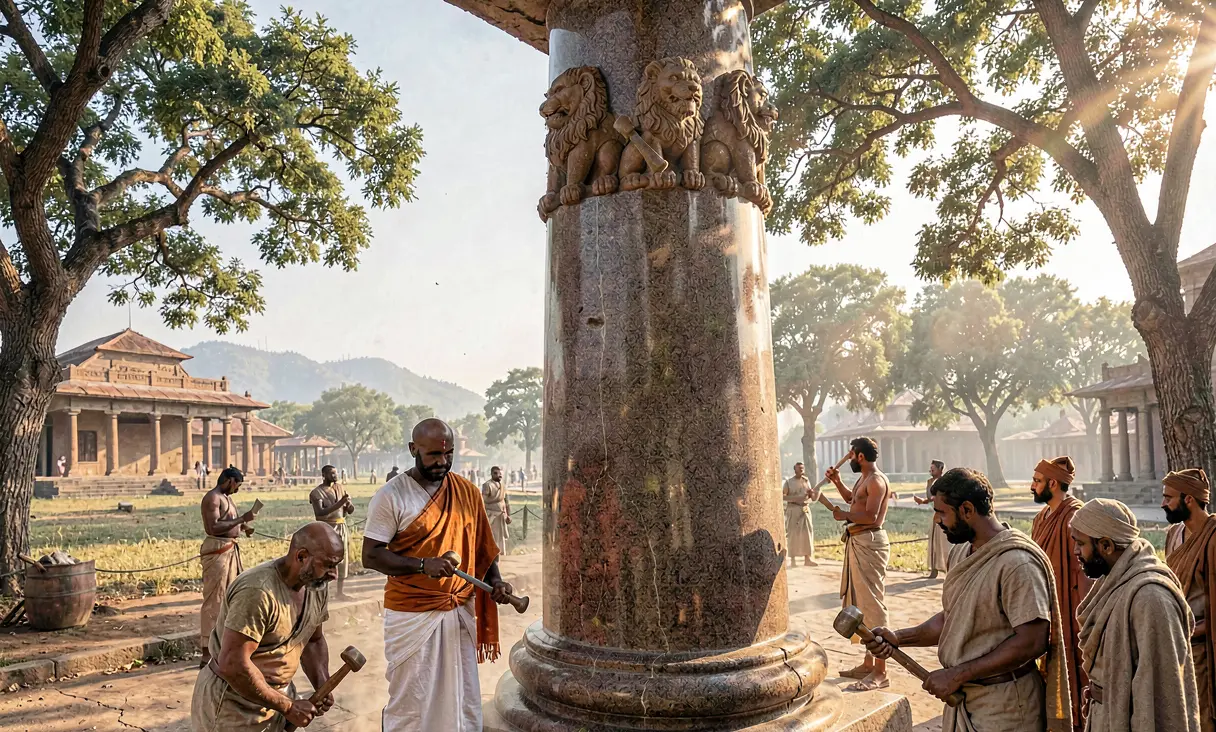
Among the most significant sites was Sarnath, where the Buddha first preached. Here, Ashoka erected a massive, monolithic sandstone pillar crowned by the Lion Capital, which later became India's national emblem. The Sarnath edicts specifically addressed the Sangha (Buddhist community), urging unity and condemning schisms within the order. While the pillars served as physical markers of imperial authority, their inscriptions functioned as a direct dialogue between the emperor and his subjects. The polished surface of the stone, reflecting light from miles away, symbolized the clarity and transparency Ashoka sought to bring to governance, transforming the landscape into a public library of moral instruction.
From Regional Sect to Global Faith
The immediate aftermath of these edicts was the transformation of Buddhism from a localized Indian sect into a major world religion. Ashoka used his diplomatic network to send missionaries, including his own son Mahinda and daughter Sanghamitta, to Sri Lanka, Central Asia, and the Hellenistic kingdoms in the Mediterranean. The state's endorsement provided the resources and protection necessary for Buddhist monasteries (viharas) to flourish. By codifying ethical behavior into law without enforcing a specific theology, Ashoka created a framework that allowed Buddhism to adapt to various cultures, eventually spreading along the Silk Road to China and Southeast Asia.
A Legacy of Ethical Governance
Ashoka's experiment in state-sponsored ethical reform remains unique in human history. He established the first known example of a government utilizing public communication for moral rehabilitation rather than mere propaganda or intimidation. Although his empire fractured shortly after his death in 232 BCE, the edicts survived as silent witnesses to his vision. Rediscovered by British archaeologist James Prinsep in the 1830s, these inscriptions fundamentally altered the modern understanding of ancient India. Today, they stand as a testament to the possibility of power exercised with compassion, influencing modern concepts of human rights and secular governance.
It marked the first time a state actively promoted non-violence and religious tolerance as official policy.

Where it happened
Sarnath, India — see it on the interactive map →
Explore related history
 ReligionConstruction of the Temple of Kukulcán at Chichén Itzác. 800 CE · Chichén Itzá, MexicoThe iconic pyramid dedicated to the feathered serpent god is built during the Puuc-Toltec fusion period.
 ReligionBuddha Attains Enlightenmentc. 528 BCE · Bodh Gaya, IndiaSiddhartha Gautama achieves nirvana under the Bodhi tree founding Buddhism.
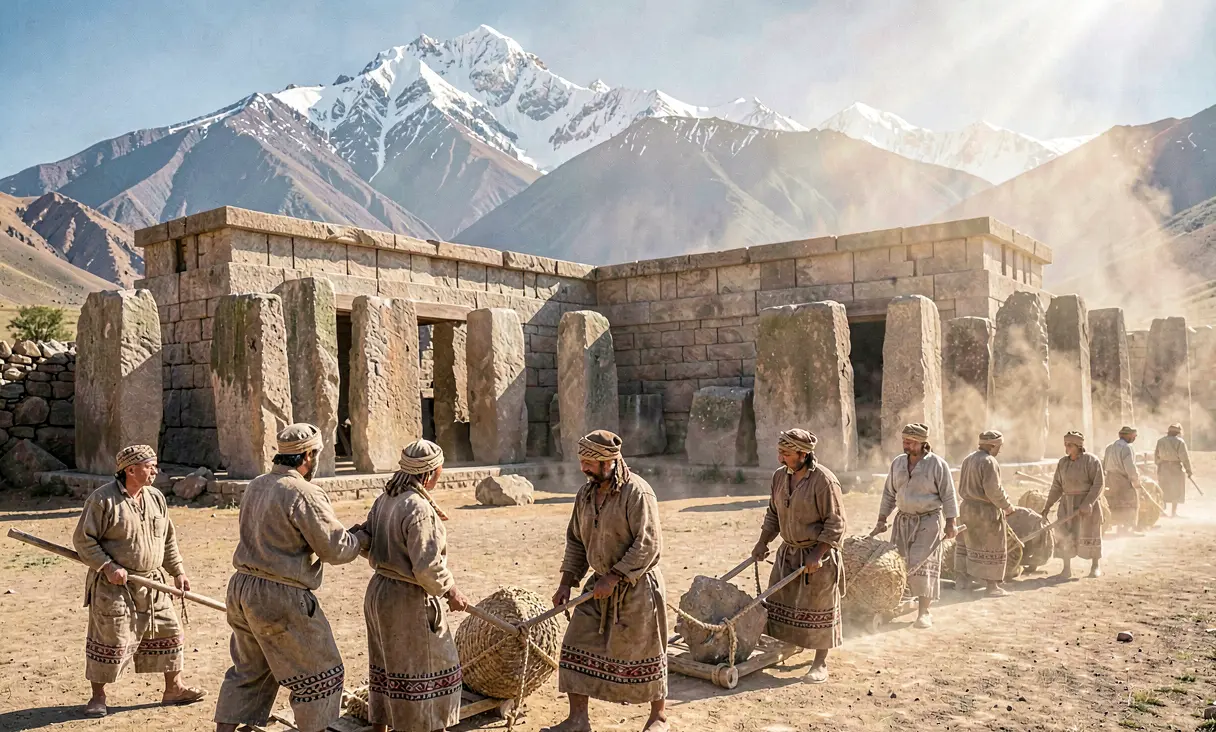 ReligionConstruction of Kalasasaya Temple at Tiwanakuc. 500 CE · Tiwanaku, BoliviaThe Kalasasaya temple is built with monolithic stones for solar observance.
 ScienceArchimedes Formulates the Law of the Leverc. 250 BCE · Syracuse, SicilyArchimedes mathematically defines the principle of the lever and buoyancy, founding classical mechanics.
 PoliticsBurial of the Lord of Sipánc. 250 BCE · Huaca Rajada, Lambayeque, PeruThe Moche ruler is buried with immense wealth and sacrificial victims.
 TechnologyInnovation of Roman Hydraulic Concrete (Opus Caementicium)c. 250 BCE · Rome, ItalyRoman engineers develop underwater-set concrete using volcanic ash and lime.
Discussion
Loading…