
Shivaji Maharaj Coronation and Maratha Empire
In 1674, Shivaji Maharaj's coronation as Chhatrapati at Raigad Fort transformed a guerrilla movement into a sovereign empire, challenging Mughal dominance and laying the administrative foundations for
The Context of Hindavi Swarajya
By the mid-17th century, the Deccan plateau was a fractured landscape dominated by the waning Adil Shahi Sultanate of Bijapur and the expanding Mughal Empire under Aurangzeb. In this volatile environment, Shivaji Bhonsle emerged not merely as a warrior but as a visionary statesman determined to establish 'Hindavi Swarajya'—a self-rule for his people that transcended religious lines while rooted in indigenous sovereignty. For decades, Shivaji had engaged in a relentless campaign of guerrilla warfare, utilizing the rugged Sahyadri mountain ranges to outmaneuver superior Mughal forces, most notably during his daring escape from Agra in 1666. By 1674, having secured a vast territory stretching from the Konkan coast to the interior Deccan, Shivaji recognized that constant military resistance required formal statehood to legitimize his rule and stabilize his administration against the theological and political claims of the Mughal Emperor.
The Coronation at Raigad
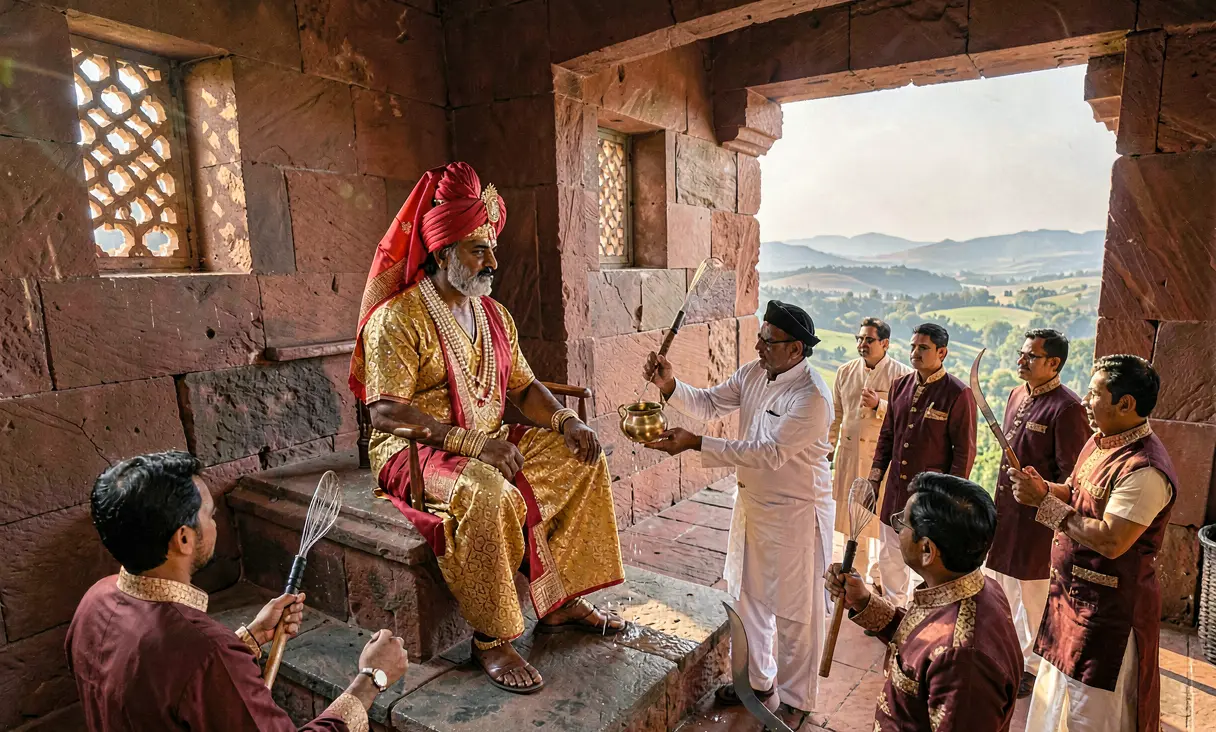
On June 6, 1674, amidst grand ceremonial splendor, Shivaji was formally crowned 'Chhatrapati,' a title denoting a paramount sovereign with the authority to grant land and command armies independently. The coronation took place at his capital, Raigad Fort, perched high above the Arabian Sea in present-day Maharashtra. To ensure the ritual's legitimacy according to ancient Hindu traditions, Shivaji invited the renowned scholar Gagabhatta of Varanasi, who performed the elaborate abhisheka (sacred bath) and anointment ceremonies. The event was marked by the distribution of vast wealth to Brahmins and the public, as well as the recitation of the Rajyabhisaka Sutra. This was not a mere coronation but a deliberate political statement: Shivaji rejected the suzerainty of both the Mughals and the Adil Shahis, declaring himself an equal to any monarch in India or Europe.
Architects of the New State
The success of the Maratha state relied heavily on a sophisticated administrative framework designed by Shivaji's inner circle. The Ashta Pradhan Mandala, or Council of Eight Ministers, was institutionalized during this period to manage the complex affairs of the empire. Key figures included Ramchandra Pant Amatya, who served as the Nyayadhish (Chief Justice) and later managed the treasury; Dadoji Kondadeo, a trusted administrator who laid early foundations for revenue collection; and Dadaji Kondev's successor, Moropant Trimbak Pingle, the Peshwa or Prime Minister. These men were not merely courtiers but architects of a meritocratic system where loyalty to the state superseded caste rigidities, allowing talented individuals from diverse backgrounds to rise within the military and civil bureaucracy.
Strategic Consolidation and Naval Power
Following his coronation, Shivaji turned his attention to fortifying the economic and military pillars of his new empire. Recognizing that control of the Konkan coast was vital for trade and defense against European colonial powers like the Portuguese, English, and Dutch, he aggressively expanded his naval capabilities. By 1674, the Maratha navy had grown into a formidable force with over 50 warships and hundreds of smaller vessels, manned by skilled sailors from the Koli community. Simultaneously, Shivaji reformed the revenue system through the Ryotwari model, bypassing feudal intermediaries to collect taxes directly from peasants, thereby ensuring a steady flow of resources for his standing army and fort maintenance. This dual focus on land administration and maritime dominance created a resilient state capable of withstanding external pressures.
Immediate Aftermath and Challenges
The declaration of sovereignty did not bring immediate peace; rather, it intensified the conflict with the Mughal Empire. Aurangzeb viewed Shivaji's coronation as a direct challenge to his imperial authority and launched massive campaigns in the Deccan to crush the new kingdom. Despite these pressures, the formalization of the state allowed Shivaji to negotiate from a position of strength rather than mere rebellion. He successfully defended Raigad and other key fortresses against sieges, utilizing his network of spies and rapid cavalry movements to harass Mughal supply lines. The coronation also solidified internal loyalty among Maratha chieftains, transforming a loose confederation of warriors into a cohesive national entity with a shared political identity.
Legacy and the Rise of an Empire
Shivaji's death in 1680 did not diminish the impact of his coronation; instead, it set the stage for the Maratha Empire's exponential expansion throughout the 18th century. The administrative structures and military tactics established by Shivaji allowed his successors to challenge Mughal hegemony effectively, eventually filling the power vacuum left by Aurangzeb's death in 1707. By the mid-1700s, the Marathas controlled a vast swath of the Indian subcontinent, from Punjab to Tamil Nadu, and even levied tribute (Chauth) on regions as far as Bengal. The coronation of 1674 remains a seminal moment in South Asian history, marking the transition from feudal resistance to organized statecraft and inspiring modern concepts of Indian nationalism and sovereignty.
Shivaji's coronation marked the rise of a powerful indigenous empire that challenged Mughal hegemony and shaped modern Indian nationalism.

Where it happened
Raigad Fort (modern Maharashtra/India) — see it on the interactive map →
Explore related history
 PoliticsFounding of Fatehpur Sikric. 1571 CE · Fatehpur Sikri, Uttar Pradesh, IndiaAkbar establishes Fatehpur Sikri as the new capital of the Mughal Empire to honor his spiritual guide and centralize administration.
 PoliticsPeace of WestphaliaOctober 24, 1648 · Münster and Osnabrück, GermanyTreaties end the Thirty Years' War, establishing state sovereignty.
 PoliticsThe Glorious RevolutionNovember 5, 1688 · London, EnglandParliament invites William of Orange to depose James II, establishing constitutional monarchy.
 ReligionBirth of Bulleh Shahc. 1680 CE · Uch (modern Pakistan)The birth of Bulleh Shah, a pivotal Sufi poet who challenged religious orthodoxy and promoted universal love.
 WarAurangzeb's Decades-Long Deccan Campaignc. 1681 CE · Deccan Plateau, IndiaEmperor Aurangzeb moves his court to the Deccan for a prolonged military campaign against the Marathas and Sultanates.
 DisasterGreat Fire of LondonSeptember 2, 1666 · London, EnglandCatastrophic fire destroys medieval London, leading to major urban reconstruction.
Discussion
Loading…