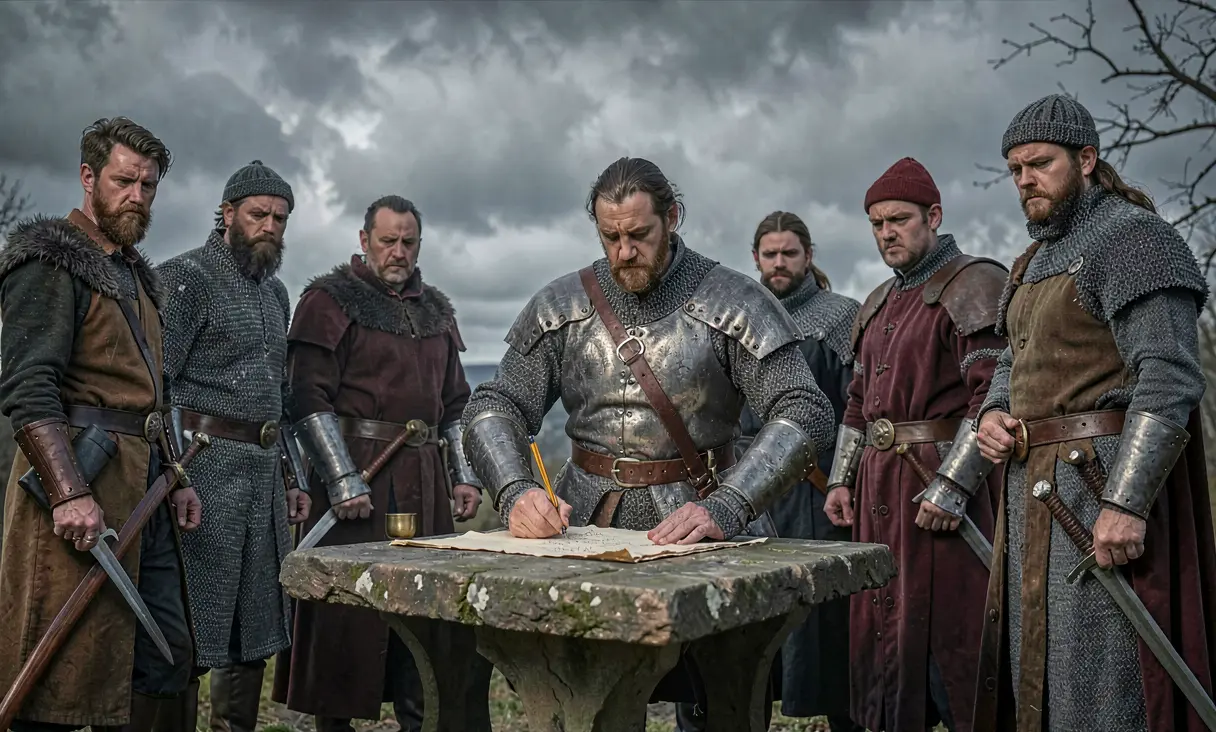
Signing of Magna Carta
In 1215, English barons forced King John to seal Magna Carta at Runnymede, establishing that no ruler is above the law and guaranteeing due process for free men.
A Kingdom in Crisis
By the spring of 1215, the reign of King John of England had reached a precipice of political and military failure. The monarch's disastrous campaign to reclaim Normandy from Philip II of France resulted in the loss of continental territories, devastating his prestige and draining the royal treasury. To fund further military ventures and settle disputes with the Papacy over the appointment of Stephen Langton as Archbishop of Canterbury, John imposed heavy scutage taxes on his barons, violating established feudal customs. The resulting alienation of the nobility was compounded by John's arbitrary exercise of power, characterized by the seizure of castles, the imprisonment of rivals without trial, and the extortion of ransoms. By early 1215, a coalition of disaffected northern barons had organized into a formidable rebel force, capturing London in May and forcing the King to the negotiating table.
The Meeting at Runnymede
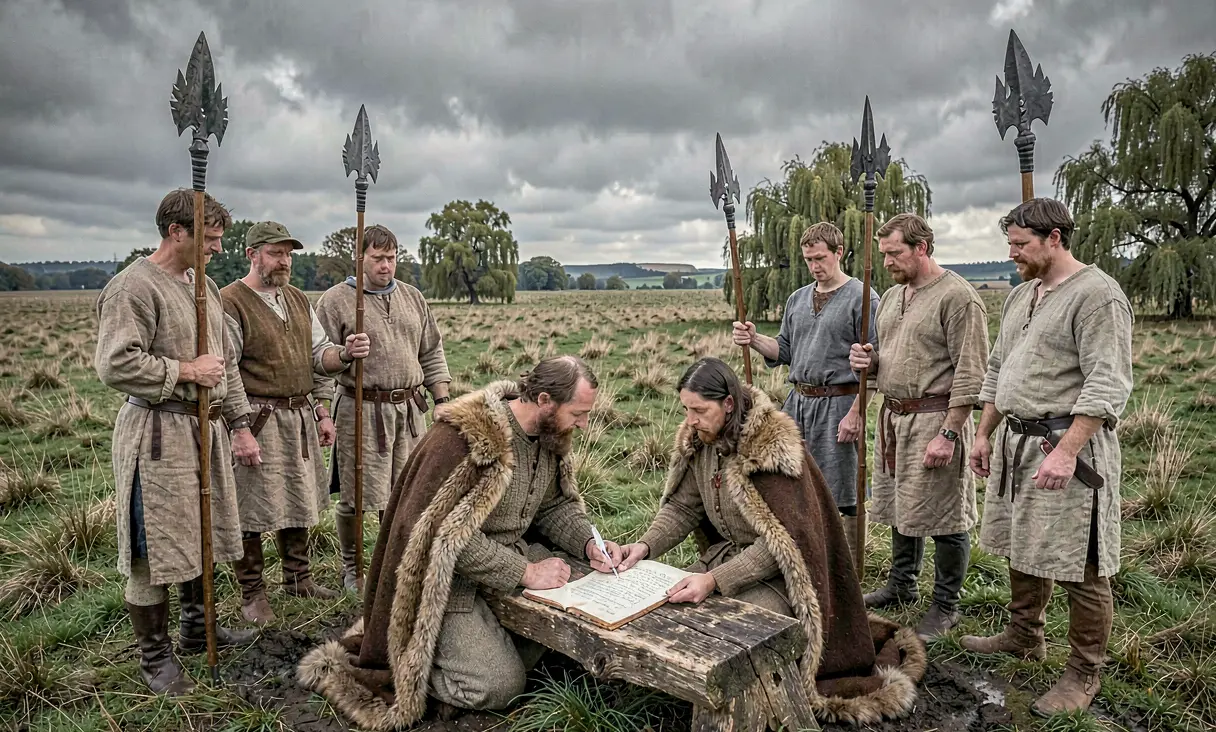
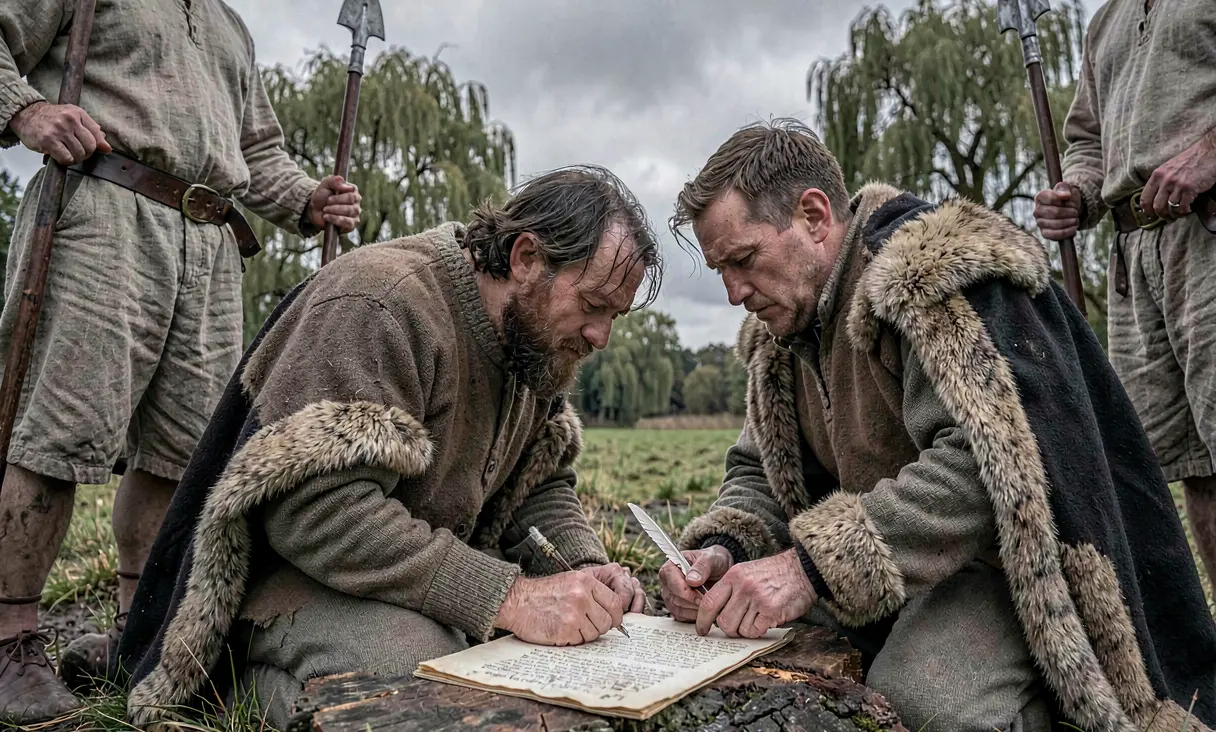
On June 15, 1215, under the shade of ancient trees along the banks of the River Thames at Runnymede, a neutral ground between Windsor Castle and Staines, King John met with his rebellious barons. The atmosphere was tense; the King's forces were outnumbered, and the rebels threatened to depose him if their demands were not met. The document presented to the King was not an invention of 1215 but a consolidation of grievances rooted in the coronation charter of Henry I and earlier customary laws. It sought to codify the rights of the church, the barons, and the free men of England against royal overreach. While the immediate catalyst was feudal privilege, the resulting text contained radical principles regarding the administration of justice that would resonate for centuries.
Archbishop Langton and the Rebel Barons
The intellectual architect behind the charter's legal framework is widely attributed to Stephen Langton, the Archbishop of Canterbury, whose theological and political acumen provided the moral weight necessary to challenge the King. Langton, who had been in exile due to John's refusal to accept his appointment, returned to England in 1213 and became a key mediator between the crown and the barons. The rebel leadership included figures such as Robert Fitzwalter, who styled himself 'Marshal of the Army of God,' and Eustace de Vesci. These men were not merely seeking tax relief; they demanded a written guarantee that the King would govern according to law. Their leverage was absolute: without their military support, John's throne was untenable.
The Provisions of the Great Charter
The resulting document, known as Magna Carta or the Great Charter, comprised 63 clauses addressing specific grievances and establishing broad legal principles. It confirmed the liberties of the English Church, regulated feudal payments such as scutage and relief, and reformed the administration of justice by prohibiting the sale, denial, or delay of right and justice. The most enduring provision is Clause 39 (numbered 29 in later reissues), which declared: 'No free man shall be seized or imprisoned, or stripped of his rights or possessions, or outlawed or exiled, or deprived of his standing in any other way, nor will we proceed with force against him, or send others to do so, except by the lawful judgment of his equals or by the law of the land.' This clause established the concept of due process and habeas corpus, asserting that even the monarch was not above the law.
Immediate Collapse and Civil War
Despite John's reluctant sealing of the charter on June 15, the agreement proved ephemeral. Within weeks, both sides reneged on their commitments; the barons feared John would seek papal annulment, while the King viewed the concession as a temporary tactical retreat. On August 24, 1215, Pope Innocent III issued a bull declaring the charter null and void, citing that it was extracted under duress and violated feudal rights. The breakdown of trust plunged England into the First Barons' War, with the barons inviting Prince Louis of France to claim the English throne. King John died in October 1216 amidst the conflict, leaving his nine-year-old son, Henry III, on the throne.
Reissues and the Birth of Common Law
The legacy of Magna Carta was secured not by its initial signing but by its strategic reissuance. Following John's death, the royal council, led by William Marshal, reissued the charter in 1216 and again in 1217 to rally support for the young Henry III against the French invasion. A definitive version was issued in 1225, which became the basis of English statute law. Although many specific feudal clauses were eventually repealed or fell into disuse, the core principles regarding liberty and legal procedure survived. By the 17th century, jurists like Sir Edward Coke revived Magna Carta as a weapon against the absolutist claims of the Stuart kings, cementing its status as a symbol of constitutional governance.
A Global Legacy
Magna Carta transcended its medieval origins to become a foundational text for modern democracy. Its influence is evident in the United States Constitution and the Bill of Rights, where concepts like due process and trial by jury are directly derived from Clause 39. It established the precedent that government authority is limited by law, a principle that underpins constitutional monarchies and republics worldwide. While the original 1215 document no longer exists, four copies survive in British libraries, serving as tangible links to the moment when the rule of law was first asserted against the arbitrary power of the crown.
It laid groundwork for modern democratic governance and human rights.
Where it happened
Runnymede, England — see it on the interactive map →
Explore related history
 PoliticsRise of Srivijaya as Maritime Hegemon683 CE · Palembang, Sumatra (Modern Indonesia)Srivijaya emerges as the dominant maritime empire controlling the Strait of Malacca.
 PoliticsEmperor Xuanzong Ascends the Tang Throne712 CE · Chang'an, ChinaEmperor Xuanzong begins his reign, ushering in the High Tang golden age.
 PoliticsFounding of Heian-kyo794 CE · Kyoto, JapanEmperor Kammu moves the capital to Heian-kyo, beginning the Heian period.
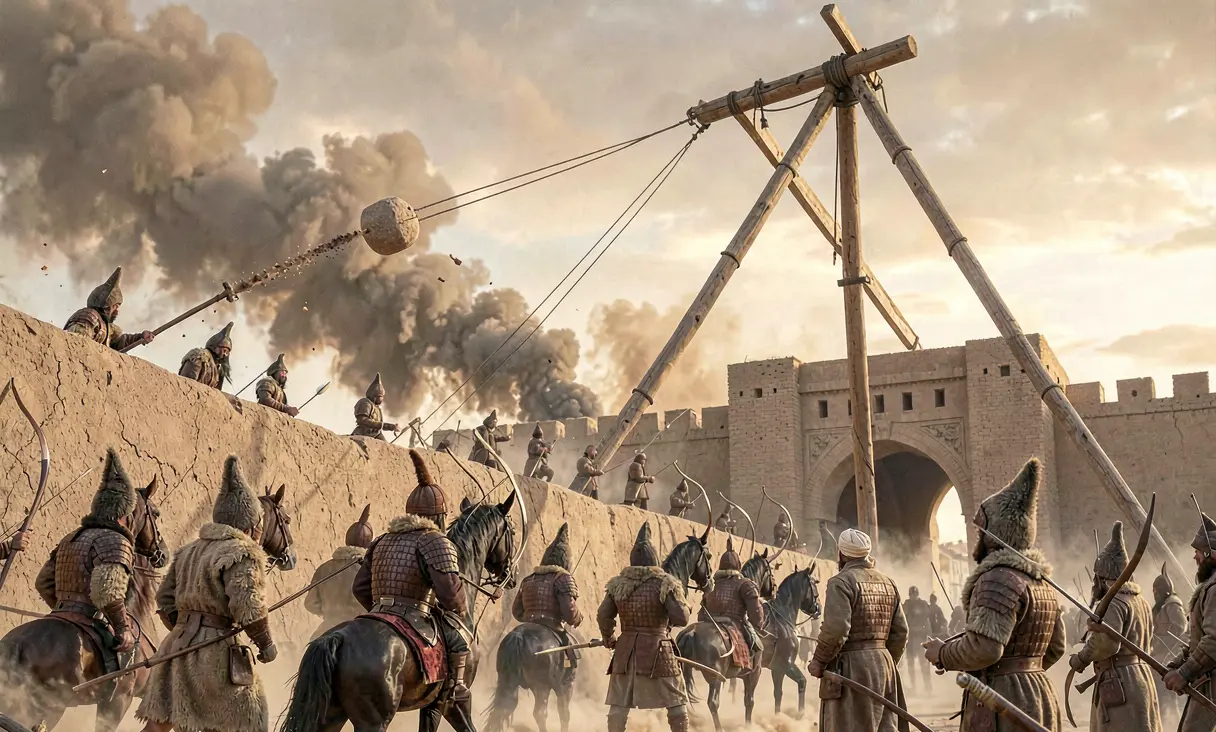 WarMongol Invasion of Khwarezmiac. 1219 CE · Urgench, Khwarazm (modern Uzbekistan/Turkmenistan)Genghis Khan launches a massive invasion of the Khwarezmian Empire, destroying its cities and ending Persian dominance in Central Asia.
 WarMongol Destruction of the Khwarazmian Empirec. 1220 CE · Samarkand/Urgench, Central AsiaGenghis Khan's armies devastate the Khwarazmian Empire, razing cities and altering the demographic map of Central Asia.
 PoliticsFounding of the Delhi Sultanate by Qutb-ud-din Aibakc. 1206 CE · Delhi (modern India)Qutb-ud-din Aibak declares independence from the Ghurids and establishes the first Muslim Sultanate in India.
Discussion
Loading…