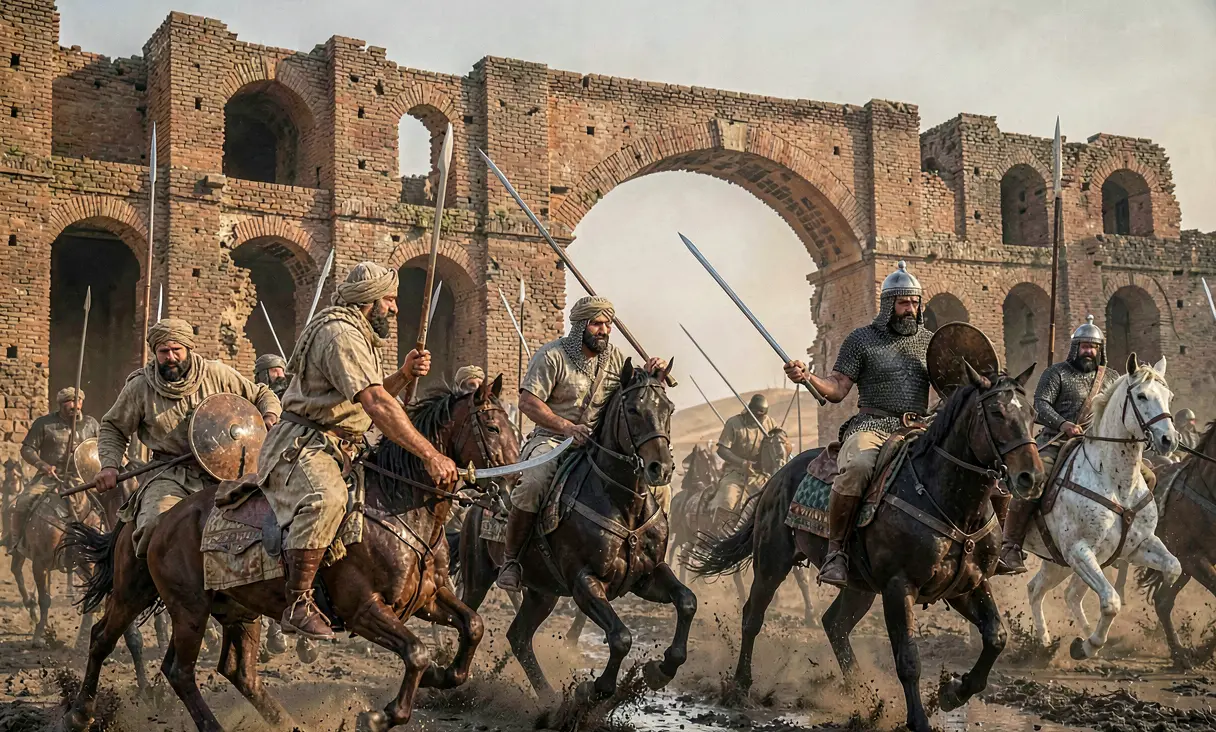
Islamic Conquest of the Sasanian Empire
The 637 CE capture of Ctesiphon by Sa'd ibn Abi Waqqas shattered the Sasanian Empire, ending Zoroastrian state power and merging Persian administration with Islam to forge a new civilization.
The Collapse of a Superpower
By the early 7th century CE, the Sasanian Empire stood as one of the two great superpowers of the ancient world, locked in a centuries-long struggle with Byzantium. However, decades of exhausting warfare against Heraclius had left Persia economically drained and politically fractured. The death of Khosrow II in 628 triggered a succession crisis that saw over ten claimants to the throne within four years, culminating in the child-king Yazdegerd III ascending in 632. This internal disarray created a vacuum of power just as the newly unified Arab tribes under the Rashidun Caliphate began their expansion outward from the Arabian Peninsula, setting the stage for a collision that would irrevocably alter the geopolitical map.
The March on Ctesiphon
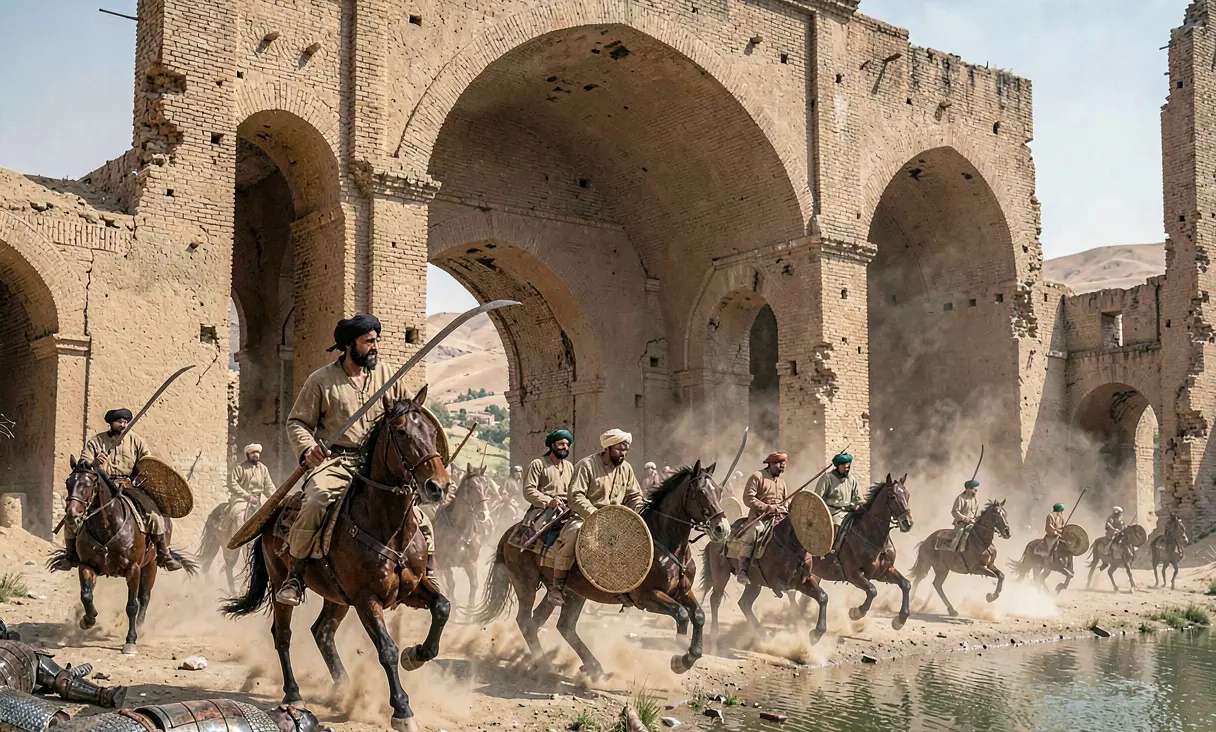
In 637 CE, the Rashidun Caliphate, under the strategic direction of Caliph Umar ibn al-Khattab, launched a decisive campaign to capture the Sasanian capital. The Arab forces, led by the seasoned commander Sa'd ibn Abi Waqqas, advanced north through Mesopotamia, securing key victories at Qadisiyya in 636 which shattered the main Sasanian field army. Following this triumph, Sa'd marched on Ctesiphon (al-Mada'in), the sprawling imperial metropolis situated on the Tigris River. The city was defended by a massive garrison and formidable fortifications, but the internal cohesion of the Persian defense had crumbled under the weight of recent defeats and political instability.
Key Figures: Sa'd and Yazdegerd
The confrontation was defined by the contrasting leadership styles of its central figures. Sa'd ibn Abi Waqqas, a companion of the Prophet Muhammad known for his piety and tactical prudence, commanded an army that relied on mobility, religious fervor, and disciplined infantry formations. Opposing him was Yazdegerd III, the last Sasanian Shahanshah, who struggled to rally a nobility deeply divided by factionalism. While Yazdegerd possessed the legitimacy of ancient lineage, his court in Ctesiphon was paralyzed by indecision. The Persian command relied heavily on heavy cavalry (aswaran) and war elephants, assets that proved less effective against the Arab light infantry and archers in the terrain surrounding the capital.
The Fall of the Imperial Capital
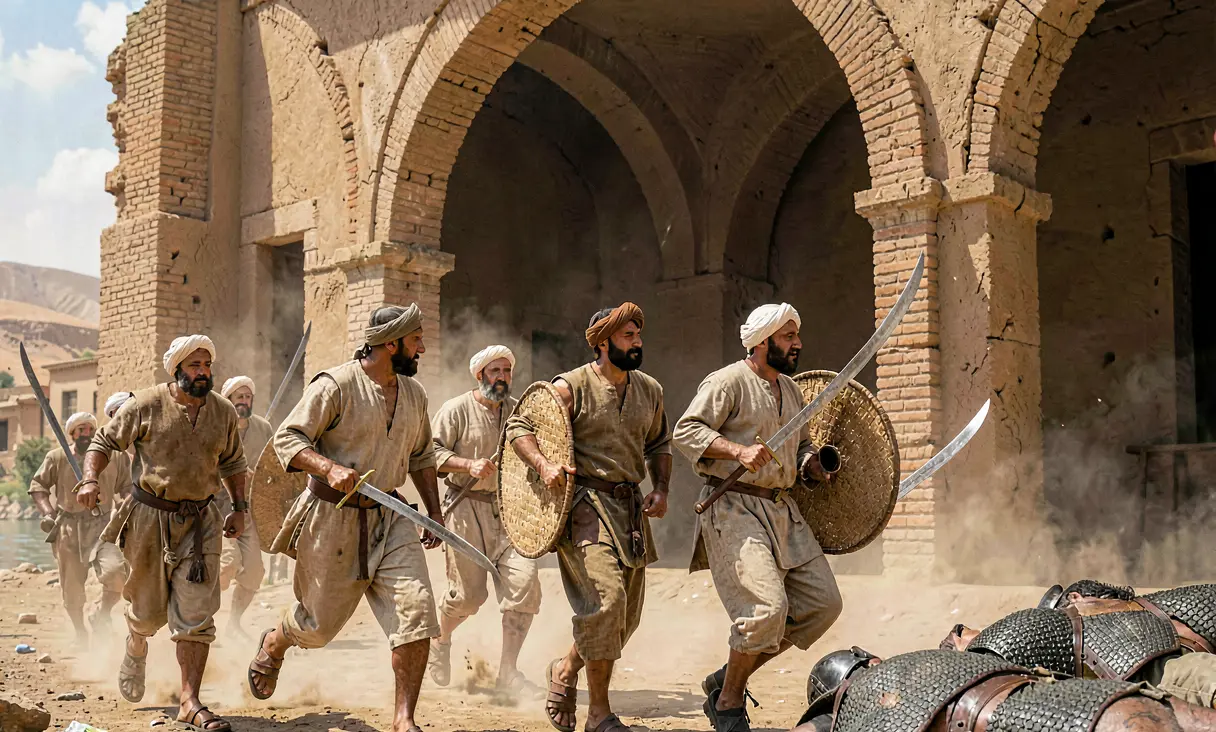
The siege of Ctesiphon began in earnest during the spring of 637. The Arab forces, outnumbered but highly motivated, utilized the flooding of the Tigris to their advantage, cutting off supply lines and isolating the city's defenses. After a brief but fierce struggle, the Sasanian garrison abandoned the western bank of the river, retreating eastward while setting fire to parts of the city to hinder pursuit. Sa'd ibn Abi Waqqas entered the magnificent palace complex of Khosrow II, finding it largely deserted as Yazdegerd fled toward the Iranian plateau. The capture of Ctesiphon was not merely a military victory; it represented the symbolic end of Zoroastrian imperial authority and the seizure of the empire's vast treasury, which funded further campaigns across the region.
The End of an Era
The fall of Ctesiphon marked the beginning of the rapid disintegration of the Sasanian state. Although Yazdegerd III attempted to regroup in the east, raising new armies in Khurasan and Merv, the loss of the capital had severed the administrative heartland from the periphery. Over the next decade, Arab forces pursued the fleeing monarch through the Zagros Mountains, defeating his remaining forces at battles such as Nahavand in 642, often called the 'Victory of Victories.' By 651, Yazdegerd III was assassinated in Merv, effectively ending the Sasanian dynasty and leaving a power vacuum that allowed Islam to spread rapidly throughout Iran and into Central Asia.
Legacy: The Persian Synthesis
The conquest of the Sasanian Empire was a pivot point in human history, dismantling one of antiquity's oldest civilizations while simultaneously birthing a new Islamic civilization. Far from erasing Persian culture, the Umayyad and later Abbasid Caliphates absorbed Sasanian administrative practices, bureaucracy, and artistic traditions. The concept of the vizier, the tax system (diwan), and the grandeur of court life were directly inherited from Persia. This synthesis fueled the Islamic Golden Age, where Persian scholars, poets, and scientists became integral to the preservation and advancement of knowledge, creating a cultural legacy that defined the medieval world.
It ended the ancient Persian Empire and shifted the center of power in West Asia to the Islamic world.
Where it happened
Ctesiphon, Iraq (Persia) — see it on the interactive map →
Explore related history
 WarViking Siege of Paris885 CE · Paris, FranceViking raiders led by Sigfred besiege Paris for over a year, testing the defenses of West Francia.
 WarChola Conquest of Sri Lankac. 993 CE · Anuradhapura, Sri LankaRajaraja Chola launches a massive amphibious invasion of Sri Lanka, defeating the Sinhalese kingdom and annexing the island.
 WarRajendra Chola I's Ganges Expeditionc. 1025 CE · Bengal to Ganges Delta, IndiaRajendra Chola I leads a northern expedition reaching the Ganges River, defeating Pala kings and bringing holy water back to Thanjavur.
 ArtBurial of the Sutton Hoo Shipc. 625 CE · Suffolk, EnglandAn Anglo-Saxon king is buried with a magnificent helmet and gold artifacts.
 ReligionStandardization of the Quranic Textc. 650 CE · Medina (and Damascus), Arabia/SyriaCaliph Uthman commissions the definitive written codex of the Quran.
 ReligionHijra of Prophet MuhammadSeptember 24, 622 CE · Medina, Saudi ArabiaMuhammad migrates to Medina establishing the first Muslim community and calendar.
Discussion
Loading…