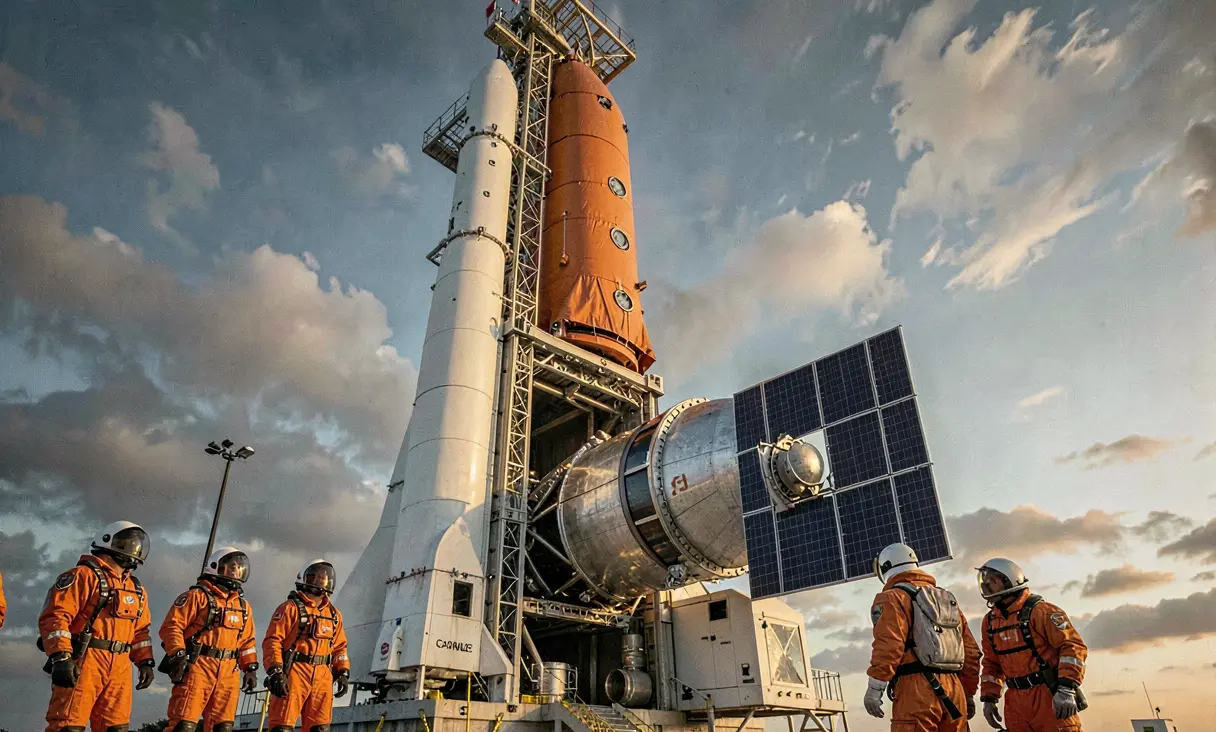
Launch of Hubble Space Telescope
Launched in 1990 and saved by astronauts, Hubble shattered atmospheric barriers to reveal dark energy, pinpoint the universe's age, and redefine human knowledge of the cosmos.
A Vision Beyond the Atmosphere
For decades, astronomers were constrained by Earth's turbulent atmosphere, which blurred celestial images and absorbed critical wavelengths of light. The concept of a space-based observatory was first seriously proposed in the 1940s, but it took over forty years of political maneuvering, engineering challenges, and international collaboration to bring the Large Space Telescope to life. Conceived as a joint project between NASA and the European Space Agency (ESA), the telescope was designed to operate above the distorting effects of the atmosphere, offering unprecedented clarity across ultraviolet, visible, and near-infrared spectra. The mission represented a monumental leap in human capability, promising to answer fundamental questions about the origin, evolution, and ultimate fate of the universe.
The Launch of Discovery
On April 24, 1990, at 8:33 a.m. EDT, the Space Shuttle Discovery lifted off from Kennedy Space Center's Launch Complex 39B in Cape Canaveral, Florida. The mission, designated STS-31, carried the Hubble Space Telescope (HST) into orbit with a crew of five astronauts led by Commander Loren Shriver. After two days of orbital maneuvers, the crew successfully deployed the telescope from Discovery's payload bay at an altitude of approximately 600 kilometers. As the solar arrays unfurled and the instrument doors opened, the world held its breath for the first images that would validate years of investment and hope. The deployment marked the beginning of a new era in observational astronomy, freeing humanity from the limitations of ground-based observation.
The Spherical Aberration Crisis
By mid-1990, the initial excitement turned to despair when analysis revealed a catastrophic flaw in the telescope's primary mirror. Despite rigorous testing prior to launch, the mirror had been ground with a spherical aberration of 2.2 micrometers—a tiny error that resulted in light reflecting from the edges focusing at a different point than light from the center. This defect rendered Hubble unable to achieve sharp focus, producing blurry images that threatened to undermine the entire mission. The discovery sparked a global scientific crisis and intense scrutiny of NASA's quality control processes. Engineers and scientists scrambled to devise a solution, realizing that without intervention, Hubble would be little more than an expensive satellite drifting in orbit.
Restoring the Vision
The salvation of Hubble came through the ingenuity of NASA engineers who designed corrective optics known as COSTAR (Corrective Optics Space Telescope Axial Replacement) and a new Wide Field and Planetary Camera 2 (WFPC2). In December 1993, the crew of STS-61, led by Commander Richard Covey, executed one of the most complex spacewalks in history. Over five days, astronauts performed seven extravehicular activities to install the corrective devices and replace aging instruments. The mission was a triumph of human skill and engineering precision; when Hubble began transmitting new images in early 1994, they were crystal clear, revealing details of celestial objects with a sharpness that ground-based telescopes could never match.
Revolutionizing Cosmology
With its vision restored, Hubble embarked on a journey that would fundamentally alter our understanding of the cosmos. Among its most profound achievements was the determination of the universe's expansion rate, or the Hubble Constant, with unprecedented precision. By observing Cepheid variable stars in distant galaxies, astronomers refined the age of the universe to approximately 13.8 billion years. Furthermore, deep field observations, such as the Hubble Deep Field and Ultra Deep Field, captured light from galaxies formed just a few hundred million years after the Big Bang, providing a window into the early universe. Perhaps most significantly, data from Hubble contributed to the discovery of dark energy, revealing that the expansion of the universe is accelerating rather than slowing down.
An Enduring Legacy
Over three decades of operation, Hubble has returned more than 1.5 million observations and produced over 20,000 peer-reviewed scientific papers, making it one of the most productive scientific instruments in history. Its iconic images, from the Pillars of Creation to the Sombrero Galaxy, have transcended science to become cultural touchstones that inspire public interest in astronomy. Although its successor, the James Webb Space Telescope, has now taken up the mantle for infrared observation, Hubble continues to operate alongside it, providing complementary data across different wavelengths. The telescope's legacy is not merely in the data it collected but in the paradigm shift it engineered, transforming cosmology from a field of speculation into one of precise measurement and deep empirical understanding.
It revolutionized our visual understanding of the cosmos and deep time.
Where it happened
Cape Canaveral, USA — see it on the interactive map →
Explore related history
 ScienceDiscovery of DNA StructureFebruary 28, 1953 CE · Cambridge, EnglandWatson and Crick identify the double helix structure of DNA revealing genetic code.
 PoliticsFall of the Berlin WallNovember 9, 1989 CE · Berlin, GermanyCitizens breach the barrier dividing East and West Berlin ending Cold War division.
 DisasterChernobyl Nuclear DisasterApril 26, 1986 CE · Pripyat, UkraineReactor explosion releases radiation contaminating large parts of Europe.
 ExplorationApollo 11 Moon LandingJuly 20, 1969 CE · Cape Canaveral, USAHumans first walk on the lunar surface during the Space Race.
Discussion
Loading…