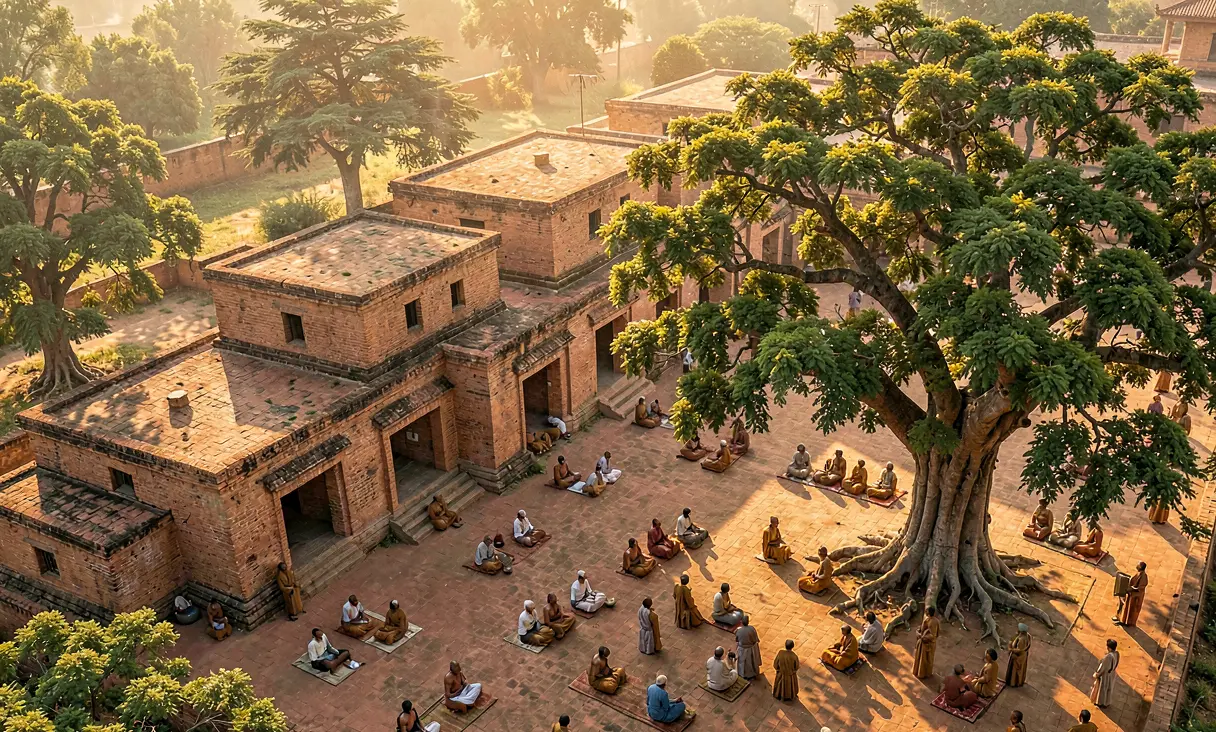
Founding of Nalanda University
Founded c. 450 CE by Kumaragupta I, Nalanda evolved into the world's first residential university, fostering a cosmopolitan exchange of Buddhist philosophy and secular sciences that shaped Asian intel
The Gupta Intellectual Renaissance
By the mid-5th century CE, the Gupta Empire had established a golden age of stability and cultural flourishing across northern India. While often celebrated for its advancements in mathematics, astronomy, and art under rulers like Chandragupta II, this era also witnessed a profound institutionalization of higher learning. The political consolidation provided by the Guptas created the necessary economic surplus and social security to support large-scale monastic communities that transcended mere religious observance. It was within this fertile climate that the foundations of Nalanda were laid, transforming the ancient Buddhist tradition of wandering ascetics into a sedentary, scholarly aristocracy.
The Founding Decree
Around 450 CE, Emperor Kumaragupta I issued the royal patronage that officially established Nalanda Mahavihara near Rajgir in present-day Bihar. Unlike earlier monastic settlements which were often small and isolated, this initiative was conceived as a grand residential university complex from its inception. The site, chosen for its proximity to the ancient capital of Magadha and its serene landscape, was intended to serve as a beacon of orthodoxy and intellectual rigor. Initial endowments included land grants and revenue from hundreds of villages, ensuring the institution's financial independence and allowing it to support thousands of resident scholars without reliance on alms alone.
Architecting a Cosmopolitan Hub
Over subsequent centuries, Nalanda expanded into a sprawling metropolis of learning that defied the conventional scale of ancient educational institutions. The campus eventually comprised eight separate compounds, massive libraries containing millions of manuscripts, and lecture halls capable of hosting thousands of students simultaneously. Dormitories were built to house monks from across Asia, including China, Korea, Tibet, and Central Asia, fostering a unique cosmopolitan environment where Sanskrit served as the lingua franca of scholarship. The architecture itself was designed to facilitate rigorous debate, with open courtyards and specialized chambers for logic (hetuvidya) and metaphysics.
Scholars and the Rigorous Curriculum
The intellectual life at Nalanda was defined by a demanding curriculum that integrated Buddhist philosophy with secular sciences. Students were required to master the Tripitaka, but also engaged deeply in logic, grammar, medicine (Ayurveda), mathematics, and astronomy. The faculty included some of history's most brilliant minds, such as Nagarjuna, Aryadeva, and later, the great logicians Dignaga and Dharmakirti. The Chinese pilgrim Xuanzang, who studied there in the 7th century, documented a system where students spent years debating a single proposition before advancing. This rigorous dialectical method ensured that Nalanda became the premier center for the development of Mahayana Buddhism and Indian logic.
The Legacy of Destruction and Memory
Nalanda's dominance lasted for nearly seven centuries until its catastrophic destruction in 1193 CE by Bakhtiyar Khilji, a general of the Ghurid dynasty. The burning of the great library is said to have raged for months, destroying an irreplaceable repository of human knowledge that had accumulated since the Gupta era. Despite this physical annihilation, the institution's legacy endured through its alumni who carried its teachings to Tibet and East Asia, preserving its texts in translation long after the Sanskrit originals were lost. The site remained a ruin until its archaeological rediscovery in the 19th century, which confirmed the scale described by ancient travelers.
The Archetype of the Modern University
Nalanda stands as the historical archetype for the modern residential university, predating institutions like Oxford and Bologna by centuries. It pioneered the concept of a centralized campus dedicated to interdisciplinary study, supported by state patronage yet maintaining academic autonomy. Its model of combining religious devotion with secular inquiry influenced educational systems across Asia, establishing a precedent for the global exchange of ideas that defines contemporary academia. The recent revival of Nalanda University in 2014 serves as a testament to its enduring symbolic power as a bridge between ancient wisdom and modern scientific pursuit.
Nalanda established the model for institutionalized higher education in Asia and served as the primary conduit for transmitting Indian knowledge to East Asia.
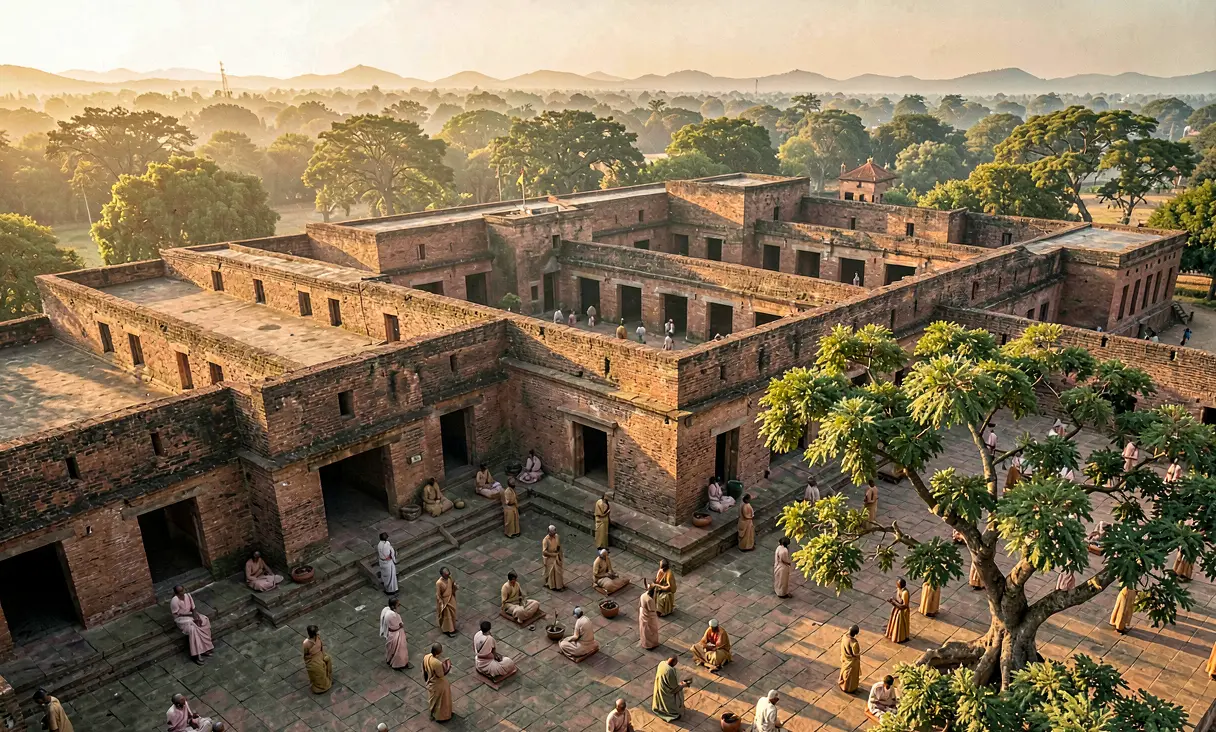

Where it happened
Rajgir, Bihar, India — see it on the interactive map →
Explore related history
 ScienceEstablishment of the Babylonian Astronomical Observatoriesc. 747 BCE · Babylon, IraqBabylonian priests begin systematic nightly recording of planetary movements and eclipses.
 ScienceCompilation of Ashurbanipal's Royal Libraryc. 650 BCE · Nineveh (Mosul), IraqKing Ashurbanipal assembles the largest collection of cuneiform tablets in the ancient world.
 ScienceRefinement of the Maya Long Count Calendar Systemc. 361 BCE · Chiapa de Corzo, MexicoMaya scholars formalize the Long Count calendar for tracking deep historical time.
 WarChandragupta II Defeats the Western Satrapsc. 409 CE · Malwa and Gujarat region, IndiaChandragupta II Vikramaditya defeats the Western Kshatrapas, annexing Gujarat and securing access to the lucrative Indian Ocean trade routes.
 TechnologyCasting of the High-Corrosion Resistant Iron Pillar at Delhic. 400 CE · Delhi, IndiaIndian metallurgists forge a massive iron pillar that resists rust for over 1,600 years.
 literatureCompilation of the Kama Sutrac. 400 CE · India (likely Pataliputra)Vatsyayana compiles the treatise on love, desire, and social conduct.
Discussion
Loading…