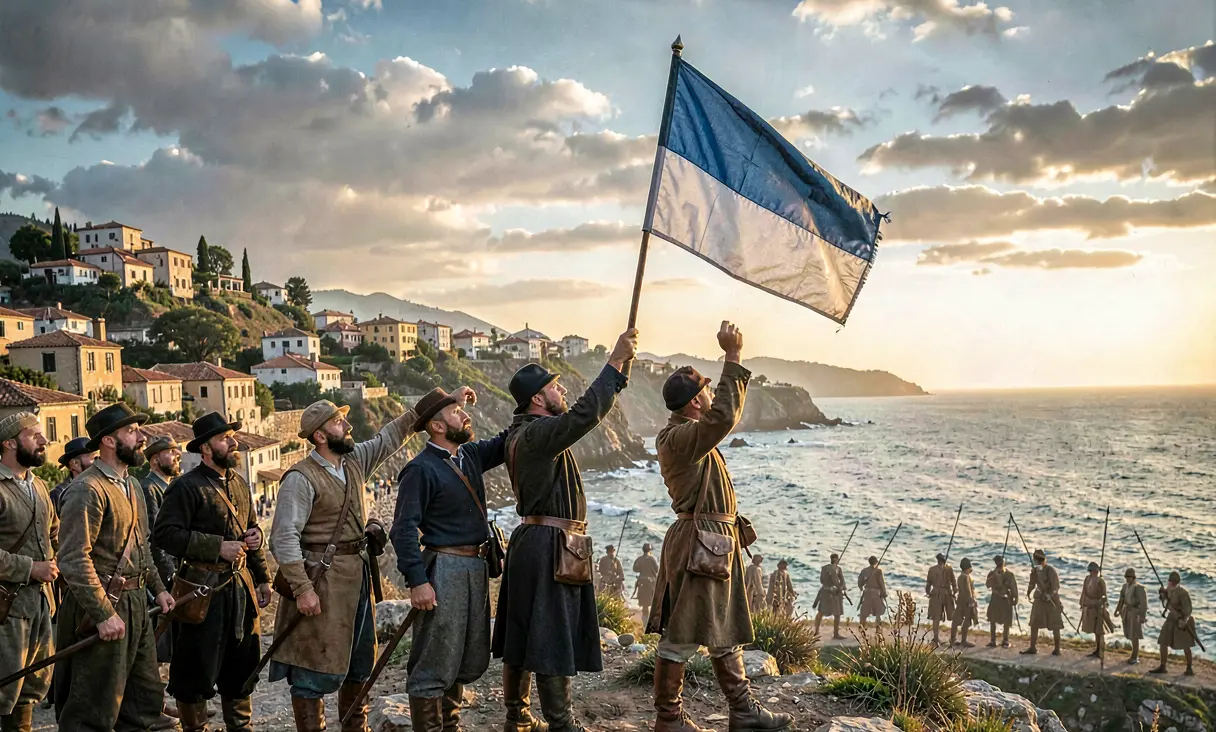
Greek War of Independence Begins
On March 25, 1821, Greeks ignited a revolution ending four centuries of Ottoman rule, securing independence through a brutal war and European intervention to forge the modern nation-state.
Centuries of Subjugation and the Rise of National Consciousness
By the early 19th century, the Ottoman Empire's grip on the Balkans was fraying under internal decay and external pressure. For nearly four centuries, the Greek-speaking populations of the Peloponnese, Central Greece, and the Aegean islands had lived under the millet system, a religious autonomy that preserved their Orthodox faith but denied them political sovereignty. The seeds of revolution were sown not merely in resentment of Ottoman taxation or local tyranny, but in the intellectual ferment of the Modern Greek Enlightenment (Diafotismos). Figures like Rigas Feraios and Adamantios Korais championed the idea of a secular nation-state rooted in classical antiquity, while secret societies began to coalesce. The most significant of these was the Filiki Eteria (Society of Friends), founded in Odessa in 1814 by Nikolaos Skoufas, Emmanuil Xanthos, and Athanasios Tsakalov. By 1820, the society had infiltrated Greek merchant communities across Europe and the Ottoman Empire, recruiting a network of conspirators ready to ignite a coordinated uprising.
The Spark in the Peloponnese
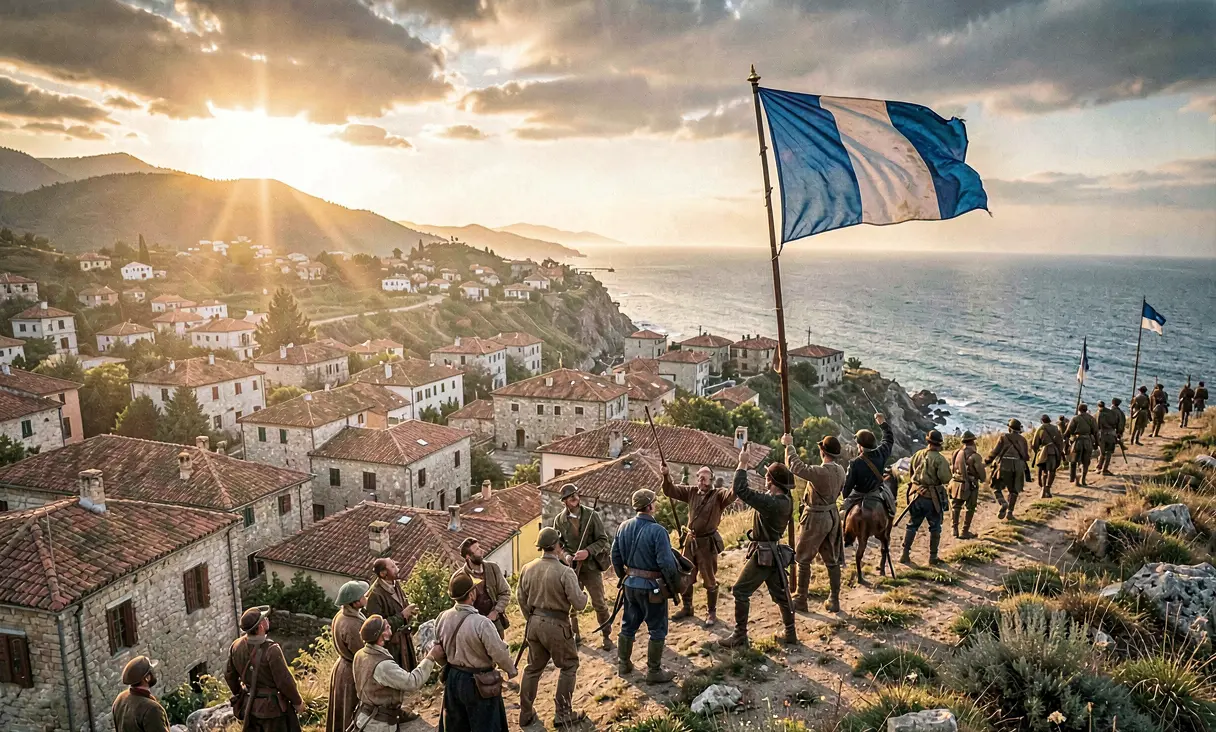
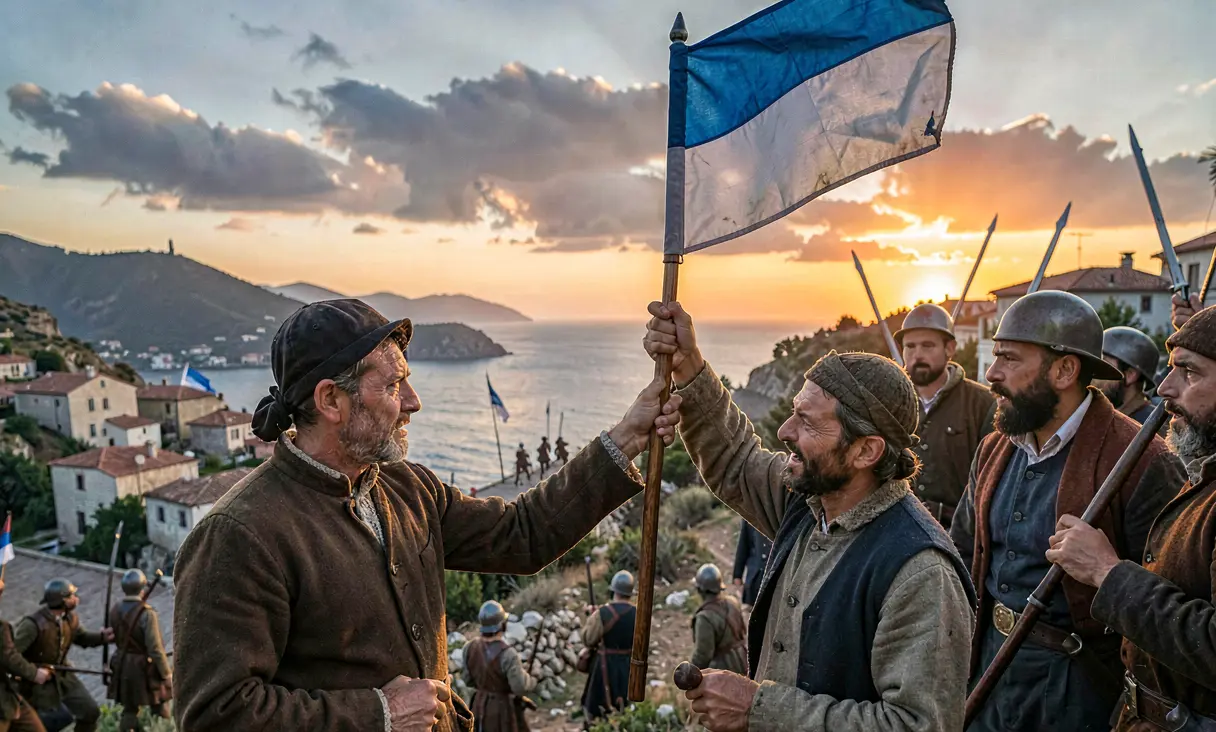
Although the Filiki Eteria initially planned a simultaneous revolt across the empire, the timeline accelerated when Alexander Ypsilantis, a Greek officer in the Russian service and leader of the society, crossed into Moldavia in February 1821. His premature uprising failed quickly, but it served as a catalyst for the Peloponnese. On March 6, 1821, Bishop Germanos of Patras is traditionally credited with raising the revolutionary flag at the Monastery of Agia Lavra, though historical debate persists regarding whether this specific ceremony occurred on that exact date or was a later symbolic construction. Regardless of the precise liturgical moment, the insurrection erupted in earnest across the Mani peninsula and the Peloponnese within days. Local chieftains (armatoloi) and peasant militias, fueled by religious fervor and nationalist rhetoric, besieged Ottoman garrisons in Tripoli, Nafplio, and Patras. The initial phase was marked by a brutal asymmetry: Greek forces, though numerically superior in the countryside, lacked heavy artillery and unified command, while Ottoman forces retreated to fortified citadels, awaiting reinforcements from Egypt and Anatolia.
Key Architects of Revolution
The war was driven by a complex alliance of disparate factions. The klephts and armatoloi, former irregular fighters who had long operated in the mountains, provided the initial military muscle; among them, Odysseas Androutsos emerged as a brilliant tactician in Central Greece. In the Peloponnese, the leadership was split between the ecclesiastical authority of Bishop Germanos and the secular notables (prokritoi) like Petrobey Mavromichalis, the bey of Mani, whose clan played a decisive role in the early victories. The naval dimension was secured by the islanders of Hydra, Spetses, and Psara, led by captains such as Andreas Miaoulis, whose fleet would dominate the Aegean for years. On the diplomatic front, Lord Byron became the most famous Philhellene, arriving in Greece in 1823 to support the cause with his wealth and prestige before dying of fever at Missolonghi in 1824, galvanizing European public opinion. Meanwhile, Tsar Alexander I initially hesitated due to his conservative stance on revolution but eventually shifted Russian policy under pressure from domestic Greek communities.
A War of Attrition and International Intervention
The conflict quickly devolved into a brutal war of attrition characterized by sieges, massacres, and naval blockades. The Ottoman response was ferocious; Sultan Mahmud II enlisted the help of Muhammad Ali Pasha of Egypt, whose modernized army and navy, led by his son Ibrahim Pasha, devastated the Peloponnese in 1825-1826, nearly crushing the rebellion. The fall of Missolonghi in April 1826 after a year-long siege became a symbol of Greek martyrdom. However, the war's turning point came through international intervention. Britain, France, and Russia, motivated by strategic interests and growing Philhellenic sentiment, signed the Treaty of London in July 1827, demanding an armistice. When the Ottomans refused, the allied fleets engaged the combined Ottoman-Egyptian fleet at the Battle of Navarino on October 20, 1827. In a single day of naval combat, the allies destroyed over sixty enemy ships without losing a single vessel of their own, effectively ending Ottoman naval supremacy in the region and forcing the Great Powers to recognize Greek autonomy.
The Path to Sovereignty
Following Navarino, the war entered a diplomatic phase punctuated by minor military actions. The Treaty of Adrianople (1829) between Russia and the Ottoman Empire formally recognized the independence of Greece, though its borders were initially limited to the Peloponnese and parts of Central Greece. Internal strife continued; the First National Assembly at Epidaurus in 1822 had declared independence but struggled with factionalism that led to civil wars between rival Greek leaders. It was not until the London Protocol of 1830 and the final Treaty of Constantinople in July 1832 that Greece was officially established as a sovereign, independent kingdom under international guarantee. Otto of Bavaria was installed as the first king, marking the transition from revolutionary chaos to state-building. The new kingdom began with a population of approximately 750,000 people and a territory far smaller than what modern Greeks consider their historical homeland.
Enduring Legacy and Global Resonance
The Greek War of Independence stands as the first successful nationalist uprising against the Ottoman Empire, shattering the myth of its invincibility and inspiring subsequent revolutions across the Balkans, including those in Serbia, Romania, and Bulgaria. It fundamentally altered the geopolitical map of Europe, introducing the concept of nation-states based on language and ethnicity rather than dynastic or religious allegiance into the Concert of Europe. The war also cemented the power of public opinion; it was arguably the first modern conflict where media coverage, poetry (by Byron), and artistic representation in Europe directly influenced foreign policy decisions. While the internal divisions and the brutal nature of the conflict left deep scars on Greek society that persisted for generations, the establishment of the modern Greek state provided a cultural anchor for the Hellenic world and remains a defining moment in the history of European nationalism.
This was the first successful nationalist uprising against the Ottoman Empire in Europe, inspiring similar movements across the Balkans and Mediterranean.
Where it happened
Peloponnese, Greece — see it on the interactive map →
Explore related history
 WarAlgerian War of Independence BeginsNovember 1, 1954 · Algiers, AlgeriaThe National Liberation Front launches coordinated attacks marking the start of the Algerian War against France.
 WarMau Mau Uprising Begins in KenyaOctober 20, 1952 · Nairobi, KenyaThe Kikuyu-led Mau Mau rebellion begins against British colonial rule and white settler land ownership.
 WarTurkish War of Independence BeginsMay 19, 1919 · Samsun, TurkeyMustafa Kemal Atatürk lands in Samsun to organize resistance against Allied occupation and the Ottoman Sultanate.
 PoliticsIndependence of Brazil DeclaredSeptember 7, 1822 · São Paulo, BrazilPrince Pedro I declares Brazil's independence from Portugal near the Ipiranga River.
 PoliticsChilean Constitution of 1823 and Conservative TurnAugust 1823 · Santiago, ChileChile adopts a new constitution that attempts to balance liberal ideals with strong executive power.
 WarSimón Bolívar's Crossing of the AndesJune 1819 · Andes Mountains, Colombia/Venezuela BorderBolivar leads his army over the frozen Andes to launch a surprise attack on Spanish forces in New Granada.
Discussion
Loading…