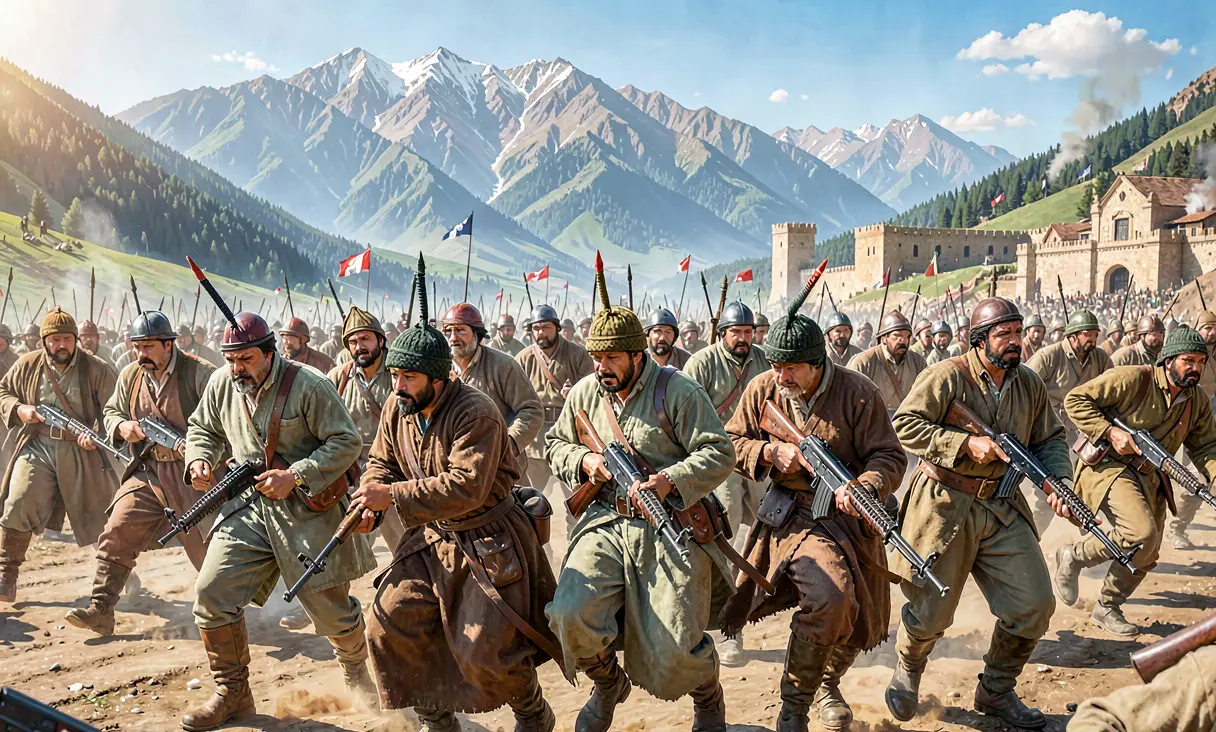
Battle of Adwa: Ethiopian Victory Over Italy
The Battle of Adwa secured Ethiopian independence by crushing an Italian invasion, standing as the sole decisive African victory against European colonialism during the Scramble for Africa.
The Scramble for Africa and the Treaty of Wuchale
By the late 19th century, the European 'Scramble for Africa' was in full swing, with Italy seeking to establish a colonial foothold in the Horn of Africa. In May 1889, Italy signed the Treaty of Wuchale with Emperor Menelik II of Ethiopia. The treaty's fatal flaw lay in its bilingual nature: the Italian version declared Ethiopia an Italian protectorate, while the Amharic version stated that Ethiopia merely had the option to use Italy for foreign affairs. When Menelik discovered this discrepancy in 1890, he formally repudiated the clause establishing a protectorate, asserting Ethiopia's full sovereignty. This diplomatic rupture set the stage for military confrontation, as Prime Minister Francesco Crispi's government in Rome resolved to enforce their interpretation by force, aiming to subjugate Ethiopia and secure its strategic position between Italian Eritrea and British Sudan.
Mobilization of a Coalition Empire
Unlike previous conflicts where regional lords acted independently, Menelik II successfully unified the fractious Ethiopian nobility into a formidable coalition. He leveraged his marriage to Empress Taytu Betul, whose political acumen and own military resources were crucial, to rally the Shewa, Gojjam, Tigray, and other provinces. By late 1895, Menelik had assembled a massive force estimated between 100,000 and 120,000 soldiers, equipped with modern rifles purchased from France and Russia, as well as artillery. In stark contrast, the Italian expeditionary force under General Oreste Baratieri numbered approximately 17,000 men, comprising Eritrean Askari troops and Italian regulars, many of whom were ill-equipped for high-altitude warfare in the harsh Ethiopian winter.
The Strategic Standoff at Adwa
In February 1896, Baratieri advanced from Eritrea into the Tigray region, eventually positioning his troops near the town of Adwa. The Italian forces occupied a series of hills overlooking a valley, but they were plagued by severe logistical failures; their supply lines were stretched thin, and morale was deteriorating due to cold and hunger. Despite advice from his subordinates to retreat or hold a defensive position, Baratieri felt pressured by political demands in Rome for a decisive victory. On the night of February 29, he made the fateful decision to launch a pre-dawn attack on three separate Ethiopian positions, intending to seize the high ground before dawn. However, the complex topography and poor intelligence led his columns to become separated and lost in the dark, leaving them vulnerable to the Ethiopian encirclement.
The Battle of March 1st
As the sun rose on March 1, 1896, the Italian brigades found themselves isolated in a valley rather than holding commanding heights. Menelik and Taytu, who had positioned their forces strategically around the perimeter, spotted the disorganized Italians and launched a coordinated counter-offensive. The Ethiopian army, utilizing their superior knowledge of the terrain and overwhelming numerical advantage, trapped the Italian columns in a pincer movement. Fierce fighting ensued throughout the day, with the Askari troops suffering heavy losses as they attempted to retreat toward the safety of Eritrea. By late afternoon, the Italian command structure had collapsed; General Baratieri fled the field, leaving his men to be decimated or captured. The battle resulted in a catastrophic defeat for Italy: approximately 7,000 Italians and 4,000 Askari were killed, while another 1,500 were taken prisoner, compared to roughly 7,000 Ethiopian casualties.
Diplomatic Resolution and Recognition
The crushing defeat at Adwa forced the Italian government to sue for peace immediately. In October 1896, the Treaty of Addis Ababa was signed, formally abrogating the Treaty of Wuchale and recognizing Ethiopia as a fully independent sovereign state within its historical borders. This diplomatic victory was unprecedented; it marked the first time an African nation had successfully resisted European colonization through military means during the height of the imperialist era. The treaty not only secured Ethiopia's independence but also established a clear boundary between Italian Eritrea and Ethiopia, solidifying Menelik II's status as a major regional power broker.
Legacy of African Sovereignty
The Battle of Adwa resonated far beyond the Horn of Africa, becoming a potent symbol of anti-colonial resistance worldwide. It shattered the myth of European invincibility and inspired independence movements across the continent and among the African diaspora in the Americas. For Ethiopia, it preserved its unique status as the only African nation to avoid formal colonization during the Scramble for Africa, allowing it to maintain its ancient traditions and political continuity. Today, Adwa is commemorated annually as a national holiday in Ethiopia, serving as a enduring testament to the power of unity and strategic foresight against overwhelming odds.
Adwa preserved Ethiopian sovereignty and became a potent symbol of Pan-African resistance and anti-colonial triumph globally.
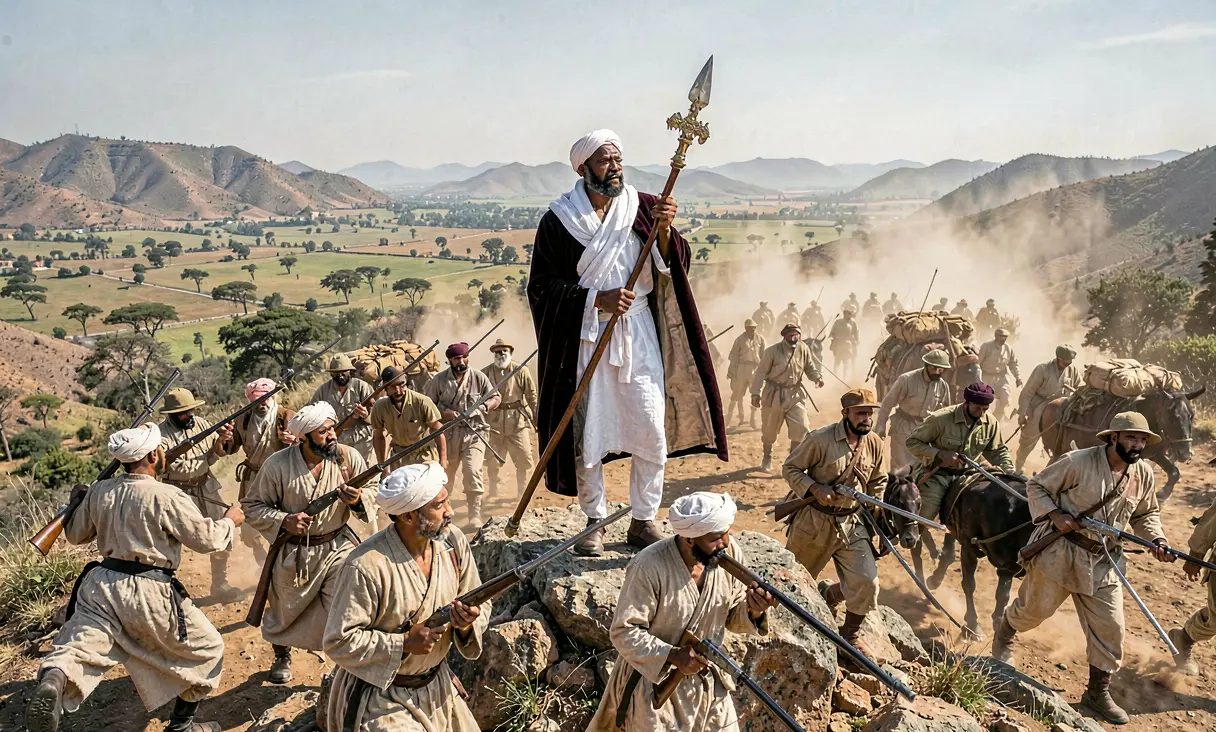

Where it happened
Adwa, Ethiopia — see it on the interactive map →
Explore related history
 WarAlgerian War of Independence BeginsNovember 1, 1954 · Algiers, AlgeriaThe National Liberation Front launches coordinated attacks marking the start of the Algerian War against France.
 WarMau Mau Uprising Begins in KenyaOctober 20, 1952 · Nairobi, KenyaThe Kikuyu-led Mau Mau rebellion begins against British colonial rule and white settler land ownership.
 WarTurkish War of Independence BeginsMay 19, 1919 · Samsun, TurkeyMustafa Kemal Atatürk lands in Samsun to organize resistance against Allied occupation and the Ottoman Sultanate.
 WarStart of the Cuban War of IndependenceFebruary 24, 1895 · CubaJosé Martí and Máximo Gómez launch a coordinated uprising against Spanish colonial rule in Cuba.
 DisasterCatastrophic Flooding at Mohenjo-Daroc. 1900 BCE · Mohenjo-Daro, Sindh, PakistanDevastating floods from the Indus River repeatedly buried and destroyed layers of Mohenjo-Daro, signaling the decline of the urban phase.
 WarBattle of Spion KopJanuary 24, 1900 · Natal, South AfricaBritish forces suffer a disastrous defeat against Boer commandos in the Second Boer War.
Discussion
Loading…