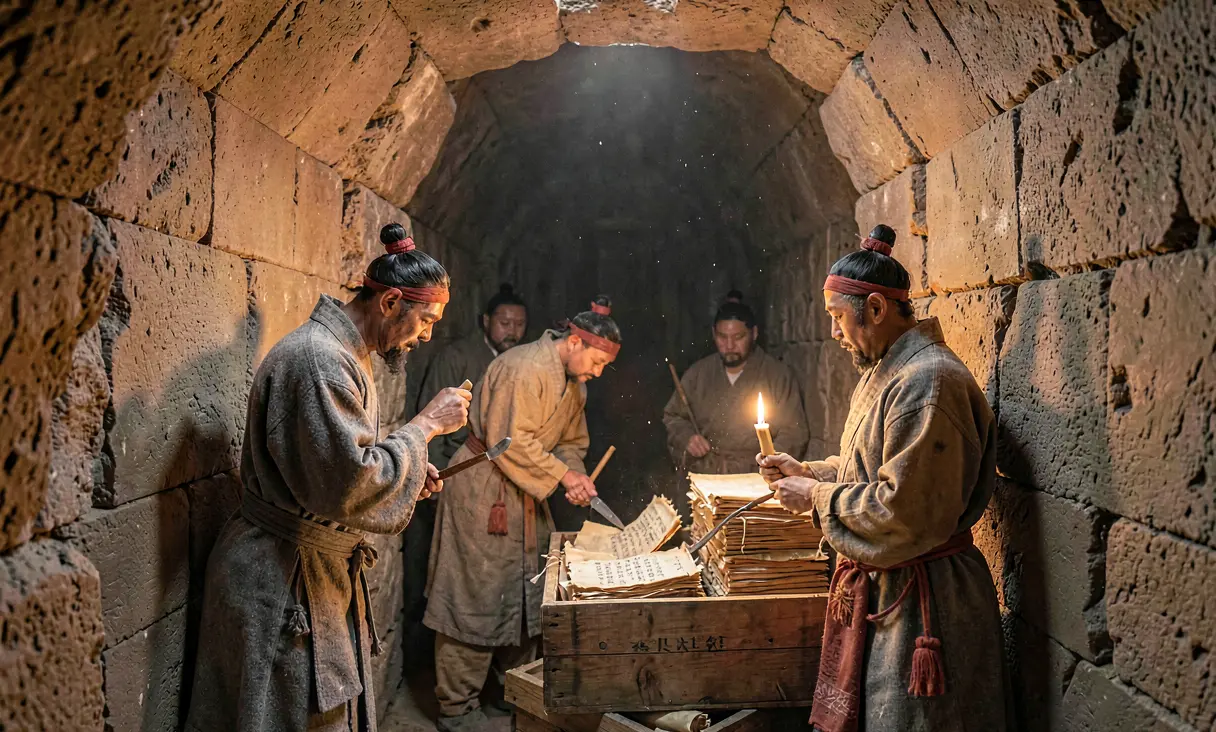
Sealing of the Dunhuang Library Cave
In c. 1035 CE, monks sealed Cave 17 at Dunhuang to protect 40,000 manuscripts from invading forces, preserving an unprecedented archive of Silk Road history that was rediscovered in 1900.
The Crossroads of Faith and Empire
By the early 11th century, Dunhuang stood as a precarious sentinel at the western edge of the Chinese cultural sphere, a vital node on the Silk Road where East met West. Once a flourishing hub under the Tang Dynasty, the region had since passed through the hands of the Tibetan Empire and local Cao families before facing the rising threat of the Western Xia (Tangut) kingdom. The Mogao Caves, carved into the cliff face near the Dang River, housed thousands of Buddhist statues and murals, but their most profound secret lay in a small antechamber known today as Cave 17. This space, originally created in the late 9th century to house the remains of the revered monk Hong Bian, had evolved over centuries into an ad hoc archive for the local monastic community.
The Imperative of Sealing
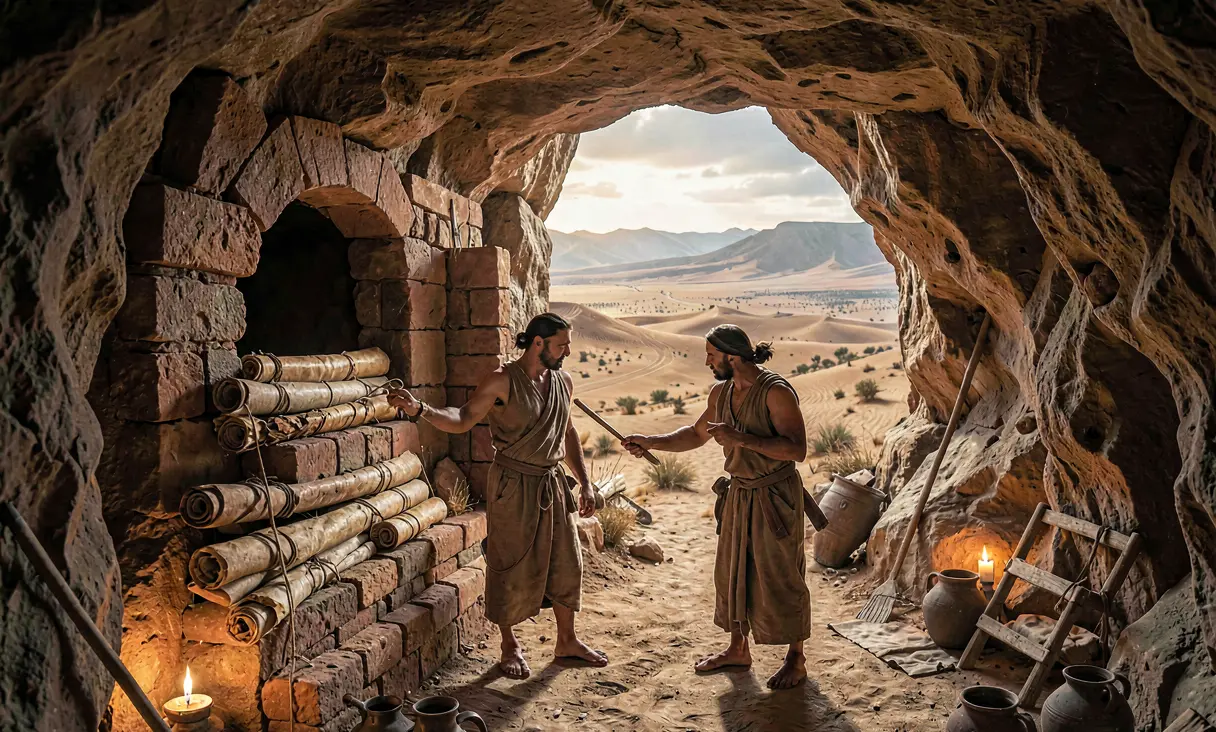
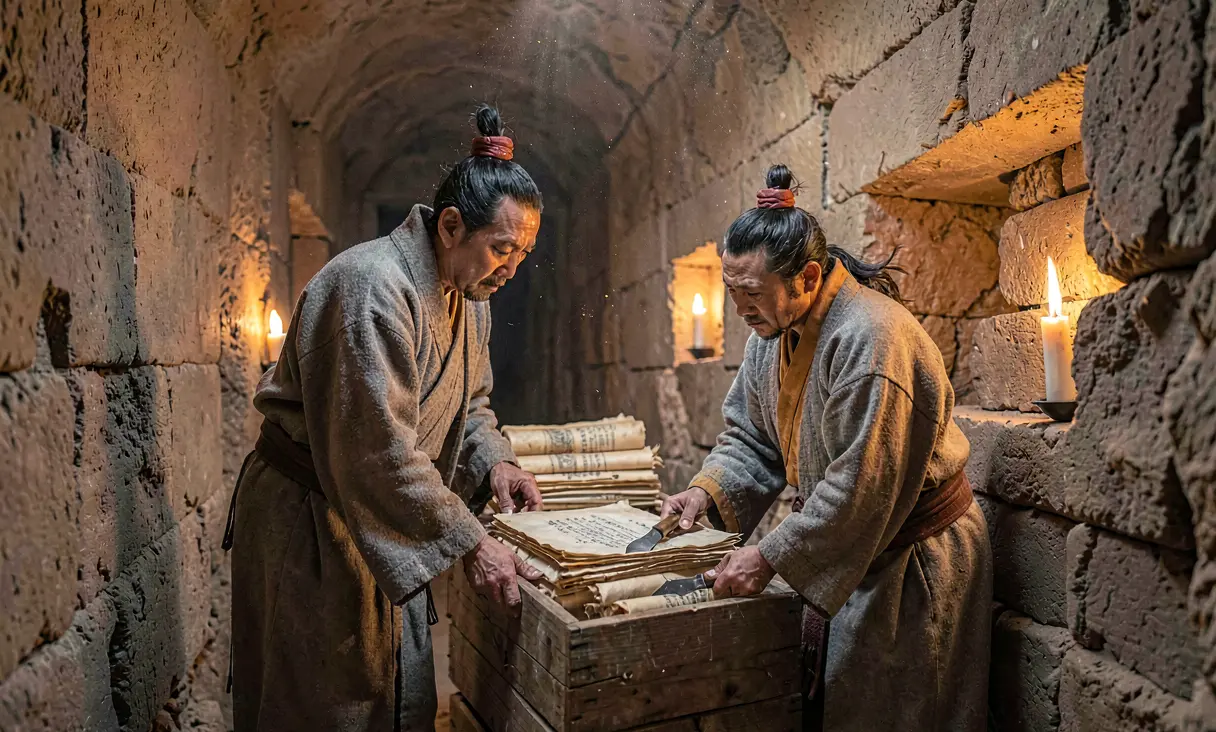
Historical consensus suggests that around 1035 CE, as Tangut forces under Emperor Jingzong of Western Xia advanced toward Dunhuang, the resident monks faced an existential crisis. Fearing the desecration or destruction of their sacred texts by invading armies, who were often hostile to Buddhist orthodoxy, the community made the desperate decision to seal the library cave. The process was swift and utilitarian: manuscripts, scrolls, paintings, and ritual objects were carefully stacked within the chamber until it was filled to capacity. A brick wall was then constructed across the entrance, plastered over with mud, and painted with murals that seamlessly matched the surrounding corridor, effectively erasing the existence of the archive from history.
The Hidden Trove
Inside the sealed darkness lay a time capsule of unparalleled density, containing an estimated 40,000 to 50,000 documents dating from the 4th to the early 11th centuries. These were not merely religious sutras; the collection represented a chaotic yet invaluable cross-section of medieval life. It included Buddhist scriptures in Chinese, Tibetan, Sanskrit, and Khotanese, alongside rare Christian Nestorian texts, Manichaean hymns, and Jewish prayer fragments. Secular records were equally abundant, featuring land deeds, tax registers, legal contracts, school primers, and medical treatises. The diversity of the collection provided a unique snapshot of the multiculturalism that defined the Silk Road, preserving voices from cultures that would otherwise have vanished without a trace.
Centuries of Silence
For nearly nine hundred years, Cave 17 remained undisturbed, its location forgotten even by the local population. The murals covering the entrance likely faded or were repainted during subsequent renovations, further obscuring the secret. Dunhuang itself gradually declined in importance as trade routes shifted and political power centers moved inland. The cave became a footnote in the collective memory of the region, a ghost story whispered among the monks but never investigated. It was not until the late Qing Dynasty that the site saw renewed attention, though the true nature of what lay behind the wall remained unknown to the outside world.
The Rediscovery
In June 1900, Daoist priest Wang Yuanlu, who had been tasked with maintaining the crumbling Mogao Caves, discovered the hidden chamber. While clearing debris from a corridor, he noticed a hollow sound when striking a section of the wall. Upon removing the bricks and peeling back the plaster, he revealed the narrow passage leading to the library cave. The discovery was immediate but initially mishandled; Wang, lacking the resources or scholarly context to preserve the vast collection, began selling manuscripts piecemeal to passing travelers and foreign explorers. This era of dispersal would eventually lead to the fragmentation of the archive across museums in London, Paris, St. Petersburg, and Beijing.
A Revolution in Historical Understanding
The unsealing of Cave 17 fundamentally altered the trajectory of medieval history studies, birthing the international discipline known as Dunhuangology. Prior to this discovery, much of the political and social history of Central Asia during the Tang and post-Tang periods was reconstructed from fragmentary official dynastic histories. The Library Cave provided primary source material that corrected, expanded, and sometimes contradicted established narratives. Scholars gained direct access to the daily lives of commoners, the evolution of religious syncretism, and the linguistic diversity of the Silk Road. The event transformed Dunhuang from a remote archaeological site into one of the most significant centers of historical research in the world.
Legacy of the Sealed Archive
The sealing of Cave 17 stands as a paradoxical act of destruction and preservation. While intended to hide knowledge from an enemy, it inadvertently saved that same knowledge from total erasure by time and neglect. The documents recovered have illuminated the complex interplay between empires, religions, and ethnic groups in medieval Asia, proving that the Silk Road was not merely a trade route but a conduit for profound intellectual exchange. Today, the scattered fragments of the Dunhuang manuscripts continue to fuel global scholarship, serving as a testament to the fragility of human culture and the enduring power of the written word.
The sealed Library Cave provided the most significant discovery of ancient manuscripts in the 20th century.
Where it happened
Dunhuang, China — see it on the interactive map →
Explore related history
 DisasterCollapse of Classic Maya Civilizationc. 900 CE · Tikal and Calakmul, Guatemala/MexicoMajor Maya city-states are abandoned due to drought, warfare, and ecological collapse during the Terminal Classic period.
 DisasterEcological Collapse and Drought Leading to Maya Declinec. 900 CE · Petén Basin, GuatemalaSevere drought and deforestation cause the collapse of Classic Maya civilization.
 DisasterOutbreak of the Black DeathOctober 1347 CE · Genoa, ItalyPlague arrives in Europe killing a third of the population and reshaping society.
 PoliticsPost-Chola War Reorganization1035 CE · Palembang, Sumatra (Modern Indonesia)Srivijaya reorganizes its administration after Chola raids.
 TechnologyMagnetic Compass Application for Navigation in Song Chinac. 1040 CE · Kaifeng, ChinaSong dynasty engineers create the first magnetic compass for maritime navigation.
 WarMahmud of Ghazni's Sack of Somnathc. 1026 CE · Somnath, Gujarat, IndiaMahmud of Ghazni leads a raid on the Somnath Temple, destroying the structure and looting its immense wealth to fund his empire.
Discussion
Loading…