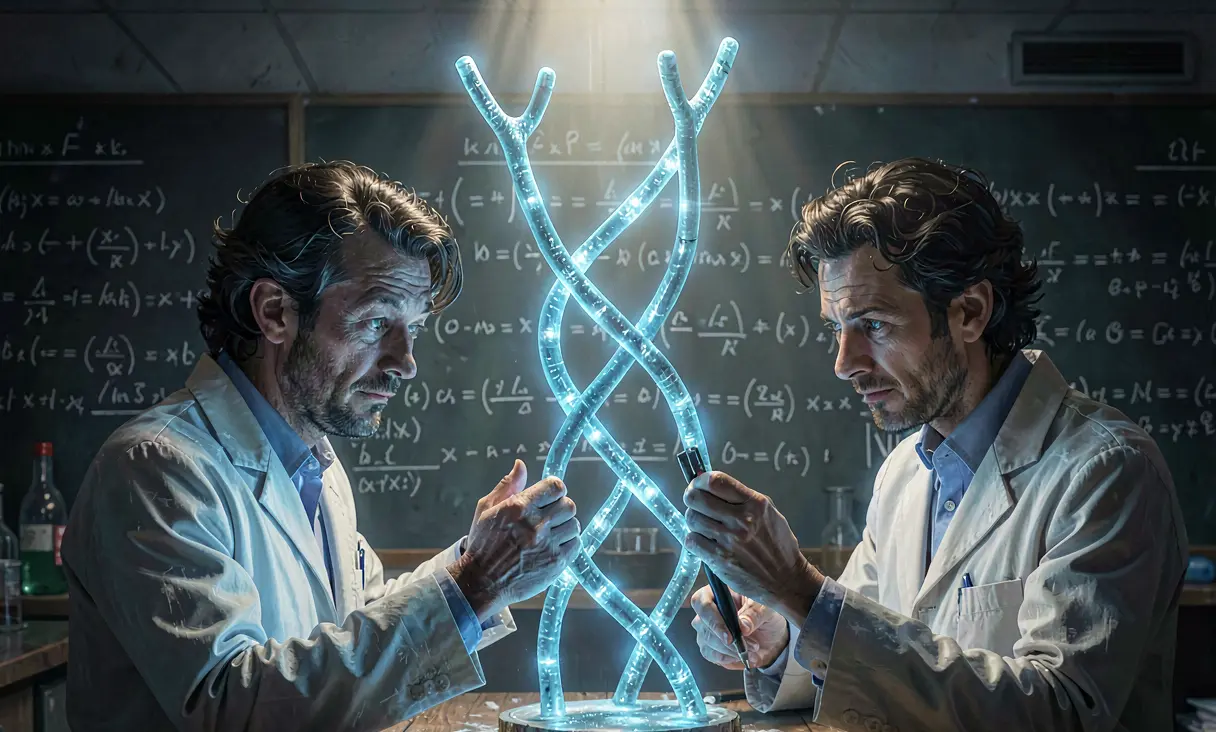
Discovery of DNA Structure
The 1953 discovery of DNA's double-helix structure by Watson and Crick, utilizing Franklin's data, unlocked the mechanism of genetic replication and birthed modern molecular biology.
The Quest for the Genetic Code
By the early 1950s, the biological community had established that deoxyribonucleic acid (DNA) was the carrier of genetic information, yet its physical architecture remained a profound mystery. In Cambridge, England, two distinct groups at the Cavendish Laboratory and King's College London were racing to solve this puzzle using X-ray crystallography, a technique capable of revealing atomic structures through diffraction patterns. While Linus Pauling in California was proposing an incorrect triple-helix model for DNA, the race intensified in Britain, driven by the realization that understanding the molecule's shape was the key to deciphering how life replicates and transmits hereditary traits.
Rosalind Franklin and the Critical Data
At King's College London, physicist Rosalind Franklin produced the most precise X-ray diffraction images of DNA fibers to date. Her meticulous work, particularly 'Photo 51' taken in May 1952 by her student Raymond Gosling under her supervision, revealed a distinct X-shaped pattern indicative of a helical structure with specific dimensions. Franklin's analysis correctly identified that the phosphate backbone lay on the outside and that DNA existed in two forms, A and B, but she remained cautious about declaring a definitive model without further evidence. Her data, characterized by its clarity and precision, became the linchpin upon which the final breakthrough would rest.
The Cambridge Rivalry
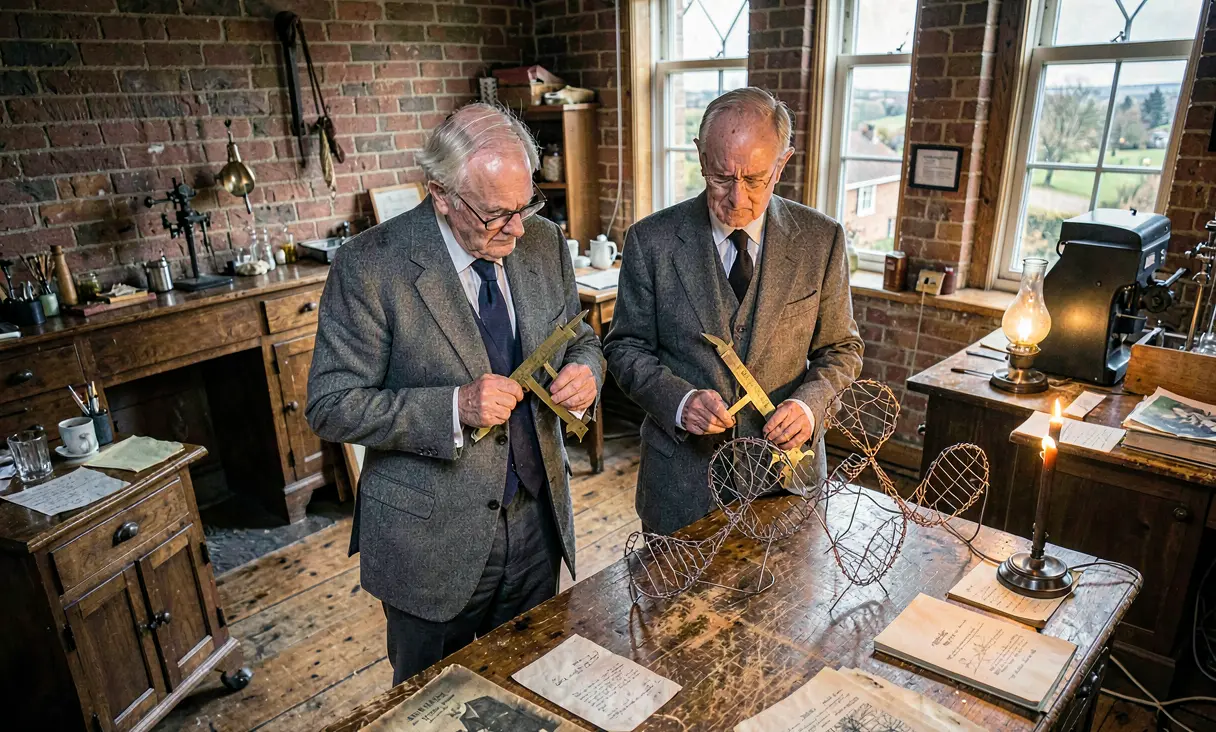
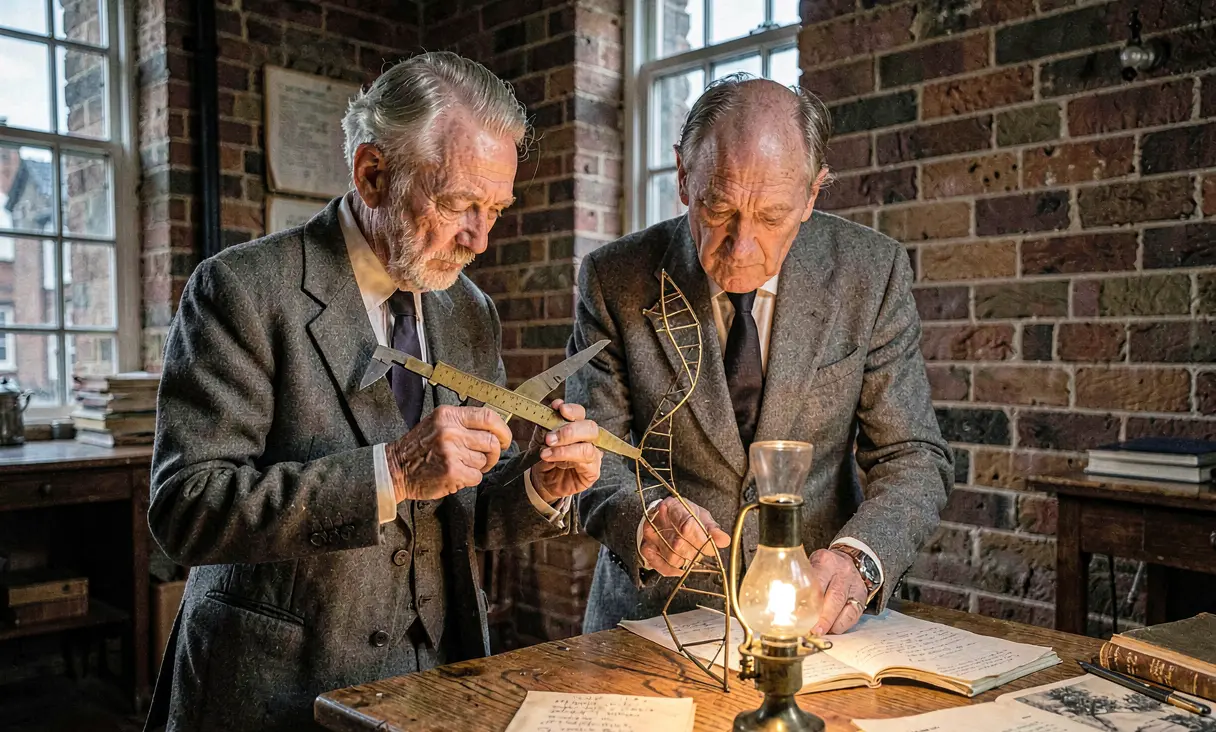
At the Cavendish Laboratory, James Watson, an American biologist, and Francis Crick, a British physicist, were constructing physical models to test structural hypotheses. Their approach was distinctively speculative; they built three-dimensional frameworks using metal rods and cardboard cutouts to visualize how atoms might fit together. Although they lacked Franklin's experimental data initially, their collaboration with Maurice Wilkins at King's College created an informal, albeit ethically fraught, channel of information. Wilkins, without Franklin's knowledge or consent, showed Watson Photo 51 in early 1953, providing the crucial geometric constraints needed to finalize their model.
The Breakthrough of February 28
On February 28, 1953, Watson and Crick achieved a moment of clarity that would alter the course of science. Using Franklin's measured dimensions for the helix diameter and the spacing between bases, combined with Chargaff's rules regarding base pairing ratios, they constructed a double-helix model where two strands ran in opposite directions (antiparallel). They realized that adenine paired specifically with thymine, and guanine with cytosine, held together by hydrogen bonds. This complementary base pairing immediately suggested a mechanism for replication: if the strands separated, each could serve as a template for a new partner strand, thus explaining the faithful transmission of genetic information.
Publication and Immediate Impact
The discovery was formally announced in the scientific journal *Nature* on April 25, 1953, in a brief but revolutionary paper titled 'Molecular Structure of Nucleic Acids: A Structure for Deoxyribose Nucleic Acid.' The article famously concluded with the understated remark, 'It has not escaped our notice that the specific pairing we have postulated immediately suggests a possible copying mechanism for the genetic material.' While the initial reaction within the small community was one of awe, it took time for the broader scientific world to grasp the full implications. Franklin's own paper, published in the same issue alongside Watson and Crick's, provided the experimental validation that their model required.
Legacy and the Dawn of Molecular Biology
The elucidation of the DNA double helix launched the era of molecular biology, fundamentally transforming medicine, agriculture, and our understanding of evolution. It paved the way for the sequencing of the human genome, the development of recombinant DNA technology, and modern genetic engineering techniques that have cured diseases and improved crop yields. In 1962, Watson, Crick, and Wilkins were awarded the Nobel Prize in Physiology or Medicine; Rosalind Franklin had passed away four years prior in 1958, and the Nobel rules preclude posthumous awards, leaving her critical contribution historically underrecognized for decades until a more nuanced appreciation of her role emerged.
A Defining Moment in Human History
The discovery stands as one of the most significant intellectual achievements of the 20th century, comparable to the splitting of the atom or the landing on the moon. It provided the physical basis for the central dogma of molecular biology—the flow of information from DNA to RNA to protein—unifying genetics and biochemistry into a single coherent framework. Today, as we navigate the complexities of gene editing and personalized medicine, the double helix remains the iconic symbol of life's fundamental code, representing a triumph of interdisciplinary collaboration and model-building that forever changed how humanity perceives its own origins.
It unlocked the secrets of heredity paving the way for biotechnology.
Where it happened
Cambridge, England — see it on the interactive map →
Explore related history
 ScienceLaunch of Hubble Space TelescopeApril 24, 1990 CE · Cape Canaveral, USASpace telescope deployed into orbit providing unprecedented deep space observations.
 TechnologyLaunch of Sputnik 1October 4, 1957 · Baikonur Cosmodrome, Kazakhstan (USSR)Soviet Union launches first artificial satellite, starting the Space Age.
 TechnologyInvention of the TransistorDecember 23, 1947 · Bell Labs, New Jersey, USAScientists create the transistor, enabling modern electronics and computing.
 WarAtomic Bombing of HiroshimaAugust 6, 1945 CE · Hiroshima, JapanUS drops the first nuclear weapon on a city, ending WWII and starting the atomic age.
Discussion
Loading…