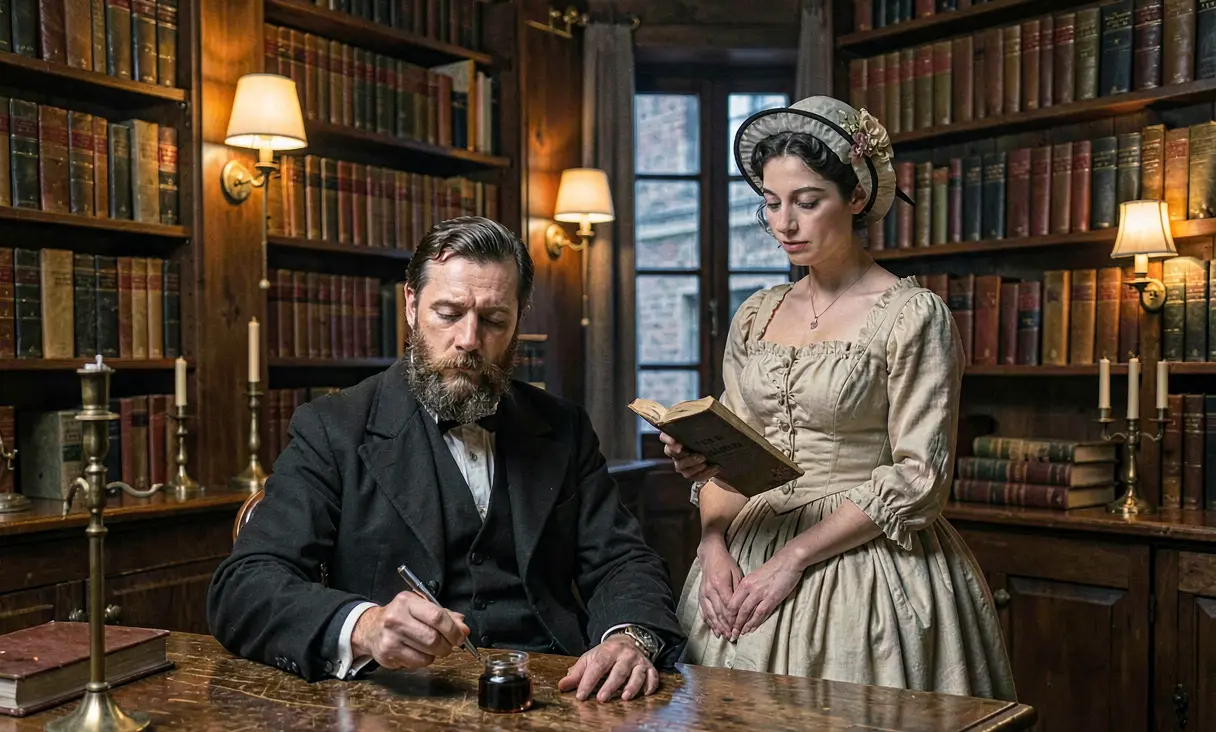
Publication of Origin of Species
Darwin's 1859 publication of 'On the Origin of Species' established natural selection as the driving force of life, shattering static creationist views and unifying all biology under a single evolutio
The Long Gestation of a Radical Idea
By the late 1850s, Charles Darwin had spent nearly two decades refining a theory that threatened to dismantle the static view of life held by Western civilization. Following his five-year voyage aboard HMS Beagle (1831–1836), during which he meticulously documented the biogeographical variations of finches in the Galápagos and fossils in South America, Darwin retreated to Down House in Kent. There, he conducted extensive experiments on barnacles and pigeon breeding, accumulating a mountain of evidence suggesting that species were not immutable creations but dynamic entities shaped by environmental pressures. Despite the urgency of his findings, fear of public backlash and professional ostracization kept him silent until 1858, when Alfred Russel Wallace independently conceived a nearly identical mechanism of natural selection, prompting Darwin's allies Charles Lyell and Joseph Hooker to arrange a joint presentation at the Linnean Society.
The Publication of November 24
On November 24, 1859, John Murray, a prominent London publisher, released the first edition of 'On the Origin of Species by Means of Natural Selection, or the Preservation of Favoured Races in the Struggle for Life.' The initial print run consisted of 1,250 copies, all of which were sold out on the very day of publication. Unlike the dense, academic treatises typical of the era, Darwin's prose was accessible and persuasive, weaving together geology, embryology, and taxonomy into a coherent narrative. He deliberately avoided the term 'evolution' in the first edition, preferring to describe 'descent with modification,' yet his central thesis was unmistakable: all life shares a common ancestry, and the diversity of organisms is the result of a blind, non-teleological process driven by the differential survival of individuals possessing advantageous traits.
The Intellectual Landscape and Immediate Reaction
The scientific community was initially divided but rapidly coalesced around Darwin's framework. While some naturalists, such as the paleontologist Richard Owen, remained skeptical or hostile, others like Thomas Henry Huxley—soon to be dubbed 'Darwin's bulldog'—recognized the theory's explanatory power. The book did not merely propose a mechanism for change; it unified disparate biological fields under a single logical structure, rendering previous explanations based on divine design insufficient. The immediate public reaction was a mixture of fascination and outrage. Religious authorities condemned the work as heretical for removing humanity from its special place in creation, while the general public was captivated by the implications of human ancestry shared with apes, a topic Darwin only hinted at in the famous concluding line: 'There is grandeur in this view of life.'
The Great Debate and Social Controversy
The controversy ignited by the Origin quickly spilled beyond academic journals into the public sphere, culminating in the famous 1860 debate at the Oxford University Museum between Huxley and Bishop Samuel Wilberforce. Although often mythologized as a physical confrontation over whether Huxley was descended from an ape on his grandmother's or grandfather's side, the exchange was actually a rigorous intellectual clash regarding the evidence for natural selection versus the argument from design. This period marked a turning point in the relationship between science and religion in Victorian England, forcing society to confront the possibility that moral and biological laws operated independently of divine intervention. The debate polarized opinion but ultimately cemented the theory's place at the center of modern intellectual discourse.
Legacy and the Unification of Biology
Within a few decades, Darwin's hypothesis became the central organizing principle of biology, transforming it from a descriptive cataloging of nature into an explanatory science. The theory provided the necessary context for understanding genetics, which was later reconciled with natural selection in the 'Modern Synthesis' of the 1930s and 40s. Today, every aspect of life sciences, from epidemiology to conservation biology, relies on the foundational concept that species change over time through adaptation. The publication of November 24, 1859, stands not merely as a scientific milestone but as one of the most significant cultural events in human history, fundamentally altering humanity's perception of its origins and its relationship with the natural world.
It fundamentally changed humanity's understanding of its own biological origins.
Where it happened
London, England — see it on the interactive map →
Explore related history
 DisasterGreat Famine of India (1876-1878)November 1, 1876 · Southern IndiaDrought and British policy cause mass starvation in India.
 WarFirst Opium War BeginsSeptember 4, 1839 · Guangzhou, ChinaBritain forces open Chinese trade via war, beginning the Century of Humiliation.
 ArtCreation of The Great Wave off Kanagawac. 1831 CE · Kanagawa, JapanHokusai produces iconic woodblock print influencing Western art movements.
Discussion
Loading…