
Ming Occupation of Vietnam Ends
In 1427, Le Loi's forces annihilated a massive Ming relief army at Dong Da, forcing China to withdraw and restoring Vietnamese independence after two decades of brutal occupation.
The Weight of Foreign Rule
Following the collapse of the Ho Dynasty in 1407, the Ming Empire annexed Vietnam, establishing the province of Jiaozhi and imposing direct Chinese administrative control. For two decades, the Vietnamese people endured a harsh regime characterized by forced cultural assimilation, heavy taxation, and the systematic dismantling of local institutions. The Ming occupation sparked intermittent resistance, but it was not until 1418 that Le Loi, a wealthy landowner from Lam Kinh in Thanh Hoa province, launched the Lam Son Uprising. What began as a localized rebellion evolved into a protracted national struggle, utilizing guerrilla tactics to harass Ming supply lines and erode the occupier's morale across the rugged terrain of northern Vietnam.
The Siege of Dong Da
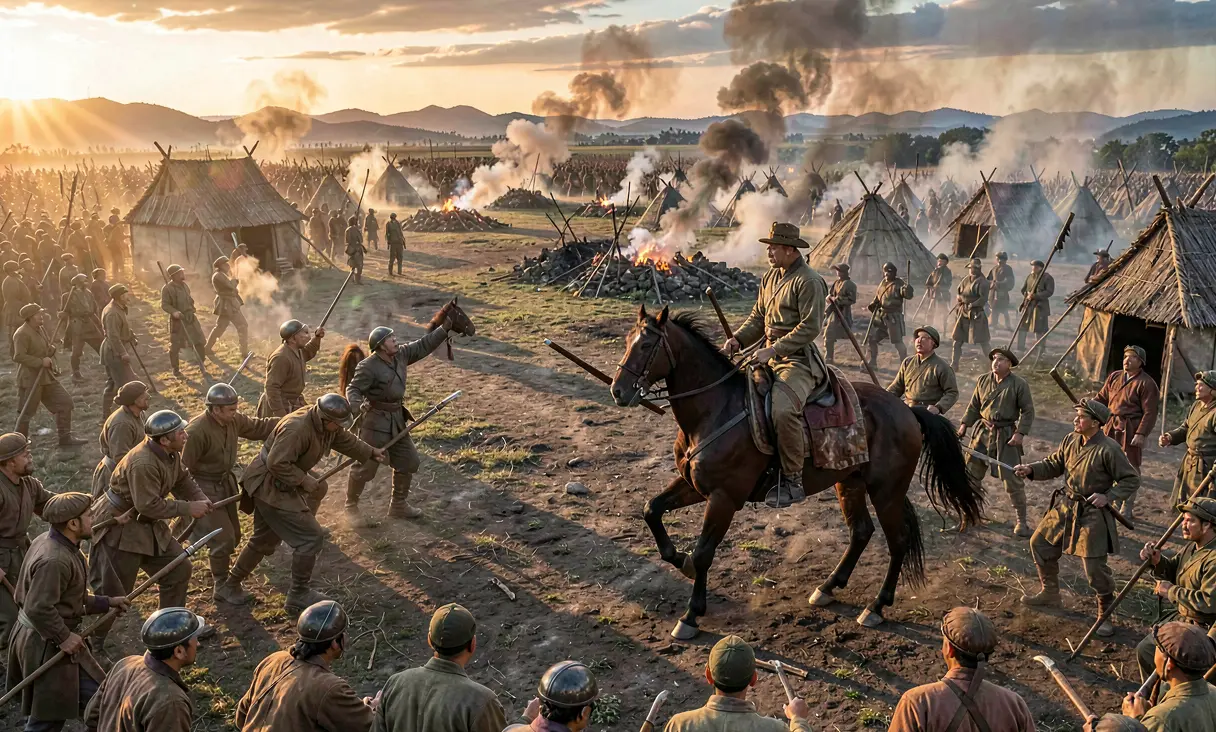
By late 1427, the conflict reached its climactic phase. The Ming commander in Jiaozhi, Wang Tong, found his forces trapped within the fortified city of Dong Da (modern-day Hanoi) and the nearby citadel of Xuan Hoa. Anticipating a massive relief force from Guangxi under the command of General Liang De and Mu Sheng, Le Loi orchestrated a masterful trap in the dense forests of Chi Lang and the narrow passes near Dong Da. In November 1427, as the Ming relief army advanced, Le Loi's forces feigned retreat, drawing the numerically superior enemy into an ambush. The terrain was meticulously prepared with bamboo spikes and hidden trenches, turning the forest floor into a killing ground.
Architects of Victory
The strategic brilliance behind the victory lay in the partnership between Le Loi, the charismatic leader who unified disparate rebel factions under the banner of restoring the Tran Dynasty, and his brilliant strategist Nguyen Trai. While Le Loi provided the moral authority and military command, Nguyen Trai devised the psychological warfare that would ultimately break the Ming resolve. He authored letters to Wang Tong urging him to surrender, arguing that further resistance was futile and that the Ming court had lost the Mandate of Heaven in Vietnam. This combination of battlefield cunning and diplomatic pressure proved fatal to the Ming occupation's cohesion.
The Decisive Ambush
The Battle of Dong Da unfolded with devastating efficiency for the Ming forces. As Liang De's column entered the ambush zone, Le Loi's troops launched a coordinated assault from all sides, utilizing crossbows and fire arrows to disrupt the enemy formation before engaging in hand-to-hand combat. The relief army was decimated; historical records indicate that tens of thousands of Ming soldiers were killed or captured, including high-ranking generals. Simultaneously, Mu Sheng's column, hearing of the disaster, halted its advance and retreated in disarray. With their reinforcements annihilated and supply lines severed, Wang Tong faced a desperate choice: fight to the death or negotiate a withdrawal.
The Withdrawal and Restoration
Recognizing the futility of holding Jiaozhi without military support and facing growing unrest within China itself, the Ming court acceded to Le Loi's terms. In early 1428, Wang Tong formally surrendered, and the remaining Ming garrisons were permitted to withdraw under a truce that guaranteed their safe passage back to China. This marked the definitive end of two decades of foreign rule. On April 15, 1428, Le Loi proclaimed himself Emperor Le Thai To, establishing the Later Le Dynasty and restoring Vietnam's sovereignty as Dai Viet. The event was not merely a military victory but a diplomatic triumph that forced one of the world's great powers to acknowledge Vietnamese independence.
A Legacy of Sovereignty
The end of the Ming Occupation stands as a defining moment in Southeast Asian history, demonstrating that a smaller nation could successfully resist a superpower through asymmetric warfare and strategic patience. The victory solidified Le Loi's status as a national hero, revered alongside figures like the Tran emperors who repelled Mongol invasions. It set a precedent for Vietnamese resistance against foreign domination that would echo through centuries of subsequent conflicts with China, France, and the United States. The restoration of 1428 ushered in a golden age of culture and administration under the Later Le Dynasty, preserving distinct Vietnamese identity and political autonomy.
It concluded two decades of Ming occupation and restored Vietnamese sovereignty.

Where it happened
Dong Da (Hanoi), Vietnam — see it on the interactive map →
Explore related history
 WarIslamic Conquest of the Sasanian Empire637 CE · Ctesiphon, Iraq (Persia)Arab Muslim forces defeat the Sasanian Empire at the Battle of al-Qadisiyyah, ending centuries of Persian rule.
 WarViking Siege of Paris885 CE · Paris, FranceViking raiders led by Sigfred besiege Paris for over a year, testing the defenses of West Francia.
 WarChola Conquest of Sri Lankac. 993 CE · Anuradhapura, Sri LankaRajaraja Chola launches a massive amphibious invasion of Sri Lanka, defeating the Sinhalese kingdom and annexing the island.
 PoliticsLe Loi Crowned Emperor of Dai Viet1428 CE · Hanoi (Thang Long), VietnamLe Loi is crowned Le Thai To, founding the Later Le Dynasty.
 WarFall of Angkor Thom to Ayutthaya1431 CE · Angkor Thom, CambodiaAyutthaya forces sack Angkor Thom, leading to the empire's relocation.
 TechnologyExpansion of Aztec Chinampa Agriculturec. 1420 CE · Lake Xochimilco, Mexico CityThe Aztecs expand the chinampa system to feed Tenochtitlan's massive population with highly productive artificial islands.
Discussion
Loading…