
Chola Invasion of Srivijaya
In 1025 CE, Rajendra Chola I's naval raid shattered Srivijaya's monopoly on the Strait of Malacca, opening direct India-China trade routes and reshaping Southeast Asian geopolitics.
The Maritime Hegemony of Srivijaya
By the early 11th century, the Srivijaya Empire, centered in Palembang on the island of Sumatra, had established itself as the dominant maritime power in Southeast Asia. Controlling the strategic Strait of Malacca and the Sunda Strait, Srivijaya acted as the indispensable gateway for trade between the Indian Ocean and the South China Sea. The empire's wealth was derived not from territorial conquest alone but from its ability to tax and regulate the flow of spices, silk, and precious metals moving between India, China, and the archipelago. However, this monopoly came at a cost; Srivijaya increasingly imposed heavy tariffs on foreign merchants and occasionally harassed vessels that refused to dock in their ports for inspection or tribute. This aggressive protectionism began to chafe against the expanding commercial ambitions of the Chola dynasty in southern India.
Rajendra Chola I's Strategic Ambition
Rajendra Chola I, who ascended the throne around 1014 CE following his father Rajaraja Chola I, was a ruler of unparalleled naval vision. Having already consolidated the Tamil kingdom and expanded its influence across the Bay of Bengal to Sri Lanka and the Maldives, Rajendra sought to break the stranglehold that Srivijaya held over Indian trade routes. The Cholas were not merely reacting to harassment; they aimed to establish direct maritime links with China, bypassing the intermediate layers of taxation imposed by Southeast Asian intermediaries. Inscriptions from the period reveal that Rajendra viewed the control of the sea lanes as essential for the economic vitality of his empire, prompting him to assemble a massive armada capable of projecting power thousands of miles from the Coromandel Coast.
The Expedition of 1025 CE
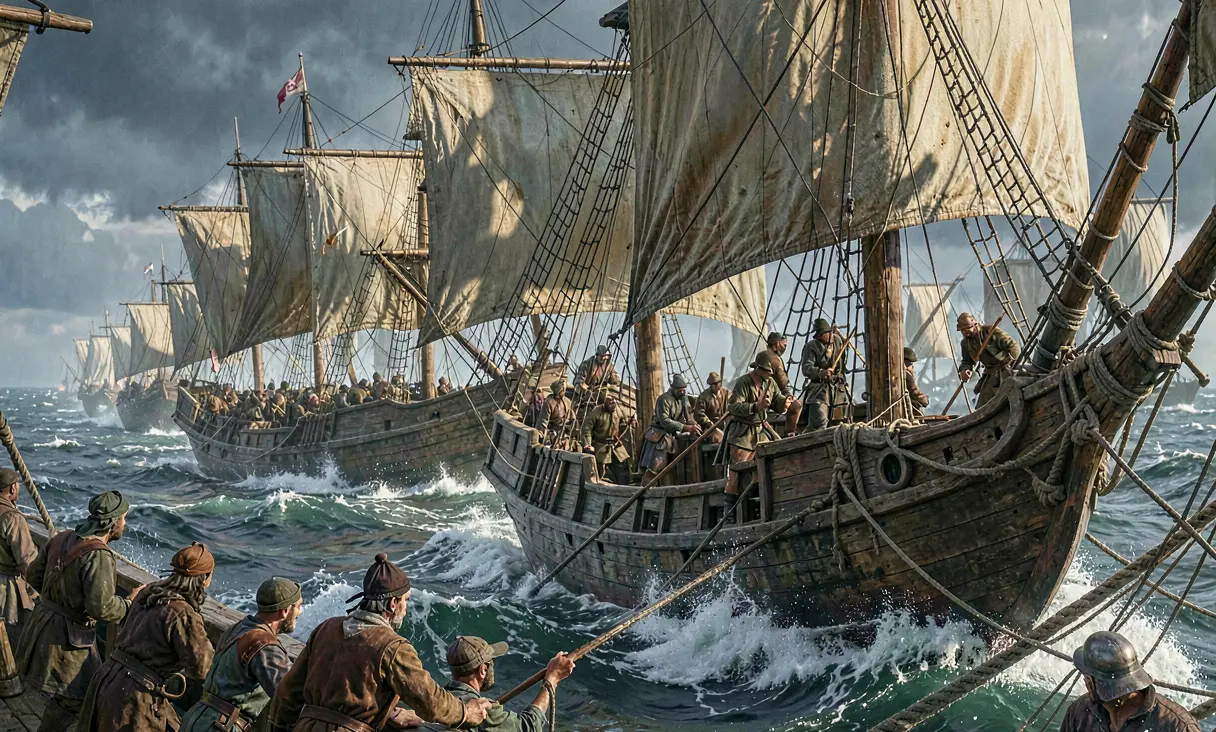
In 1025 CE, Rajendra Chola launched one of the most audacious naval campaigns in pre-modern history. The Chola fleet, described in the Thanjavur inscriptions as comprising hundreds of warships, sailed across the Bay of Bengal and into the South China Sea. Their target was the heart of the Srivijaya Empire: the port city of Palembang. The attack was swift and devastating. The Cholas bypassed traditional diplomatic overtures, striking directly at the capital with overwhelming force. King Sangrama Vijayatungavarman, the ruler of Srivijaya at the time, was captured during the assault, a humiliation that signaled the collapse of the empire's defensive perimeter. The raiders systematically sacked Palembang and other key ports, including Kadaram (Kedah) on the Malay Peninsula, seizing immense quantities of gold, jewels, and religious artifacts.
The Collapse of Srivijayan Authority
The campaign was not an attempt at permanent territorial annexation; rather, it was a punitive strike designed to shatter the political and economic confidence of the rival empire. The capture of King Sangrama Vijayatungavarman served as a potent symbol of Chola supremacy. Following the raid, the Cholas withdrew, leaving behind a fractured Srivijaya that struggled to reassert its authority over the archipelago. The sudden vacuum of power allowed local polities in Sumatra and Java to assert greater autonomy, leading to a period of fragmentation within the region. While Srivijaya eventually recovered enough to remain a significant player for another century, it never fully regained its former hegemony or its absolute control over the Strait of Malacca.
Economic Realignments and Direct Trade
The immediate aftermath of the invasion was a dramatic shift in maritime economics. With Srivijaya's grip loosened, Indian merchants found it easier to navigate the straits without paying exorbitant fees or submitting to local inspections. The Chola victory effectively opened direct trade channels between India and China, fostering a new era of exchange that bypassed the traditional intermediaries. This shift is evidenced by the surge in Chinese records mentioning Indian traders and the increased flow of Tamil merchants into Southeast Asian ports. The raid demonstrated that naval power could be projected across vast distances to alter the geopolitical landscape, proving that the Indian Ocean was no longer a domain solely controlled by local Southeast Asian kingdoms.
Legacy of the Chola Naval Supremacy
The invasion of Srivijaya remains a defining moment in the history of Indian Ocean trade and naval warfare. It stands as the only instance in recorded history where an Indian power launched a major offensive expedition into Southeast Asia, showcasing the sophistication of Chola shipbuilding and logistics. The event is immortalized in the Tiruvalangadu plates, which list fifteen conquered kingdoms, including Kadaram, as part of Rajendra's conquests. Beyond the military achievement, the raid facilitated a cultural exchange that deepened the influence of Hinduism and Buddhism across the region, even as it marked the beginning of Srivijaya's gradual decline. It serves as a testament to the interconnectedness of the medieval world, where trade disputes could escalate into transoceanic wars.
The raid shattered Srivijaya's monopoly on Southeast Asian trade and established Chola influence as a major factor in the Indian Ocean economy.


Where it happened
Palembang, Sumatra, Indonesia — see it on the interactive map →
Explore related history
 WarIslamic Conquest of the Sasanian Empire637 CE · Ctesiphon, Iraq (Persia)Arab Muslim forces defeat the Sasanian Empire at the Battle of al-Qadisiyyah, ending centuries of Persian rule.
 WarViking Siege of Paris885 CE · Paris, FranceViking raiders led by Sigfred besiege Paris for over a year, testing the defenses of West Francia.
 WarChola Conquest of Sri Lankac. 993 CE · Anuradhapura, Sri LankaRajaraja Chola launches a massive amphibious invasion of Sri Lanka, defeating the Sinhalese kingdom and annexing the island.
 WarRajendra Chola I's Ganges Expeditionc. 1025 CE · Bengal to Ganges Delta, IndiaRajendra Chola I leads a northern expedition reaching the Ganges River, defeating Pala kings and bringing holy water back to Thanjavur.
 ExplorationChola Naval Expedition to Southeast Asia1025 CE · Java and Sumatra (Modern Indonesia)Chola fleet raids coastal cities across the archipelago.
 WarRajendra Chola I's Expedition to Southeast Asiac. 1025 CE · Kedah (modern Malaysia)Chola Emperor Rajendra I launches a massive naval raid on Srivijaya, projecting Indian power across the Bay of Bengal.
Discussion
Loading…