
Chola Naval Expedition Against Srivijaya
Rajendra Chola I's 1025 CE naval raid shattered Srivijayan control over the Malacca Strait, securing Indian Ocean trade routes for Tamil merchants and reshaping Southeast Asian geopolitics.
The Strategic Stakes of the Malacca Strait
By the early 11th century, the maritime trade routes connecting the Han Dynasty in China with the Abbasid Caliphate and the Indian subcontinent were dominated by the Srivijaya Empire. Centered in Palembang on the island of Sumatra, this thalassocracy controlled the critical choke points of the Malacca and Sunda Straits, levying heavy tolls on merchant vessels and effectively strangling the economic ambitions of rival powers. The Chola dynasty, under the rule of Rajendra Chola I (who succeeded his father Rajaraja Chola I), viewed these tariffs not merely as an inconvenience but as a direct threat to their own burgeoning maritime commerce. The Cholas sought to secure safe passage for Tamil merchants and break the Srivijayan monopoly on spices, gold, and exotic woods that flowed through these waters.
The Expedition of 1025 CE
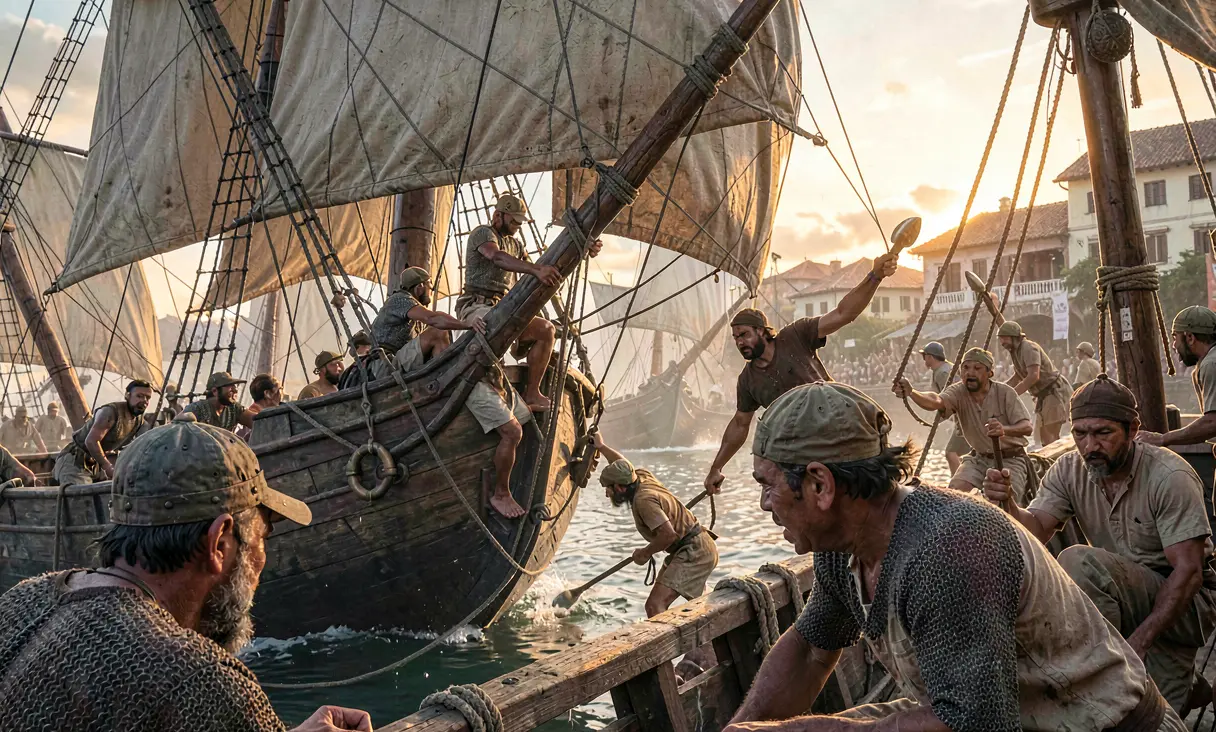
In 1025 CE, Rajendra Chola I launched what is historically recorded as the most ambitious naval campaign in pre-modern Indian history. Unlike previous regional conflicts fought on land, this was a massive amphibious assault designed to project power across the Bay of Bengal and into the Indonesian archipelago. The Chola fleet, comprising hundreds of warships and thousands of seasoned soldiers, sailed south with unprecedented logistical precision. Their targets were explicitly defined: Kadaram (modern Kedah in Malaysia), the port city of Palembang, and other key Srivijayan strongholds along the Sumatran coast. The sheer scale of this operation demonstrated a level of naval organization and maritime capability that had rarely been seen in the Indian Ocean world.
Key Figures: Rajendra Chola I and the Fall of Srivijaya
The architect of this campaign was Emperor Rajendra Chola I, a ruler whose inscriptions boastfully detail his conquests stretching from the Ganges to the ocean. While historical records do not name specific Srivijayan commanders who fell in battle, the campaign is often associated with the weakening of the Sailendra dynasty that ruled Srivijaya at the time. Rajendra's forces moved with surgical speed, bypassing traditional land sieges to strike directly at the heart of the enemy's economic power. The Chola king later claimed in his Gangaikonda Cholapuram inscriptions that he had captured the 'king of Kadaram' and plundered the treasures of Srivijaya, effectively reducing a major regional hegemon to vassalage.
The Campaign Unfolds: Sacking Palembang
The military operation unfolded with devastating efficiency. The Chola fleet first secured the northern approaches at Kadaram before turning their full attention to Sumatra. They landed near Palembang, the capital of Srivijaya, and engaged in fierce combat that resulted in the sacking of the city. Archaeological evidence and contemporary chronicles suggest that the Cholas looted vast quantities of gold, jewels, and religious artifacts, including those from the great Buddhist monasteries that had made Palembang a center of learning. The assault was not merely a raid but a systematic dismantling of Srivijaya's administrative and military infrastructure, leaving the empire unable to enforce its tolls or protect its trade routes for decades.
Immediate Aftermath and Political Realignment
The immediate consequence of the 1025 expedition was the collapse of Srivijayan hegemony. The empire, which had dominated Southeast Asian politics for centuries, fractured into smaller, competing principalities that were unable to coordinate a unified defense or re-establish control over the straits. While the Cholas did not establish a permanent colonial administration in Sumatra, they successfully forced the remaining local rulers to acknowledge their suzerainty and pay tribute. This shift in power dynamics opened the Indian Ocean trade network to Tamil merchants, who could now navigate the Malacca Strait without fear of arbitrary confiscation or extortion by Srivijayan authorities.
Legacy: The Apex of Chola Naval Power
The Chola naval expedition stands as a defining moment in the history of Indian Ocean geopolitics, marking the zenith of South Indian maritime power. It demonstrated that an Asian land empire could project force thousands of miles from its capital to reshape international trade networks. Although Srivijaya eventually recovered and re-emerged as a significant power in later centuries, it never fully regained its former dominance. The campaign facilitated a golden age of cultural exchange between India and Southeast Asia, evidenced by the proliferation of Tamil merchant guilds like the Ainnurruvar and the enduring influence of Chola art and architecture in the region.
It marked the first major projection of South Indian naval power into Southeast Asia, reshaping global trade dynamics in the medieval period.

Where it happened
Palembang, Sumatra, Indonesia — see it on the interactive map →
Explore related history
 ExplorationViking Settlement of Iceland874 CE · Reykjavik, IcelandNorse explorers led by Ingólfr Arnarson settle Iceland, establishing the first permanent European community in the North Atlantic.
 ExplorationKorean Tribute Trade with China918 CE · Sungnyemun Gate (Kaesong), KoreaGoryeo establishes formal tributary relations with the Song Dynasty.
 ExplorationLeif Erikson's Voyage to Vinlandc. 1000 CE · L'Anse aux Meadows, Newfoundland, CanadaLeif Erikson establishes a short-lived Norse settlement in North America, five centuries before Columbus.
 WarRajendra Chola I's Ganges Expeditionc. 1025 CE · Bengal to Ganges Delta, IndiaRajendra Chola I leads a northern expedition reaching the Ganges River, defeating Pala kings and bringing holy water back to Thanjavur.
 WarChola Invasion of Srivijayac. 1025 CE · Palembang, Sumatra, IndonesiaRajendra Chola I launches a naval raid on the Srivijaya Empire, disrupting its control over the Strait of Malacca and securing trade routes.
 ExplorationChola Naval Expedition to Southeast Asia1025 CE · Java and Sumatra (Modern Indonesia)Chola fleet raids coastal cities across the archipelago.
Discussion
Loading…