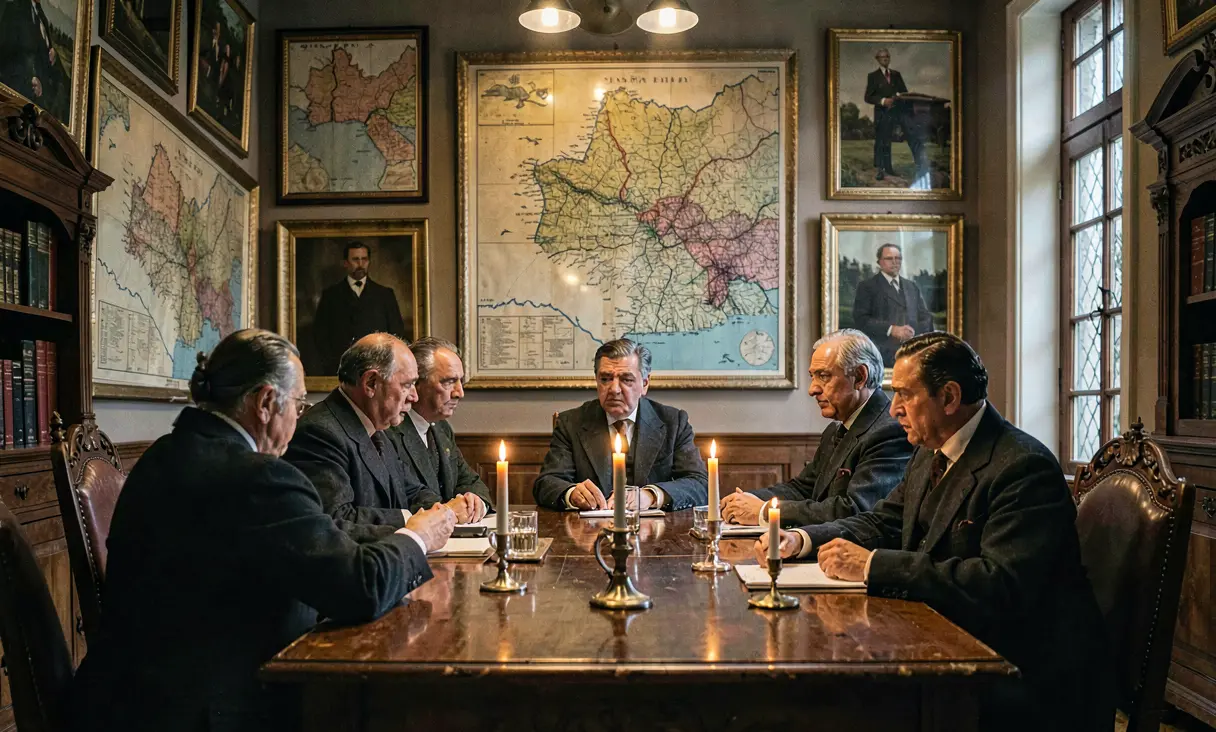
Chilean Constitution of 1823 and Conservative Turn
The 1823 Constitution established Chile's first conservative, centralized framework under Juan Egaña, prioritizing moral order and restricting suffrage to end post-independence chaos.
The Crisis of the Patria Nueva
By early 1823, the Chilean experiment in independence was teetering on the brink of collapse. The era known as the 'Patria Nueva,' initiated by Bernardo O'Higgins and characterized by ambitious reforms and a centralized state, had exhausted its political capital. O'Higgins faced mounting opposition from the landed aristocracy, who resented his land redistribution efforts and authoritarian tendencies, as well as from liberal factions demanding broader representation. The economic situation was dire; the treasury was empty, the war with Spain continued to drain resources, and social unrest simmered in the provinces. In January 1823, under intense pressure from a mutiny led by Colonel Ramón Freire, O'Higgins abdicated, leaving a power vacuum that threatened to plunge the nation into civil war or foreign intervention.
The Constitutional Congress of 1823
In the wake of O'Higgins' departure, a Constituent Congress was convened in Santiago to draft a new fundamental law intended to stabilize the republic. Unlike previous attempts that leaned toward liberal federalism or absolute centralization, this assembly sought a middle path grounded in order and moral authority. The driving intellectual force behind the document was Juan Egaña Risco, a jurist and statesman who believed that Chile's social fabric required a paternalistic state to guide a populace he deemed unprepared for full democracy. The resulting Constitution of 1823, promulgated on August 29, 1823, was a radical departure from the liberal ideals of the early independence years, prioritizing stability over liberty and establishing a framework that would influence Chilean governance for generations.
The 'Moral' Constitution
The Constitution of 1823 was unique in its explicit incorporation of Catholic doctrine into the legal framework, declaring Roman Catholicism the sole religion of the state and prohibiting the practice of any other. Egaña's vision was not merely political but moral; he argued that a republic could not survive without a unified ethical foundation. The document established a strong executive branch with a President elected for a term of years, though the system of election was indirect and heavily restricted by property and literacy requirements, effectively limiting suffrage to a small elite of landowners and professionals. It created a 'Senate' with significant powers to check the executive, yet the overall design favored a centralized authority capable of suppressing regional caudillismo and federalist aspirations.
Key Architects: Egaña and Freire
Juan Egaña was the undisputed architect of the 1823 Constitution, serving as its primary drafter and ideological guide. A man of profound conservative conviction, Egaña had previously served in O'Higgins' government but grew disillusioned with what he perceived as excessive liberalism. His influence extended beyond the text; he shaped the political culture that would dominate Chile for decades. Conversely, Ramón Freire, who replaced O'Higgins as Supreme Director, represented a more pragmatic, albeit still authoritarian, approach. While Freire supported the new constitution as a necessary evil to prevent anarchy, his own power was constrained by its provisions. The tension between Egaña's theoretical conservatism and Freire's practical governance defined the early years of the new regime.
Implementation and Immediate Resistance
The promulgation of the Constitution in August 1823 did not bring immediate peace. The document faced fierce resistance from federalist groups in the provinces, particularly in Concepción and Coquimbo, who viewed the centralization of power as a betrayal of local autonomy. Furthermore, the liberal faction, which had hoped for a more democratic charter, was alienated by the restrictive suffrage and the entrenchment of clerical privileges. The implementation process was fraught with difficulty; the electoral mechanisms were complex and slow to activate, leading to a period where the Supreme Director ruled largely by decree while waiting for the new institutions to take root. This instability highlighted the deep fissures within Chilean society between the urban elite and the rural populace.
Legacy of Authoritarian Stability
Although the Constitution of 1823 was short-lived, effectively replaced by a new charter in 1828 after Freire's resignation, its legacy was profound. It established the precedent that order and centralization were prerequisites for Chilean nationhood, a lesson that would be fully realized under Diego Portales and the Constitution of 1833. The document marked the definitive end of the liberal experiments of the 1820s and initiated the 'Conservative Turn' that would characterize Chilean politics until the mid-20th century. By prioritizing a strong state, restricting suffrage, and aligning the church with the government, Egaña's blueprint provided the ideological foundation for the long period of stability known as the Conservative Republic.
The 1823 constitution laid the groundwork for Chile's long-term political stability and centralized state structure, distinguishing it from its neighbors' chaotic post-independence eras.
Where it happened
Santiago, Chile — see it on the interactive map →
Explore related history
 PoliticsSargon of Akkad Establishes the First Empirec. 2334 BCE · Akkad (Location uncertain, near Baghdad, Iraq)Sargon unifies Sumerian city-states to create the world's first multi-ethnic empire.
 PoliticsPromulgation of the Code of Ur-Nammuc. 2100 BCE · Ur, Southern Mesopotamia (Iraq)The earliest known surviving law code is established in the Sumerian city of Ur.
 PoliticsNelson Mandela Elected President of South AfricaApril 27, 1994 · Cape Town, South AfricaSouth Africa holds its first democratic election, ending the apartheid regime and establishing a multiracial government.
 PoliticsIndependence of Brazil DeclaredSeptember 7, 1822 · São Paulo, BrazilPrince Pedro I declares Brazil's independence from Portugal near the Ipiranga River.
 WarGreek War of Independence BeginsMarch 25, 1821 · Peloponnese, GreeceGreek revolutionaries rise against Ottoman rule, initiating a war that leads to the creation of modern Greece.
 WarSimón Bolívar's Crossing of the AndesJune 1819 · Andes Mountains, Colombia/Venezuela BorderBolivar leads his army over the frozen Andes to launch a surprise attack on Spanish forces in New Granada.
Discussion
Loading…