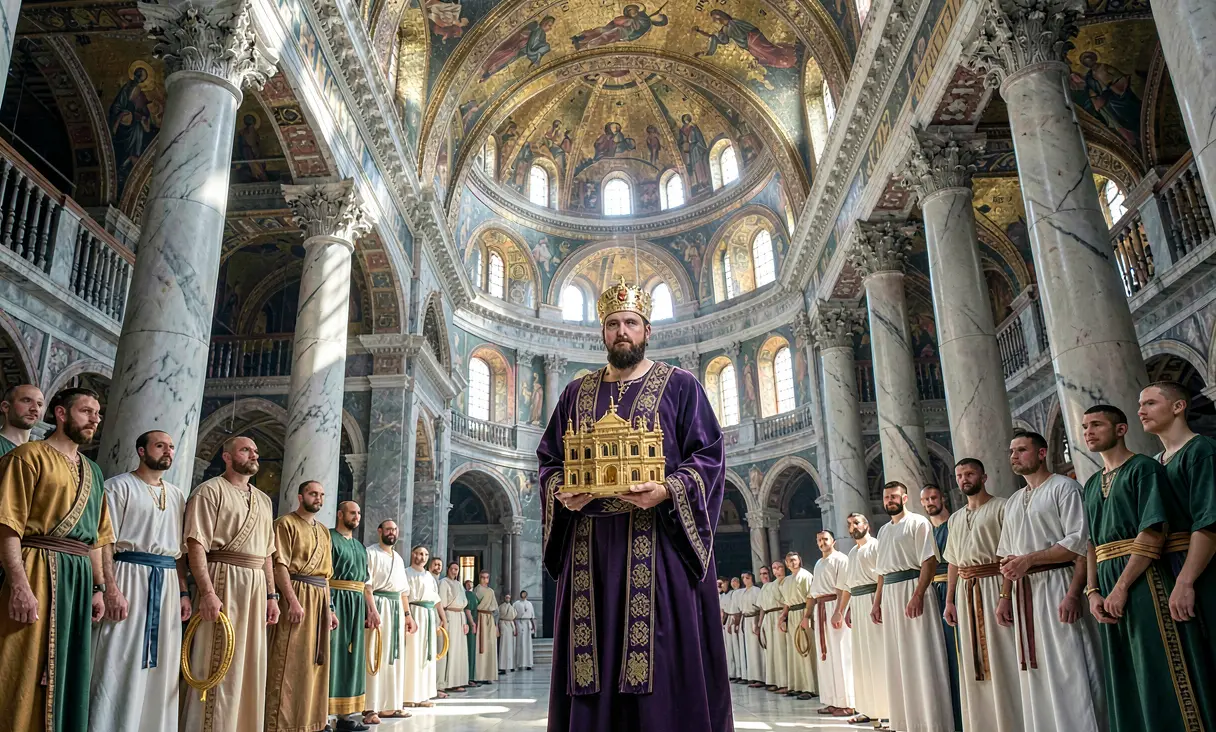
Completion of the Hagia Sophia
In 537 CE, Justinian I's Hagia Sophia revolutionized architecture with its floating dome, establishing the visual language of Byzantine power and influencing Islamic mosque design for centuries.
The Imperial Mandate and the Ruins of Nicaea
In the wake of the devastating Nika Riots of January 532 CE, which left much of Constantinople in ashes and nearly toppled Emperor Justinian I's reign, a singular vision emerged to restore imperial authority through architectural grandeur. The previous Great Church, known as the Magna Ecclesia, had been destroyed during the uprising; its predecessor, built by Constantius II, was already deemed insufficient for the expanding theological and political ambitions of the Byzantine Empire. Justinian, driven by a desire to demonstrate that his rule was divinely sanctioned and unshakeable, commissioned a structure that would surpass all earthly precedents in scale and engineering. The mandate was explicit: construct a cathedral so magnificent that it would prove God had not abandoned the capital, effectively rewriting the city's skyline and the empire's spiritual identity overnight.
Architects of Genius: Anthemius and Isidore
To realize this audacious vision, Justinian bypassed traditional ecclesiastical architects in favor of two secular scholars of immense mathematical and physical prowess: Anthemius of Tralles and Isidore of Miletus. Anthemius, a geometer from Anatolia, brought rigorous theoretical knowledge to the project, while Isidore, an expert on Archimedean mechanics, managed the practical engineering challenges. Their collaboration marked a paradigm shift in architectural history; rather than adhering to the longitudinal basilica form common since Roman times, they conceived a centralized plan dominated by a massive pendentive dome. This structural innovation allowed a circular dome of 31 meters (102 feet) in diameter to rest upon four massive arches supported by piers, creating an interior space that appeared to float without visible support.
The Construction Miracle of the Six Years
Construction began in February 532 CE and proceeded with a speed and intensity unprecedented in antiquity. Justinian spared no expense, importing marble columns from Egypt, Syria, and Greece, and utilizing vast quantities of gold, silver, ivory, and precious stones for the interior decoration. Over 10,000 workers labored simultaneously, often under dangerous conditions, to erect the massive dome which collapsed during a minor earthquake in 558 CE before being rebuilt with a steeper profile by Isidore the Younger. The original completion date was December 27, 537 CE, achieved in less than six years—a feat that contemporary observers attributed as much to divine intervention as to human ingenuity. The sheer volume of materials and the complexity of the pendentive system required a logistical organization that rivaled the construction of the Pyramids.
The Dedication: A City Transformed
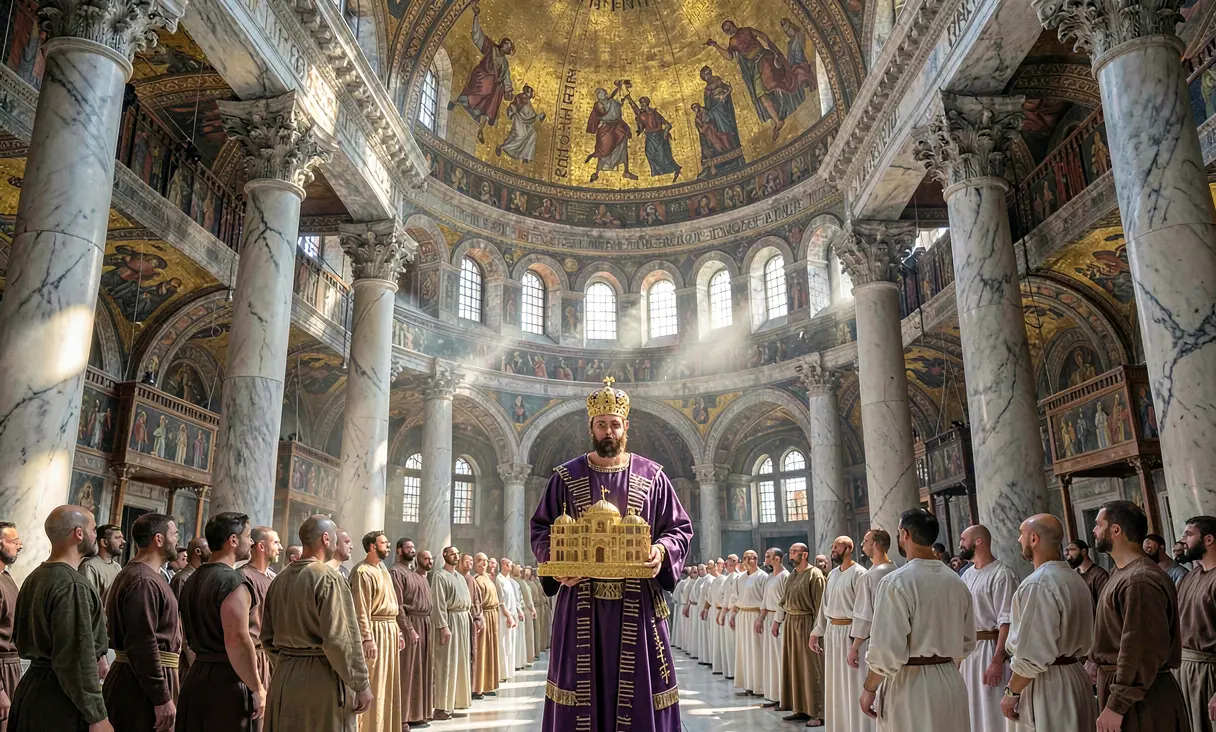
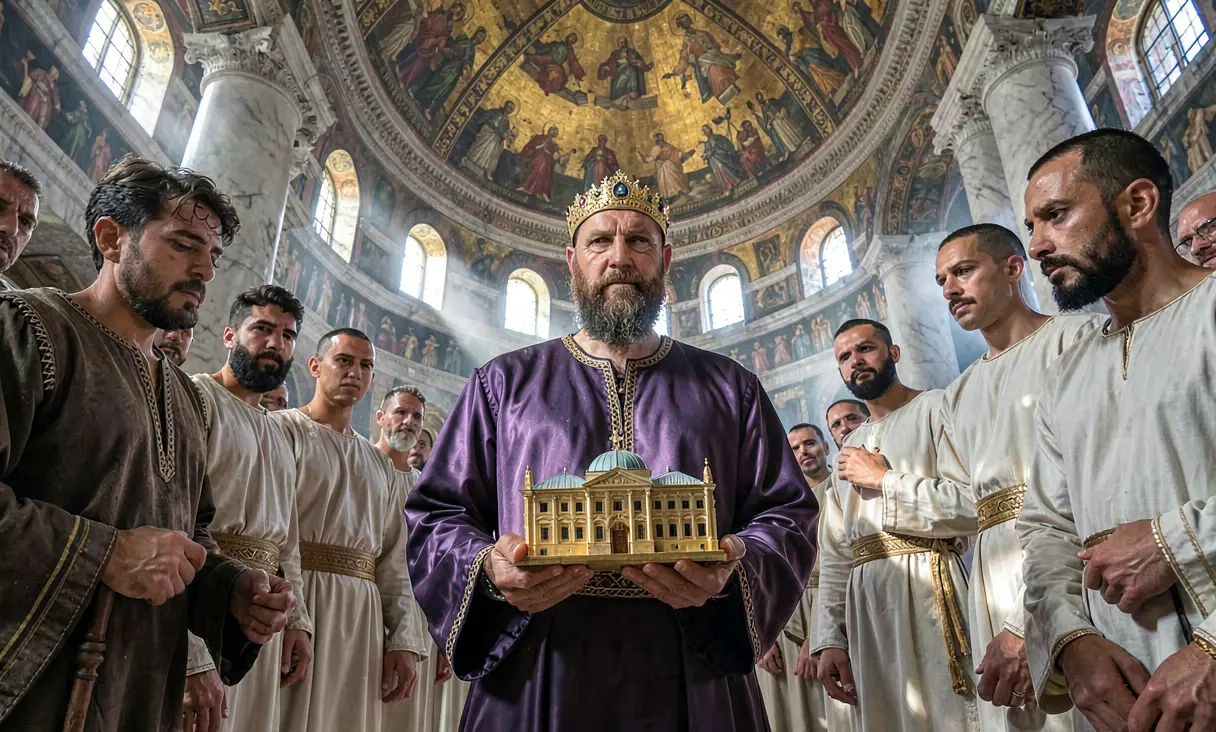
On December 27, 537 CE, the church was consecrated by Patriarch Menas in a ceremony of overwhelming splendor. Emperor Justinian is famously reported to have entered the nave and declared, 'Solomon, I have surpassed thee,' referencing the biblical temple's grandeur while asserting his own supremacy as the new Solomon. The interior was illuminated by 40 windows at the base of the dome, creating an optical illusion that the massive structure was suspended from heaven on a chain of light. Gold mosaics depicting Christ Pantocrator and the Virgin Mary covered the vast surfaces, radiating a divine luminescence intended to overwhelm the senses of the faithful. This space did not merely house a congregation; it physically manifested the concept of the Byzantine Empire as the terrestrial reflection of the Kingdom of Heaven.
Theological and Political Resonance
The Hagia Sophia served as the spiritual heart of Orthodox Christianity for nearly a millennium, hosting the coronations of emperors and the patriarchs who shaped the theological trajectory of Christendom. Its architecture facilitated a unique liturgical experience where the boundary between the earthly and the divine seemed porous; the centralized plan allowed the emperor to be visually present in the center of the cosmic order while remaining distinct from the clergy. The building became a symbol of Constantinople's resilience, surviving sieges by Persians, Avars, Arabs, and Russians. It stood as the ultimate testament to Justinian's *Renovatio Imperii*, asserting that the Roman Empire had not fallen but had been transfigured into a Christian empire with its capital at the crossroads of Europe and Asia.
A Legacy Across Faiths and Centuries
The architectural language established by Anthemius and Isidore fundamentally altered the course of religious building design. Following the Ottoman conquest in 1453, the structure was converted into a mosque, where its central dome became the prototype for Ottoman imperial mosques, most notably Sinan's Süleymaniye and the Blue Mosque. The synthesis of Roman engineering with Byzantine aesthetics created a hybrid architectural vocabulary that influenced structures from the Renaissance to the modern era. Even as a museum in the 20th century and a mosque again in the 21st, the Hagia Sophia remains a singular artifact where the history of two major world religions converges within a single, soaring space. It stands not just as a monument to one emperor or one faith, but as a testament to human capacity for artistic and engineering transcendence.
It remains an architectural marvel that influenced both Christian and Muslim religious building traditions globally.
Where it happened
Constantinople (Istanbul), Turkey — see it on the interactive map →
Explore related history
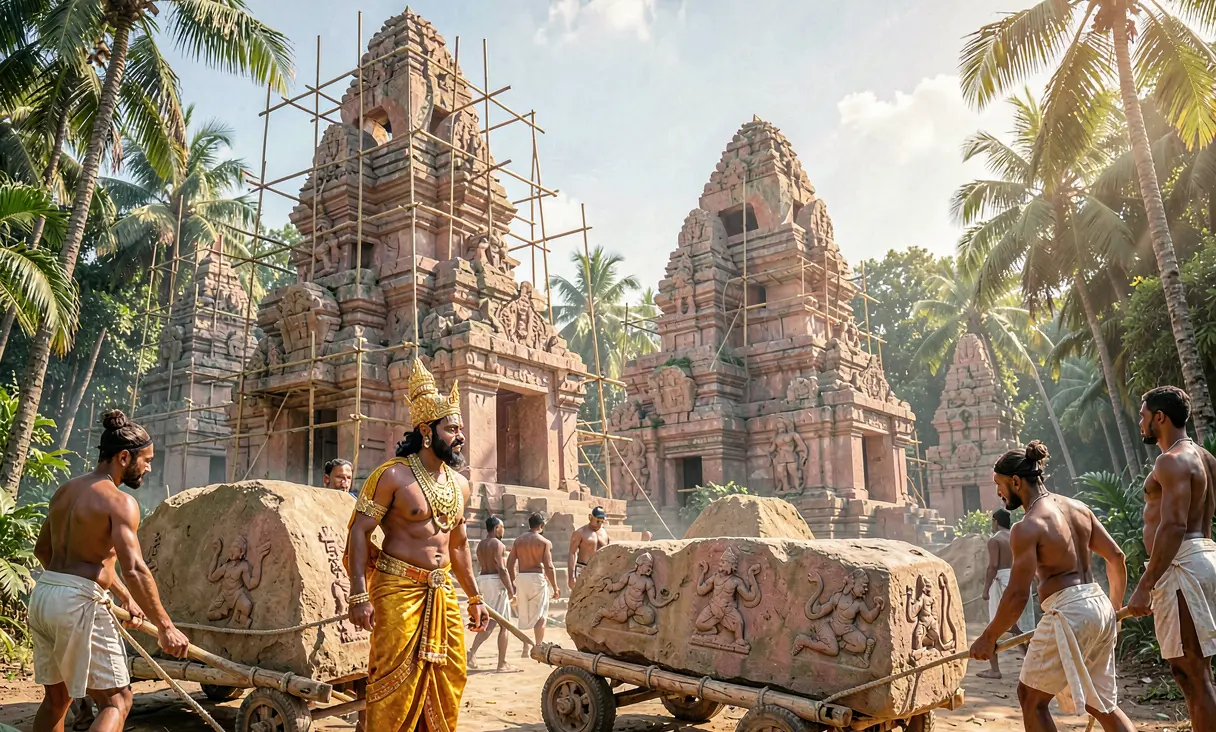 architectureConstruction of Angkor Wat Beginsc. 1113 CE · Angkor, CambodiaKing Suryavarman II begins building Angkor Wat as a Hindu temple complex dedicated to Vishnu.
 ArtCreation of Maya Polished Obsidian Mirrorsc. 600 CE · Guatemala (Maya Lowlands)Artisans craft polished obsidian mirrors for divination and ritual use.
 ReligionHijra of Prophet MuhammadSeptember 24, 622 CE · Medina, Saudi ArabiaMuhammad migrates to Medina establishing the first Muslim community and calendar.
 ArtBurial of the Sutton Hoo Shipc. 625 CE · Suffolk, EnglandAn Anglo-Saxon king is buried with a magnificent helmet and gold artifacts.
Discussion
Loading…