Invention of Greek Fire by Kallinikos
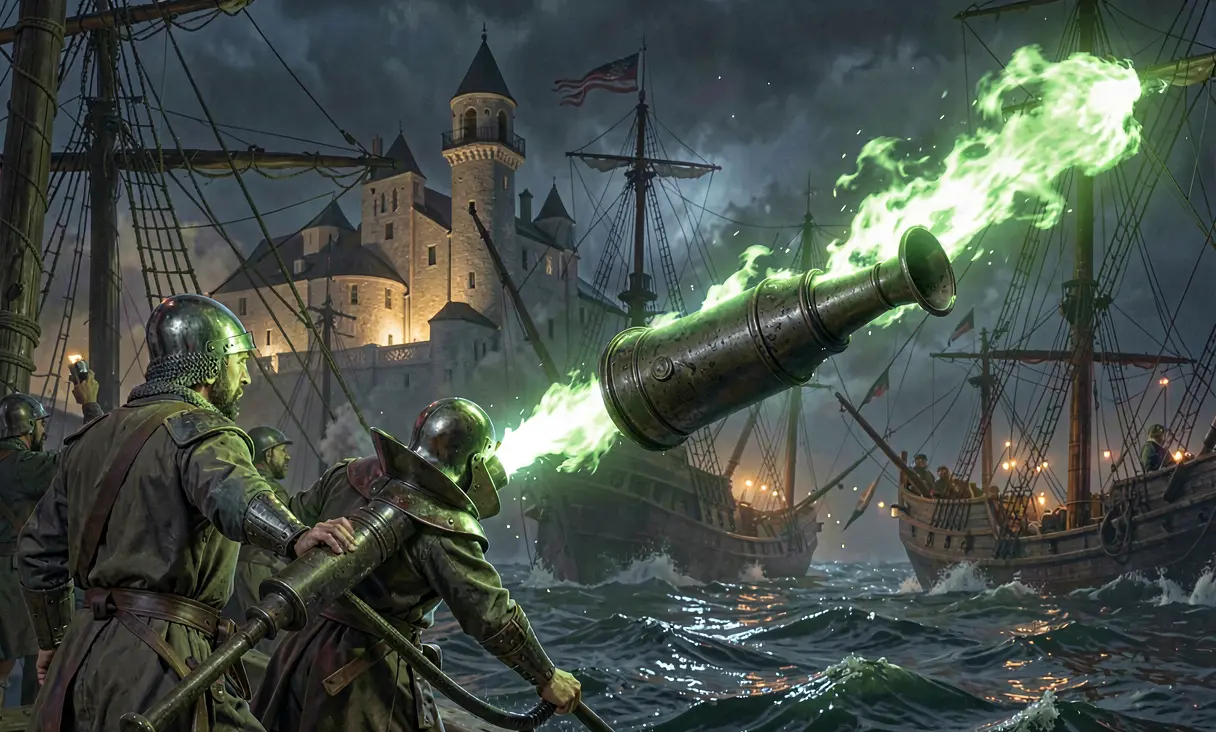
Syrian engineer Kallinikos introduced Greek fire around 673 CE, saving Constantinople from Arab sieges and preserving the Byzantine Empire for centuries through an unmatched naval weapon.
The Siege of Constantinople and the Arab Threat
By the mid-7th century, the Byzantine Empire faced an existential crisis. Following the rapid Islamic conquests of Syria, Egypt, and North Africa, the Umayyad Caliphate turned its full military might toward the imperial capital, Constantinople. Between 673 and 678 CE, a massive Arab fleet under the command of Sufyan ibn Abdallah established a naval blockade, aiming to starve the city into submission or breach its formidable Theodosian Walls from the sea. The Byzantine navy, though historically formidable, was struggling against the sheer scale of the Arab armada and their innovative siege tactics. Without a decisive technological breakthrough, the fall of Constantinople seemed imminent, which would have likely ended the Eastern Roman Empire and altered the trajectory of European history.
The Arrival of Kallinikos
Amidst this desperate siege, a Syrian refugee named Kallinikos arrived in Constantinople. Hailing from Heliopolis (modern-day Baalbek), Kallinikos was reportedly an architect or engineer who had fled the advancing Islamic forces. While historical records regarding his specific background are sparse and often shrouded in legend, Byzantine chroniclers credit him with possessing knowledge of a potent incendiary mixture that could be projected onto enemy ships. Unlike traditional Greek fire, which burned on land, Kallinikos's innovation was specifically engineered to ignite upon contact with water, rendering the sea itself a weapon against the besieging fleet.
The Mechanics of Greek Fire
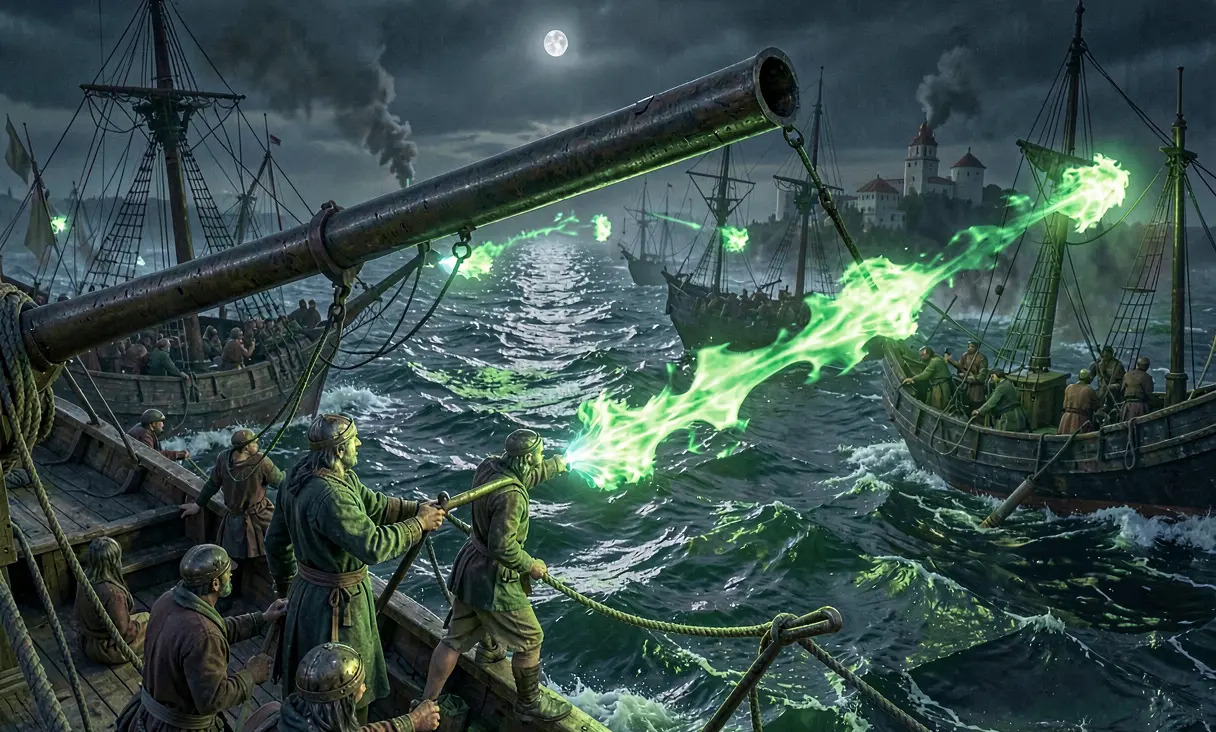
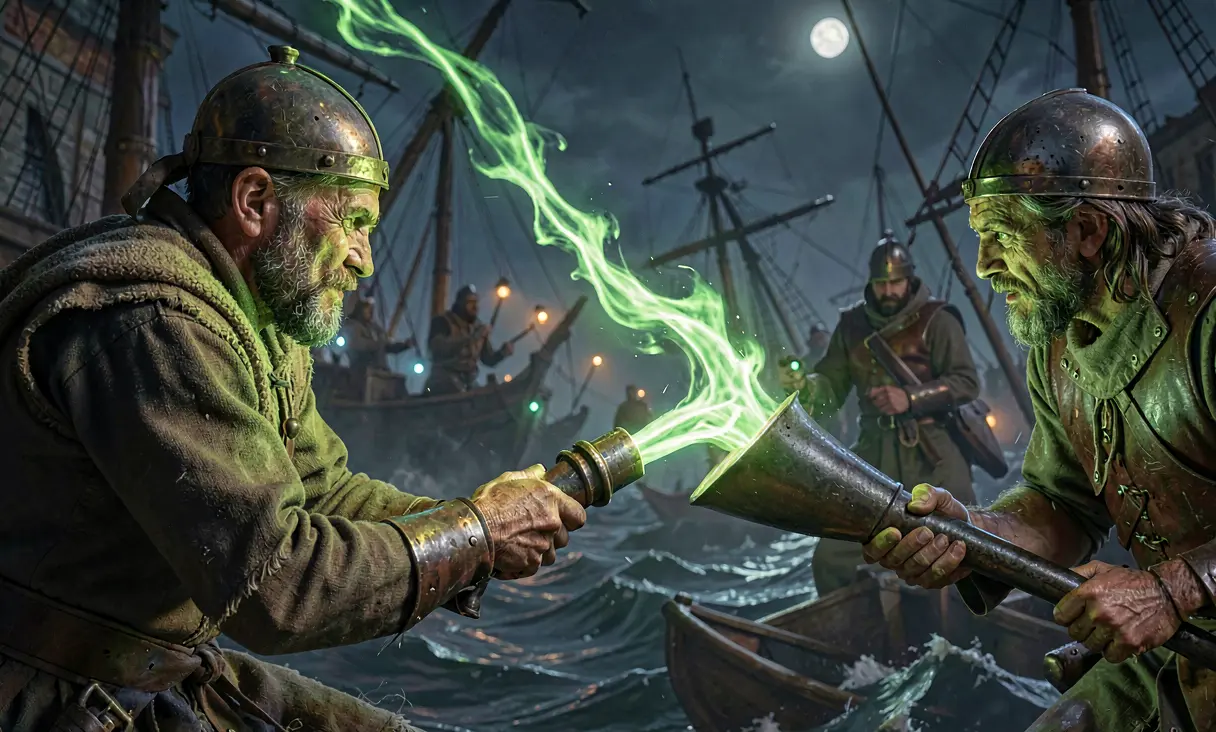
Kallinikos introduced not merely a chemical compound but an entire delivery system. The substance, later known as "Greek fire," was likely a mixture of crude oil (naphtha), sulfur, resin, and quicklime, stored in pressurized bronze containers aboard Byzantine dromons (warships). These containers were connected to siphons—early flamethrowers—that allowed crews to project a stream of liquid fire onto enemy vessels. The chemical composition was designed so that the mixture would ignite spontaneously or be ignited by a fuse upon exiting the nozzle, burning fiercely even while floating on water and resisting attempts to extinguish it with sand or vinegar. This technological leap transformed naval warfare from a contest of boarding and ramming into a one-sided slaughter.
The Decisive Naval Engagements
The first major deployment of this new weapon occurred in 673 CE, shattering the Arab blockade. Byzantine sources describe how the Arab fleets, unprepared for a fire that could not be doused by water, were thrown into panic as their wooden ships caught fire and burned uncontrollably. The psychological impact was as devastating as the physical destruction; the "fire from the sea" was viewed by many contemporaries as divine intervention. Over the course of the siege, repeated sorties using Kallinikos's invention decimated the Arab fleet, forcing them to abandon their blockade in 678 CE and retreat with heavy losses. The survival of Constantinople during these critical years is directly attributed to this technological superiority.
Imperial Secrecy and State Control
Recognizing the strategic value of Kallinikos's invention, Emperor Constantine IV immediately classified the formula as a supreme state secret. The production and deployment of Greek fire were strictly controlled by the imperial court, with the recipe known only to a select few chemists and engineers within the palace. Historical accounts suggest that the secret was so closely guarded that even high-ranking generals were often unaware of the exact composition or maintenance procedures, relying instead on specialized crews who swore oaths of silence. This secrecy ensured that for centuries, no rival power could replicate the weapon, maintaining Byzantine naval dominance in the Mediterranean.
Legacy and Historical Significance
The invention of Greek fire by Kallinikos stands as a pivotal moment in military history, effectively preserving the Eastern Roman Empire for another seven centuries. Its impact extended beyond the immediate repulsion of the Arab sieges; it established a technological asymmetry that deterred naval aggression against Constantinople until the rise of gunpowder technology. The weapon became synonymous with Byzantine power, appearing in countless conflicts from the Battle of Syllaeum to the Fourth Crusade. While the exact formula was lost following the fall of Constantinople in 1453, Kallinikos's contribution remains a testament to the role of scientific innovation in shaping the geopolitical landscape of the medieval world.
Greek fire provided the Byzantines with a naval superweapon that secured their survival against overwhelming Arab forces.
Where it happened
Constantinople, Turkey — see it on the interactive map →
Explore related history
 TechnologyDiscovery of Gunpowder by Tang Dynasty Alchemistsc. 850 CE · Chang'an, ChinaTang alchemists accidentally discover gunpowder while seeking an elixir of immortality.
 TechnologyUse of Astrolabes for Celestial Navigation by Arab Sailorsc. 1000 CE · Jeddah, Saudi ArabiaArab navigators utilize refined astrolabes to cross the Indian Ocean.
 TechnologyMagnetic Compass Application for Navigation in Song Chinac. 1040 CE · Kaifeng, ChinaSong dynasty engineers create the first magnetic compass for maritime navigation.
 PoliticsRise of Srivijaya as Maritime Hegemon683 CE · Palembang, Sumatra (Modern Indonesia)Srivijaya emerges as the dominant maritime empire controlling the Strait of Malacca.
 ReligionStandardization of the Quranic Textc. 650 CE · Medina (and Damascus), Arabia/SyriaCaliph Uthman commissions the definitive written codex of the Quran.
 WarIslamic Conquest of the Sasanian Empire637 CE · Ctesiphon, Iraq (Persia)Arab Muslim forces defeat the Sasanian Empire at the Battle of al-Qadisiyyah, ending centuries of Persian rule.
Discussion
Loading…