
Independence of Brazil Declared
On September 7, 1822, Dom Pedro I declared 'Independence or Death,' transforming Brazil into a unified empire and avoiding the fragmentation that plagued Spanish America.
The Crisis of the Portuguese Crown
By 1820, the geopolitical landscape of the Atlantic world had shifted dramatically following the Napoleonic Wars. The Portuguese royal family, having fled to Brazil in 1808 to escape French invasion, had elevated Rio de Janeiro to the status of a co-capital of the Portuguese Empire for over a decade. However, the Liberal Revolution of Porto in August 1820 forced King João VI to return to Lisbon, leaving his eldest son, Dom Pedro, as Prince Regent in Brazil. The newly elected Portuguese Cortes (parliament) sought to reverse this elevation, demanding Brazil's reversion to colonial status and ordering Dom Pedro's immediate return to Portugal. They viewed the Brazilian autonomy established since 1808 as an aberration that threatened Lisbon's economic dominance.
Mounting Tensions in São Paulo
The political atmosphere in Brazil grew increasingly volatile throughout early 1822. The Cortes issued decrees stripping the Brazilian government of its authority and demanding Dom Pedro's departure, a move that galvanized local elites who feared economic ruin under renewed colonial subjugation. In May 1822, Dom Pedro famously declared 'O Dia do Fico' (The Day I Stayed), defying Lisbon's orders to remain in Brazil. By August, the tension reached a breaking point; the Cortes annulled his recent decrees and sent a new expeditionary force to enforce their will. Returning from a diplomatic mission in São Paulo on September 7, 1822, Dom Pedro found himself at the Ipiranga Creek, where he received urgent dispatches from his wife, Empress Leopoldina, and his minister José Bonifácio de Andrada e Silva, urging him to sever ties with Portugal completely.
The Cry of Independence
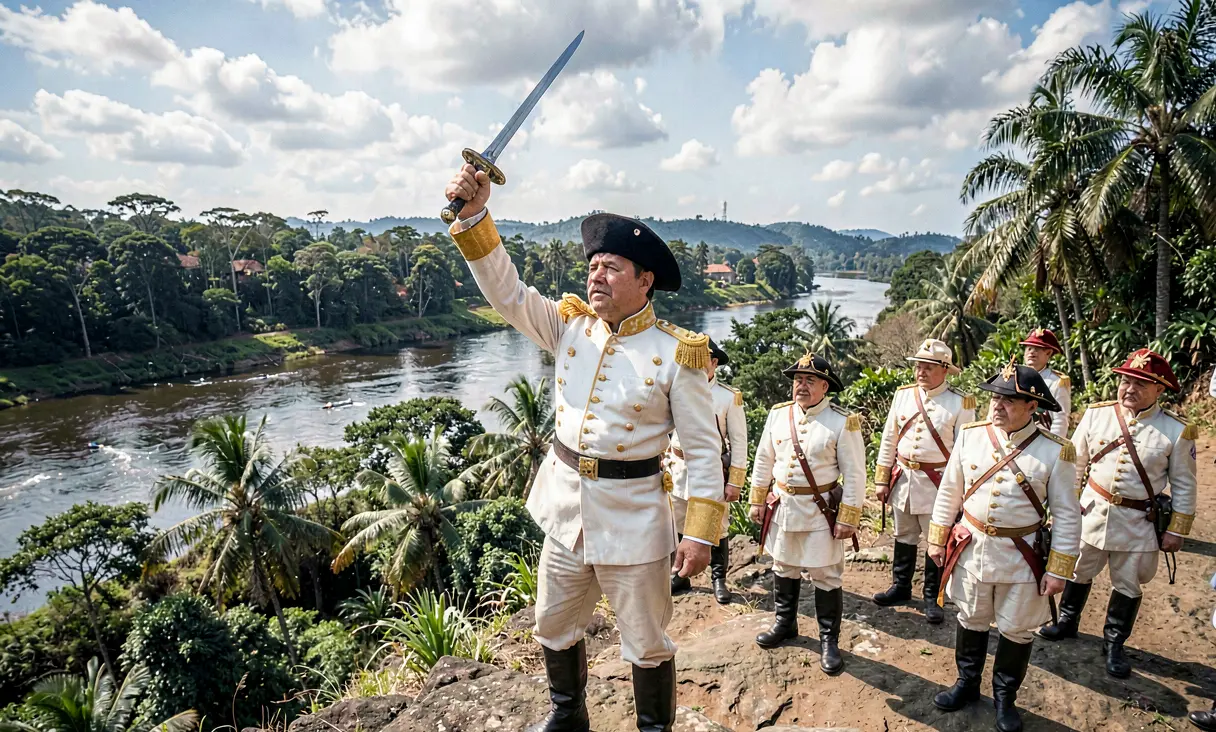
On the afternoon of September 7, 1822, amidst a backdrop of political uncertainty and military posturing, Prince Regent Dom Pedro I drew his sword at the banks of the Ipiranga Creek. Surrounded by his small escort and local dignitaries, he read the latest letters from Lisbon which demanded his submission. In a moment that would define Brazilian national identity, he shouted 'Independência ou Morte!' (Independence or Death!). This declaration was not merely a rhetorical flourish but a formal act of statecraft; it signaled the end of Brazil's status as a colony and the beginning of its existence as a sovereign nation. The event marked a decisive rupture with the Portuguese Crown, transforming the Prince Regent into the first Emperor of an independent Brazil.
A Peaceful Monarchical Transition
Unlike the protracted and often brutal wars of independence that characterized Spanish America, Brazil's path to sovereignty was remarkably swift and relatively bloodless. The transition was orchestrated by the existing colonial elite and the royal family itself, avoiding the social upheaval and fragmentation that plagued neighboring republics. Dom Pedro I's proclamation was swiftly followed by a formal declaration on October 12, 1822, establishing the Empire of Brazil. This continuity of leadership ensured that the vast territory remained intact; while Spanish America fractured into multiple nations, Brazil maintained its colonial borders, creating a unified state that stretched from the Amazon to the Rio de la Plata.
Consolidation and International Recognition
The immediate aftermath of September 7 involved a delicate struggle for legitimacy. Portugal initially refused to recognize Brazilian independence, leading to sporadic military conflicts along the northern coast until late 1823. However, Dom Pedro's government moved quickly to secure international standing, notably through the mediation of Great Britain, which recognized Brazil in 1825 in exchange for favorable trade terms and an agreement to end the transatlantic slave trade. The new Empire established a constitutional monarchy in 1824, creating a stable political framework that would endure until 1889. This stability allowed Brazil to emerge as a dominant regional power, avoiding the civil wars and caudillismo that destabilized its southern neighbors.
Legacy of Unity and Monarchy
The declaration of independence on September 7, 1822, remains the cornerstone of Brazilian national identity. It established a unique historical trajectory where a colony achieved sovereignty through a monarchical transition rather than a republican revolution. The preservation of territorial integrity stands as one of the most significant political outcomes in Latin American history, creating a single nation-state out of a vast colonial possession. Although the monarchy would eventually fall in 1889, the foundational unity forged in 1822 prevented the balkanization seen elsewhere in the region, shaping Brazil's demographic, cultural, and geopolitical landscape for nearly two centuries.
Brazil's unique path to independence maintained its territorial integrity and established it as the only independent nation in Latin America ruled by a monarch.

Where it happened
São Paulo, Brazil — see it on the interactive map →
Explore related history
 PoliticsSargon of Akkad Establishes the First Empirec. 2334 BCE · Akkad (Location uncertain, near Baghdad, Iraq)Sargon unifies Sumerian city-states to create the world's first multi-ethnic empire.
 PoliticsPromulgation of the Code of Ur-Nammuc. 2100 BCE · Ur, Southern Mesopotamia (Iraq)The earliest known surviving law code is established in the Sumerian city of Ur.
 PoliticsNelson Mandela Elected President of South AfricaApril 27, 1994 · Cape Town, South AfricaSouth Africa holds its first democratic election, ending the apartheid regime and establishing a multiracial government.
 PoliticsChilean Constitution of 1823 and Conservative TurnAugust 1823 · Santiago, ChileChile adopts a new constitution that attempts to balance liberal ideals with strong executive power.
 WarGreek War of Independence BeginsMarch 25, 1821 · Peloponnese, GreeceGreek revolutionaries rise against Ottoman rule, initiating a war that leads to the creation of modern Greece.
 WarSimón Bolívar's Crossing of the AndesJune 1819 · Andes Mountains, Colombia/Venezuela BorderBolivar leads his army over the frozen Andes to launch a surprise attack on Spanish forces in New Granada.
Discussion
Loading…