Battle of Hastings
The Battle of Hastings in 1066 saw William the Conqueror defeat Harold Godwinson, ending Anglo-Saxon rule and permanently merging English and French cultures to reshape European history.
A Kingdom in Crisis
By late 1066, the English throne was a prize contested by three powerful claimants following the death of King Edward the Confessor. Harold Godwinson, Earl of Wessex, had been crowned king in January, but his reign faced immediate existential threats from Harald Hardrada of Norway and William, Duke of Normandy. While Harold successfully repelled the Norwegian invasion at the Battle of Stamford Bridge on September 25, killing both Hardrada and Tostig Godwinson, this victory proved pyrrhic. His army, exhausted and depleted, was forced to march over two hundred miles south in less than a week to confront William's invading force, which had landed unopposed at Pevensey Bay on September 28.
The Armies of Senlac
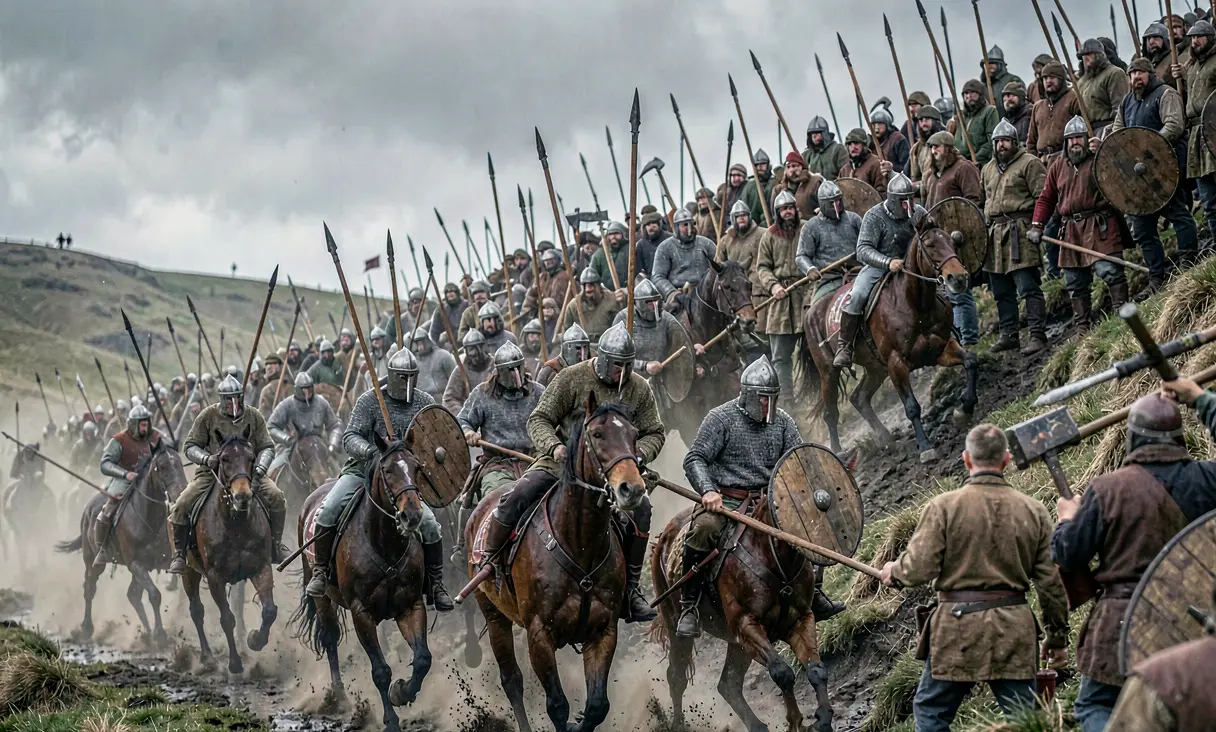
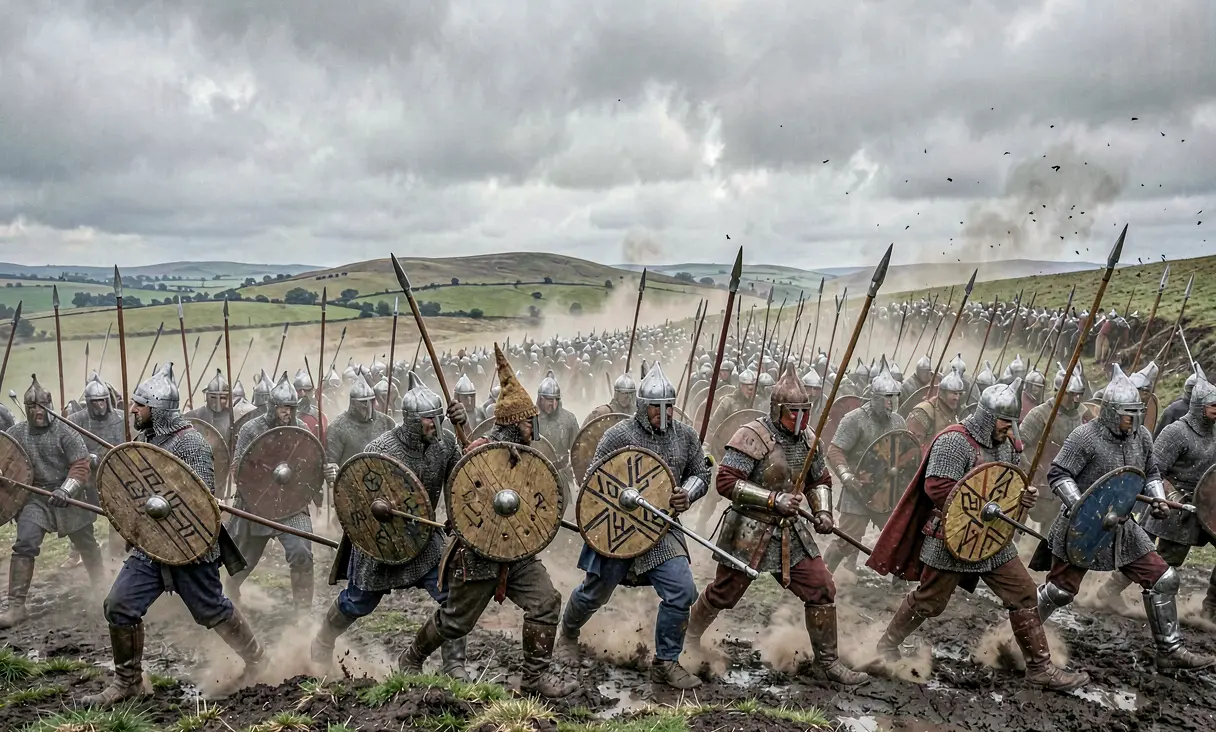
On the morning of October 14, the two forces met at Senlac Hill, near present-day Battle, East Sussex. Harold Godwinson held the high ground, deploying his infantry in a dense shield wall that stretched across the ridge's crest. This formation, composed largely of housecarls and fyrd levies, was designed to be impervious to frontal assault. Opposing them, William of Normandy commanded a composite army of approximately 7,000 to 8,000 men, including heavy cavalry, infantry, and archers. Unlike the English, who lacked significant cavalry or missile troops, the Normans possessed tactical versatility, relying on coordinated strikes between their different units to break the static English line.
The Battle Unfolds
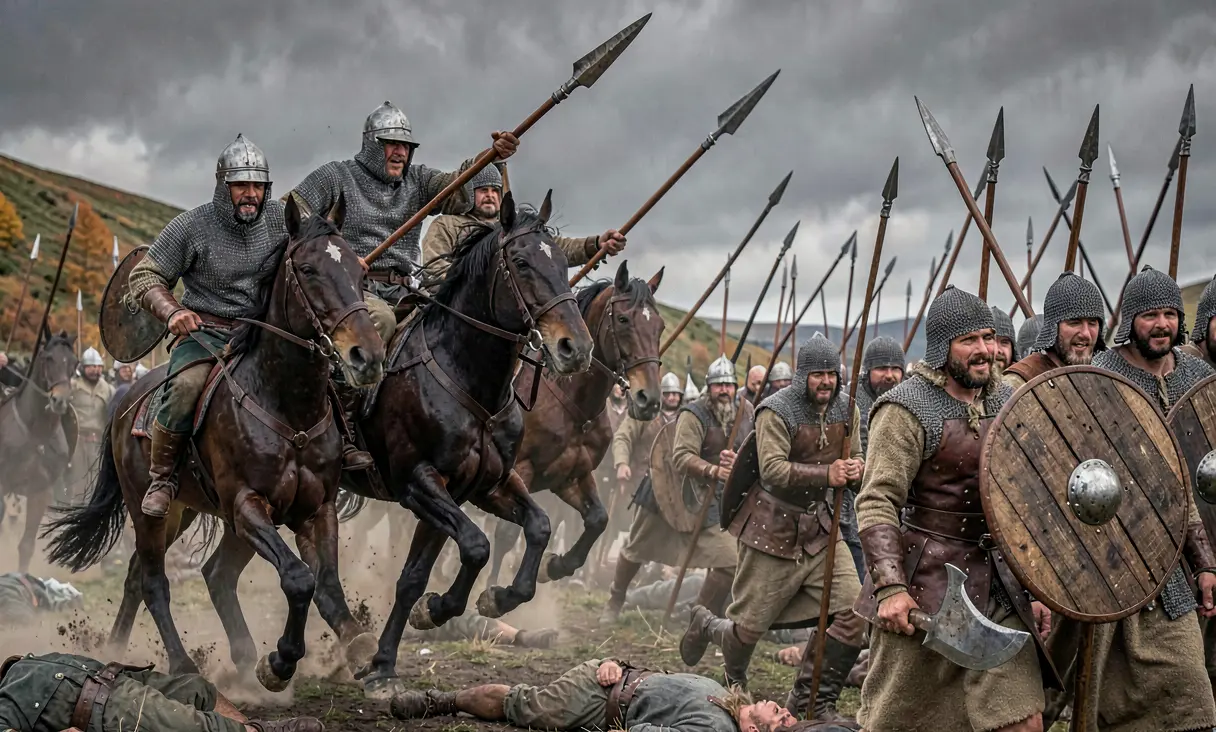
The battle began with a series of failed Norman assaults. William's archers fired uphill but could not penetrate the English shield wall, and his infantry attacks were repulsed by the disciplined housecarls wielding two-handed axes. The turning point came when rumors spread that William had been killed, causing a segment of the Norman left flank to retreat in panic. Seizing the opportunity, Harold's troops broke formation to pursue them down the slope. This maneuver exposed the English flanks, allowing William to order a feigned retreat, drawing more English soldiers out of their defensive position. Once the pursuers were isolated and disordered, Norman cavalry wheeled around and cut them down.
The Fall of Harold
As night fell, the battle raged on with ferocious intensity. The English shield wall was slowly eroded by repeated Norman charges and the relentless pressure of the feigned retreats. King Harold Godwinson remained at the center of the line until the end; historical accounts differ on his demise, with some chroniclers claiming he was struck in the eye by an arrow, while others suggest he was hacked to death by Norman knights. With their king dead and their defensive cohesion shattered, the remaining English forces fled into the night. The battlefield was littered with the bodies of thousands, marking the effective end of Anglo-Saxon rule.
The Norman Conquest
William's victory at Hastings did not immediately grant him control over all of England; he faced sporadic resistance for several years before his coronation on Christmas Day, 1066. The conquest triggered a systematic replacement of the English aristocracy with French-speaking Normans, fundamentally altering the island's social and political fabric. William introduced feudalism in its continental form, redistributing land to his barons who held it directly from the crown. This centralization of power was meticulously recorded in the Domesday Book of 1086, a survey that remains one of the most comprehensive records of medieval society.
A Transformed Nation
The long-term consequences of Hastings were profound and enduring. The English language absorbed thousands of French words, creating the hybrid Middle English that would evolve into modern English. Culturally and politically, England was pulled firmly into the sphere of continental Europe, leading to centuries of conflict with France over territories like Aquitaine. The event effectively ended the Viking Age in Britain and established a new dynasty that would shape the trajectory of British history, influencing its legal systems, architecture, and global expansion for nearly a millennium.
It fundamentally transformed English culture, language, and political structure for the modern era.
Where it happened
Hastings, England — see it on the interactive map →
Explore related history
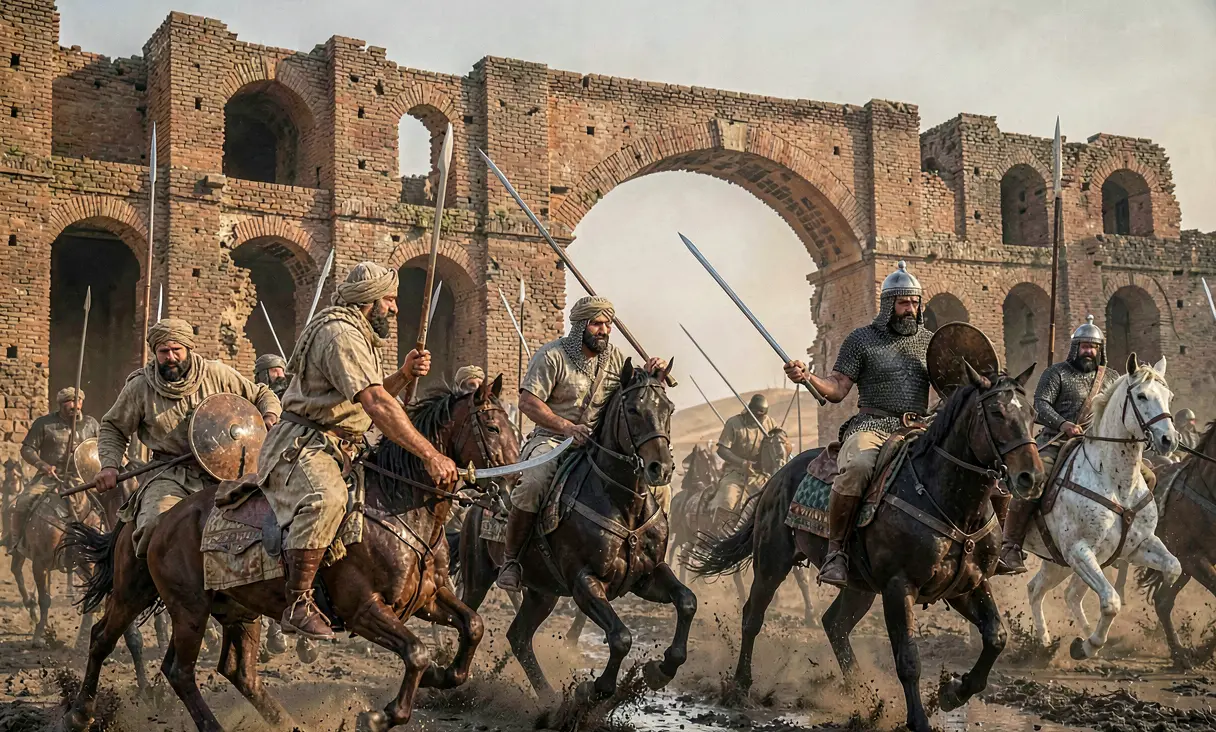 WarIslamic Conquest of the Sasanian Empire637 CE · Ctesiphon, Iraq (Persia)Arab Muslim forces defeat the Sasanian Empire at the Battle of al-Qadisiyyah, ending centuries of Persian rule.
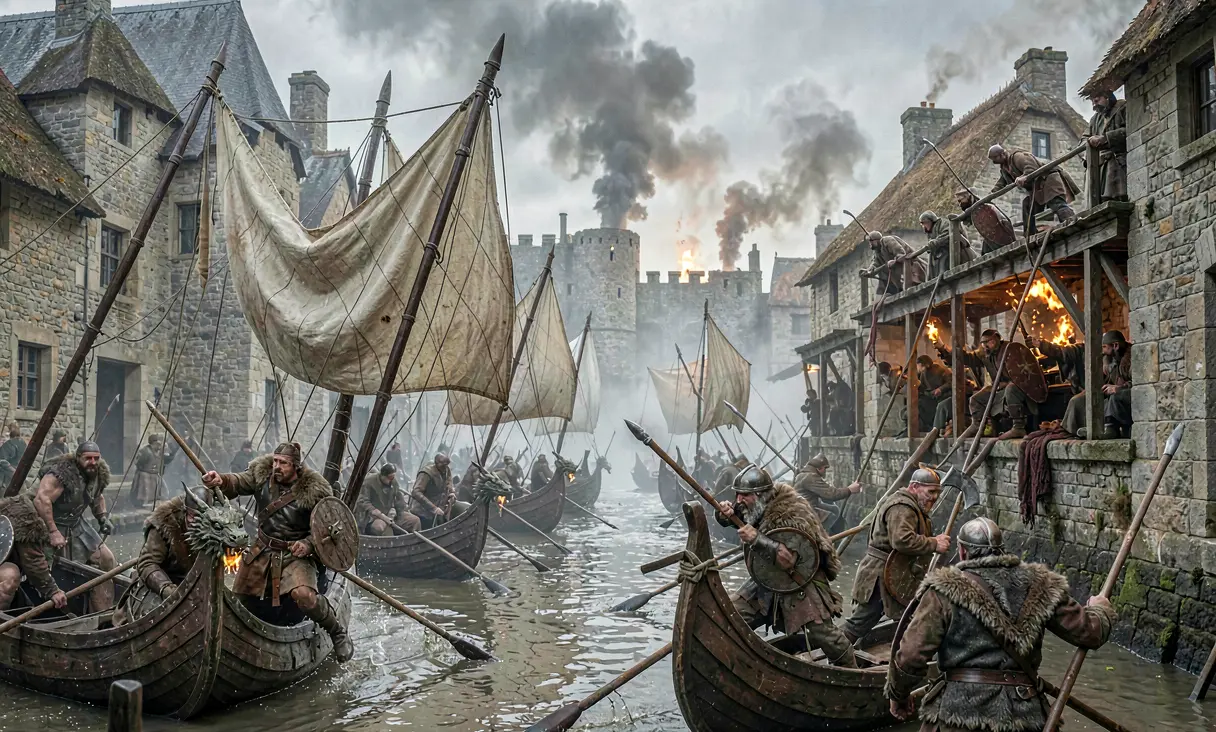 WarViking Siege of Paris885 CE · Paris, FranceViking raiders led by Sigfred besiege Paris for over a year, testing the defenses of West Francia.
 WarChola Conquest of Sri Lankac. 993 CE · Anuradhapura, Sri LankaRajaraja Chola launches a massive amphibious invasion of Sri Lanka, defeating the Sinhalese kingdom and annexing the island.
 PoliticsDecline of Srivjaya1079 CE · Palembang, Sumatra (Modern Indonesia)Internal strife and external pressure weaken Srivijaya's control.
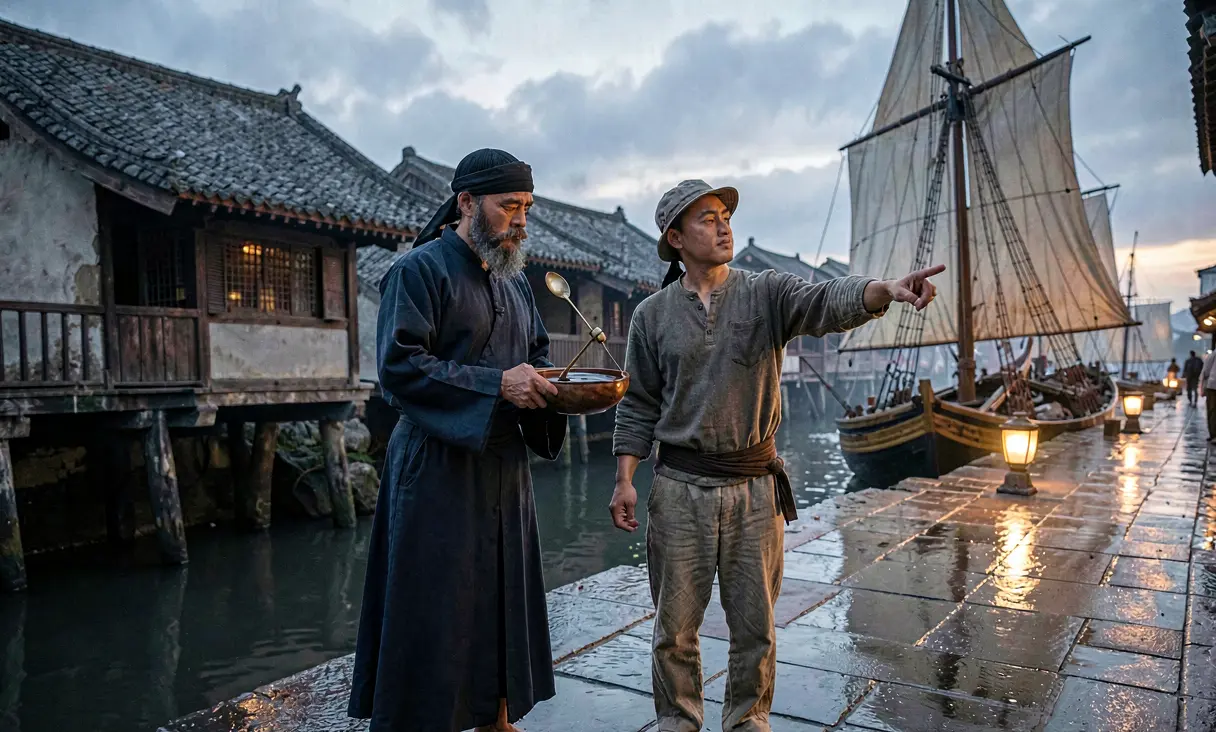 TechnologyMagnetic Compass Application for Navigation in Song Chinac. 1040 CE · Kaifeng, ChinaSong dynasty engineers create the first magnetic compass for maritime navigation.
 PoliticsPost-Chola War Reorganization1035 CE · Palembang, Sumatra (Modern Indonesia)Srivijaya reorganizes its administration after Chola raids.
Discussion
Loading…