Expansion of Aztec Chinampa Agriculture
Around 1420 CE, Aztec engineers transformed Lake Xochimilco into highly productive floating gardens, enabling seven annual harvests that sustained Tenochtitlan's massive population and fueled imperial
Context of the Basin of Mexico
By the early 15th century, the Valley of Mexico faced a critical demographic paradox. The rise of the Triple Alliance, led by Tenochtitlan, Texcoco, and Tlacopan, had catalyzed rapid urbanization, yet the available arable land on the valley floor was finite and increasingly saline due to the natural hydrology of the basin. As the population swelled toward 200,000 inhabitants within the island city of Tenochtitlan alone by 1430, traditional slash-and-burn techniques were insufficient to sustain the caloric demands of a complex state apparatus. The solution lay not in conquering new territories for farming, but in mastering the aquatic environment that surrounded them: Lake Xochimilco and its adjacent shallow waters.
The Chinampa Innovation
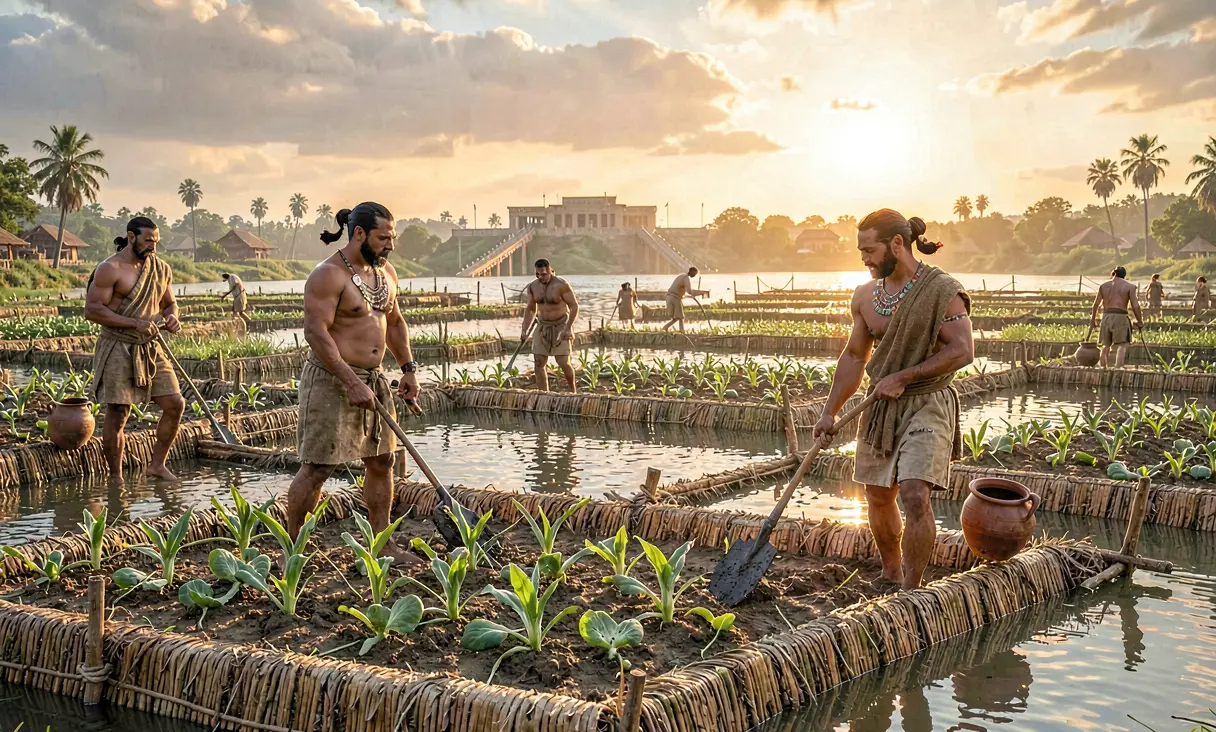
Around 1420 CE, under the reign of Itzcoatl and the strategic guidance of his advisors, the Aztec engineering corps perfected the chinampa system, a method of artificial island agriculture that transformed shallow lake beds into some of the most productive farmland in human history. This was not merely gardening on water; it was a sophisticated hydraulic intervention involving the dredging of nutrient-rich sediment from the lake bottom and piling it onto rectangular plots framed by woven reeds (ahuejotes) and willow trees. These floating gardens, anchored to the lakebed by stakes driven deep into the mud, created stable, fertile islands that rose just above the waterline, allowing for constant capillary action to draw moisture to the crops without flooding.
Engineering and Construction
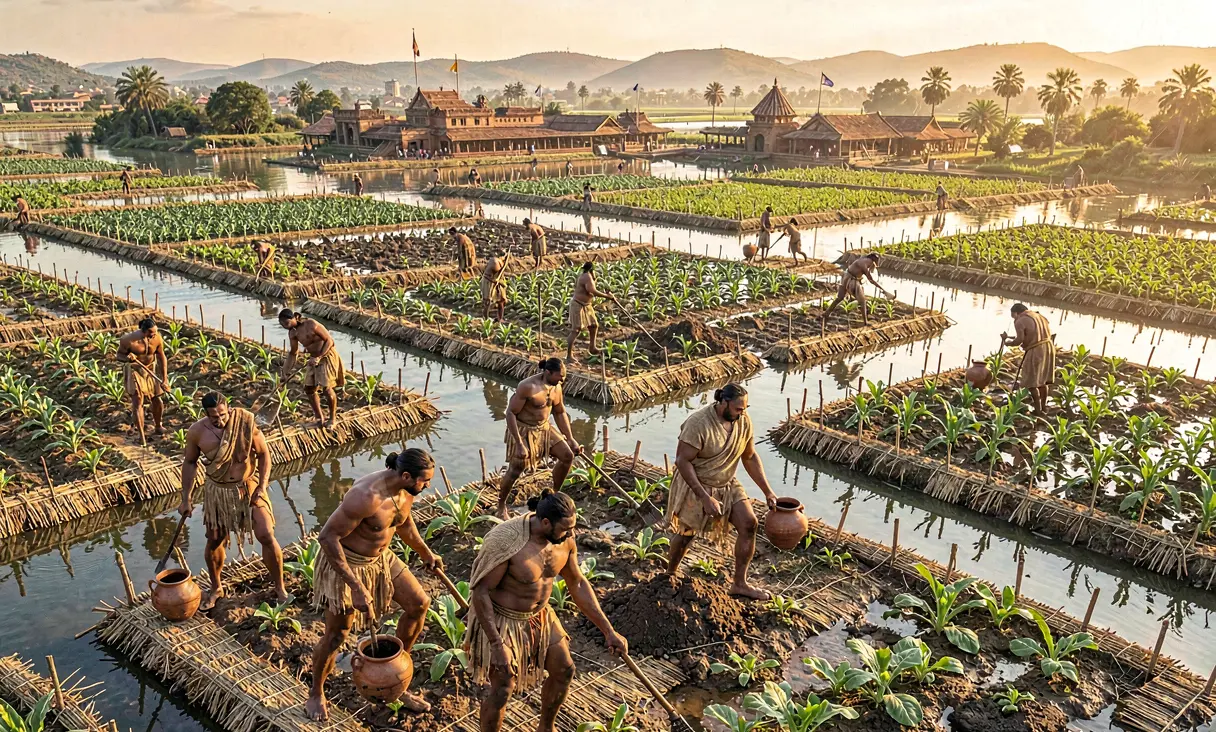
The construction of a chinampa was a communal endeavor requiring precise coordination. Workers first drove long poles into the lakebed to outline a rectangle, typically measuring 30 by 2.5 meters, though some extended significantly larger. They then wove a lattice of reeds and branches between these stakes to form a retaining wall, preventing the soil from washing away. Subsequently, layers of mud, decaying vegetation, and aquatic weeds were dredged from the lake floor and piled atop this foundation until the plot stood roughly 40 to 50 centimeters above the water level. The resulting structure was self-irrigating; as the water table fluctuated with the seasons, moisture wicked up through the porous soil, ensuring crops remained hydrated even during dry spells.
Agricultural Intensity and Output
The true marvel of the chinampa system was its unparalleled agricultural intensity. Unlike European fields that typically yielded one harvest annually, the microclimate of Lake Xochimilco allowed for continuous cultivation cycles. Farmers could harvest up to seven crops a year from a single plot, growing maize, beans, squash, amaranth, tomatoes, chilies, and flowers in rapid succession. The nutrient cycle was closed-loop; excess lake sediment and human waste from Tenochtitlan were regularly dredged and added back to the plots, maintaining soil fertility without chemical intervention. This efficiency allowed a relatively small land area to support a massive urban population, effectively turning the lake into an edible landscape that fed the capital city.
Socio-Political Impact
The expansion of chinampa agriculture was inextricably linked to the political consolidation of the Aztec Empire. The surplus generated by these floating gardens freed a significant portion of the population from subsistence farming, allowing them to serve as artisans, soldiers, priests, and administrators within Tenochtitlan's complex bureaucracy. Furthermore, the control of chinampa production became a source of state power; the tribute system relied heavily on the agricultural output of Xochimilco, which was often administered directly by the imperial court or granted to loyal nobility (pipiltin). This economic backbone enabled the Triple Alliance to project military power across Mesoamerica, fueling campaigns that expanded the empire's borders from the Gulf Coast to the Pacific.
Legacy and Modern Relevance
Although the Spanish conquest in 1521 led to the draining of much of Lake Xochimilco for urban expansion, fragments of the chinampa system survive today as a UNESCO World Heritage site and a living testament to pre-Columbian sustainability. The failure of European agricultural models to adapt to the local hydrology initially caused famine, highlighting the sophistication of the indigenous system. Modern agronomists and ecologists now study the chinampas as a model for regenerative agriculture, noting their ability to sequester carbon, manage water resources efficiently, and maintain biodiversity without synthetic inputs. The 1420 expansion stands not just as a feat of engineering, but as a pivotal moment where human ingenuity turned a challenging wetland into the heart of one of history's greatest civilizations.
It enabled the rise of one of history's most populous urban centers through innovative agricultural technology.
Where it happened
Lake Xochimilco, Mexico City — see it on the interactive map →
Explore related history
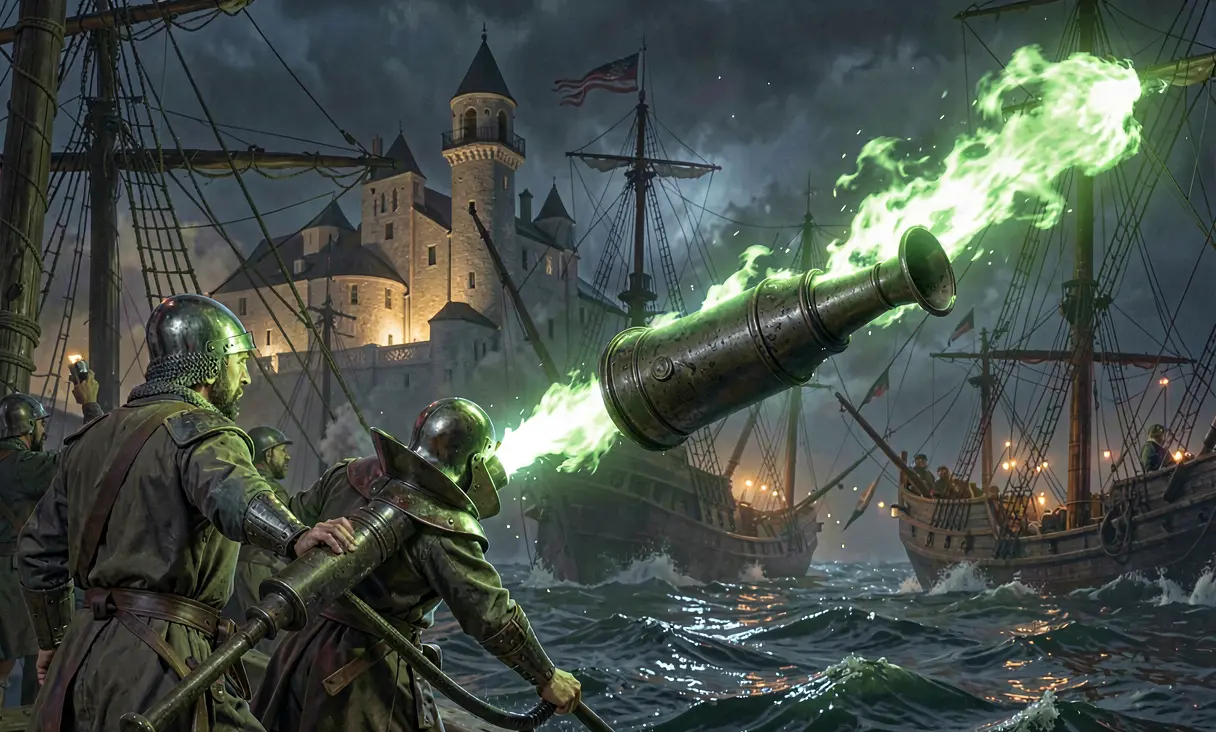 TechnologyInvention of Greek Fire by Kallinikosc. 673 CE · Constantinople, TurkeyByzantine engineers develop a liquid incendiary weapon that burns on water.
 TechnologyDiscovery of Gunpowder by Tang Dynasty Alchemistsc. 850 CE · Chang'an, ChinaTang alchemists accidentally discover gunpowder while seeking an elixir of immortality.
 TechnologyUse of Astrolabes for Celestial Navigation by Arab Sailorsc. 1000 CE · Jeddah, Saudi ArabiaArab navigators utilize refined astrolabes to cross the Indian Ocean.
 WarLe Dynasty Restoration (Lam Son Uprising)1418 CE · Lam Son (Thanh Hoa, Vietnam)Le Loi initiates the Lam Son Uprising against Ming occupation.
 WarMing Occupation of Vietnam Ends1427 CE · Dong Da (Hanoi), VietnamLe Loi defeats the Ming army at Dong Da, ending occupation.
 PoliticsLe Loi Crowned Emperor of Dai Viet1428 CE · Hanoi (Thang Long), VietnamLe Loi is crowned Le Thai To, founding the Later Le Dynasty.
Discussion
Loading…