
Aurangzeb's Decades-Long Deccan Campaign
Aurangzeb's twenty-seven-year Deccan campaign drained the Mughal treasury and overextended military resources, failing to subdue the Marathas while accelerating the empire's irreversible decline.
The Imperial Gambit in the Deccan
In 1681, Emperor Aurangzeb made a decision that would irrevocably alter the trajectory of South Asian history: he abandoned the traditional Mughal capitals of Delhi and Agra to establish his court permanently in the Deccan. At nearly seventy years old, the sixth Mughal emperor moved with his entire administration, army, and harem to Aurangabad, a strategic hub on the edge of the plateau. This was not merely a military maneuver but a profound political statement; Aurangzeb sought to personally crush the rising Maratha power under Sambhaji, son of Shivaji, and finally annex the independent Sultanates of Bijapur and Golconda that had long resisted Mughal suzerainty. The shift marked the beginning of a twenty-seven-year campaign that would consume the empire's vast resources.
The Antagonists: Marathas, Bijapur, and Golconda
Aurangzeb faced a complex triad of adversaries. The Sultanates of Bijapur (Adil Shahi) and Golconda (Qutb Shahi), though weakened by internal strife, possessed formidable fortifications and wealth derived from the diamond mines of Kollur. However, the most elusive foe was the Maratha Confederacy. Following the death of Chhatrapati Shivaji in 1680, his son Sambhaji inherited a kingdom defined by *ganimi kava* (guerrilla warfare). The Marathas utilized the rugged terrain of the Western Ghats, retreating into impregnable hill forts like Raigad and Pratapgad whenever Mughal forces advanced, only to strike supply lines with lightning speed. Unlike the conventional pitched battles the Mughals were trained for, this was a war of attrition against an enemy that refused to be pinned down.
The Grind of Conquest and Stalemate
The campaign unfolded in two distinct phases. Initially, Aurangzeb achieved spectacular conventional victories; by 1686, the Mughal armies had besieged and captured Bijapur, and by 1687, Golconda fell after a grueling siege that saw the execution of its ruler, Abul Hasan Qutb Shah. The Deccan Sultanates were formally annexed into the empire. Yet, these successes proved hollow regarding the Marathas. Despite capturing Sambhaji in 1689 and executing him in 1689, the Maratha resistance did not crumble; it fractured and reformed under new leaders like Rajaram and later Tarabai. The Mughal army, numbering over half a million men including camp followers, found itself bogged down in a quagmire of endless skirmishes. The massive logistical burden required to feed such an army in the Deccan's harsh climate drained the imperial treasury, while the Marathas continued to raid Mughal territories with impunity.
The Cost of Imperial Overreach
By the time Aurangzeb died in 1707 at the age of eighty-nine, he had spent nearly his entire reign in the Deccan. The campaign had cost an estimated 60 million rupees annually, a sum that exhausted the accumulated wealth of Akbar and Shah Jahan's eras. The constant warfare prevented the consolidation of Mughal authority; provinces in the north were left under-garrisoned, inviting rebellion from Rajputs, Sikhs, and Jats. Furthermore, the emperor's rigid religious policies alienated potential allies among the Deccan's Hindu population, who increasingly viewed the Marathas as defenders of their faith rather than rebels against the state. The Mughal military machine, once the most formidable in Asia, was stretched to its breaking point, unable to achieve a decisive final victory despite decades of presence.
Legacy and the Seeds of Decline
The death of Aurangzeb in 1707 marked the end of an era but not the beginning of peace. The Marathas, having survived the empire's greatest assault, emerged stronger and more organized, eventually filling the power vacuum left by the retreating Mughals. The Deccan Campaign is widely regarded by historians as the turning point in the decline of the Mughal Empire. It demonstrated that sheer military might could not conquer a determined insurgency supported by local geography and popular sentiment. The financial ruin incurred during these decades left Aurangzeb's successors with an empty treasury and a fractured realm, accelerating the fragmentation of India into competing regional powers.
Aurangzeb's prolonged Deccan campaign exhausted the Mughal Empire's resources and accelerated its fragmentation by empowering regional powers like the Marathas.


Where it happened
Deccan Plateau, India — see it on the interactive map →
Explore related history
 WarBabur's Victory at Panipat and Founding of Mughalsc. 1526 CE · Panipat (modern Haryana/India)Babur defeats the Lodi Sultanate at the First Battle of Panipat, establishing the Mughal Empire in India.
 WarSack of RomeMay 6, 1527 · Rome, ItalyMutinous troops of Charles V brutally loot Rome, ending the High Renaissance.
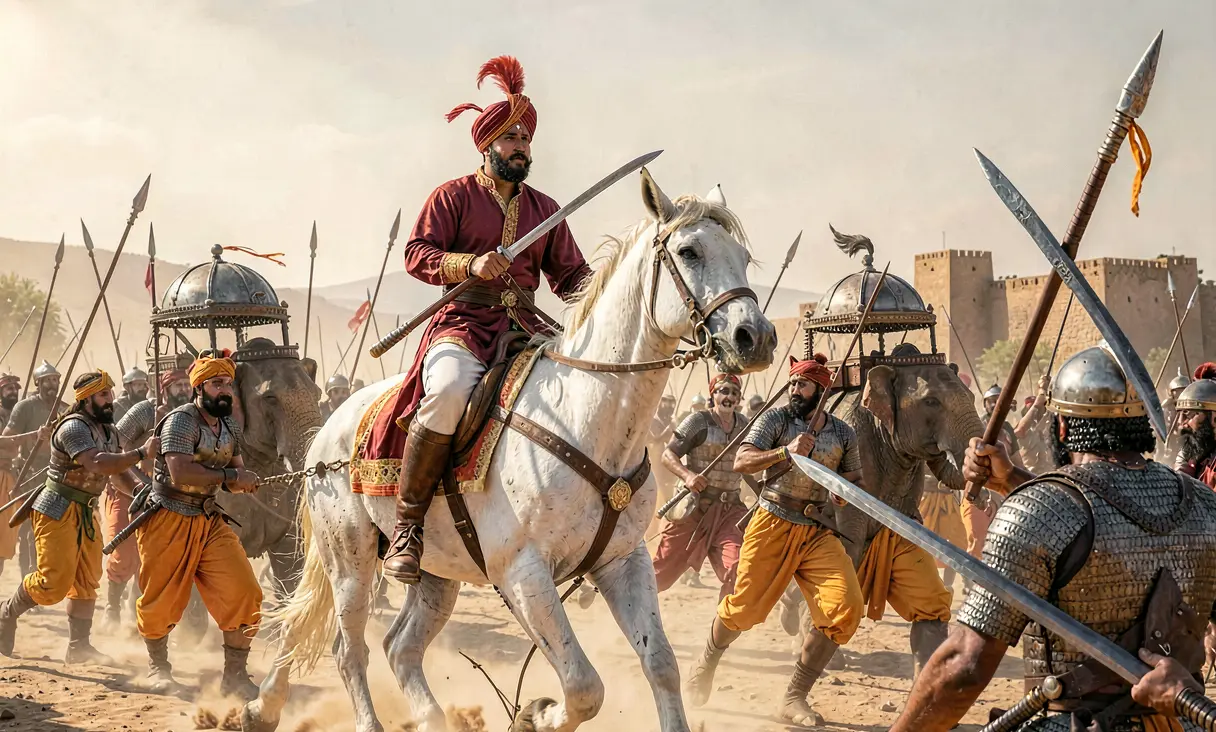 WarBabur's Victory at Khanwac. 1527 CE · Khanwa, Rajasthan, IndiaBabur defeats the Rajput confederacy led by Rana Sanga, consolidating Mughal rule over North India.
 ReligionBirth of Bulleh Shahc. 1680 CE · Uch (modern Pakistan)The birth of Bulleh Shah, a pivotal Sufi poet who challenged religious orthodoxy and promoted universal love.
 SciencePublication of Newton's PrincipiaJuly 5, 1687 CE · Cambridge, EnglandIsaac Newton defines laws of motion and universal gravitation revolutionizing physics.
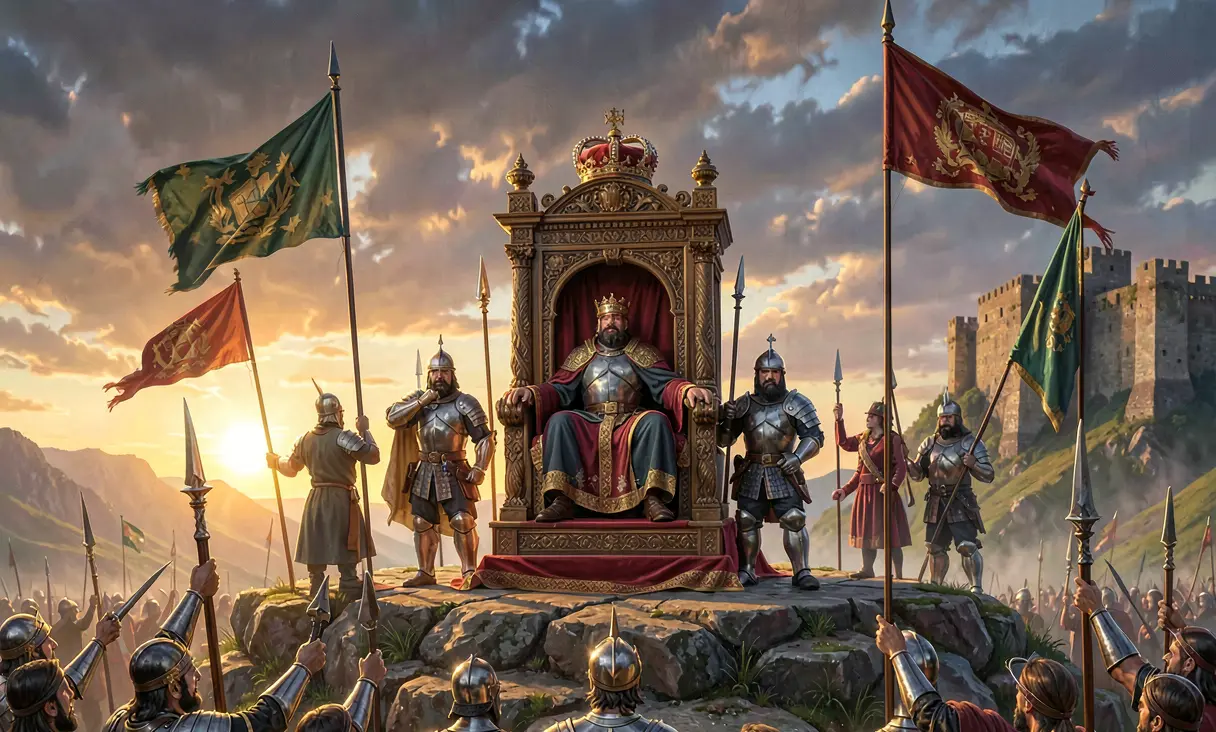 PoliticsShivaji Maharaj Coronation and Maratha Empirec. 1674 CE · Raigad Fort (modern Maharashtra/India)Chhatrapati Shivaji is crowned as the sovereign ruler of the Marathas, establishing an independent Hindu kingdom against Mughal dominance.
Discussion
Loading…