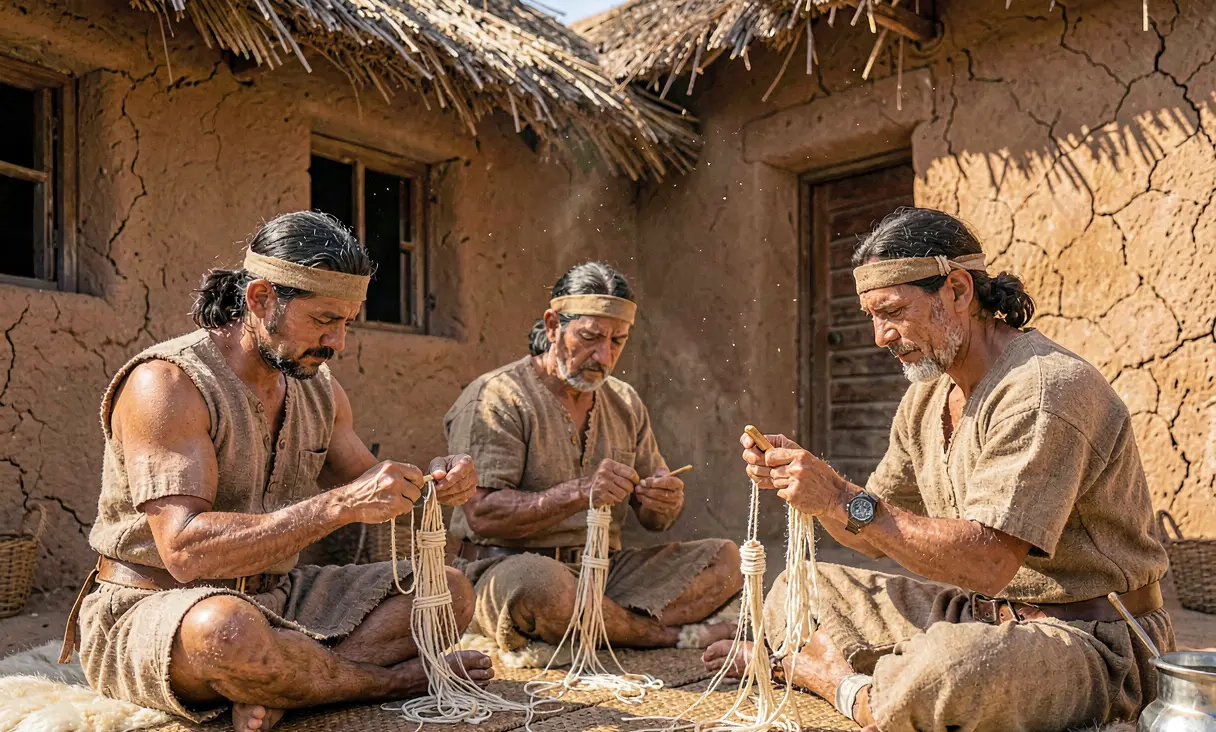
Standardization of the Quipu System in the Andes
Around 1200 CE, Inka administrators standardized the quipu into a decimal-based, color-coded data system, enabling the first non-written empire to manage vast resources and complex logistics across th
Context of Imperial Expansion
By the early 13th century, the polity centered in Cusco was transitioning from a local chiefdom into a nascent imperial power. The Andean highlands presented unique administrative challenges: a rugged geography that fragmented communities and a lack of a traditional written script to record laws, census data, or tribute obligations. In this vacuum, the quipu (Quechua for 'knot') evolved from a simple mnemonic device used by local curacas into a sophisticated state technology. This period marked a critical inflection point where administrative necessity drove the formalization of a complex, three-dimensional recording system capable of managing resources across diverse ecological zones.
The Standardization Event
Around 1200 CE, under the leadership of early Inka rulers such as Sinchi Roca or Lloque Yupanqui, a concerted effort was made to standardize the quipu system. Prior to this, knotting practices varied significantly between regions and lineages. The new standardization introduced a rigid decimal positional system, where knots placed at specific intervals along a primary cord represented units, tens, hundreds, and thousands. This mathematical precision allowed for the accurate tracking of agricultural yields in maize and potatoes, the movement of llamas, and population censuses. Furthermore, color-coding was codified to denote categories: yellow for gold, red for soldiers, and white for silver or peace treaties, creating a universal visual language understood by administrators from Cusco to the frontiers.
The Quipucamayocs
The execution of this standardized system relied entirely on a specialized class of bureaucrats known as quipucamayocs, or 'knot keepers.' These were not merely scribes but highly trained specialists who underwent rigorous instruction to memorize the intricate syntax of the knots. Their role was dual: they encoded data onto the strings and, crucially, could decode and recite the information from memory when presenting reports to the Sapa Inka or local governors. The existence of this professional class suggests a centralized curriculum in Cusco, ensuring that a quipu created in the southern provinces could be accurately read by an official in the capital, thereby unifying the administrative logic of the expanding realm.
Mechanics of the System
The technical sophistication of the standardized quipu lay in its ability to encode both quantitative and qualitative data simultaneously. While numerical values were represented by specific knot types—such as single knots for tens, long knots with multiple turns for units, and figure-eight knots for ones—the narrative or categorical information was embedded in the string's color, ply direction (S or Z twist), and the hierarchical arrangement of pendant strings attached to a main cord. This allowed a single artifact to function as a ledger, a census record, and potentially a historical chronicle. The system's three-dimensionality meant that data could be accessed by touch, making it an effective tool for blind administrators or in low-light conditions within government storehouses (qollqa).
Administrative Impact
The immediate aftermath of this standardization was the consolidation of Inka control over the Cusco region and its rapid expansion into neighboring valleys. With a reliable method to audit tribute and manage labor drafts (mit'a), the state could mobilize resources with unprecedented efficiency. The quipu became the backbone of the vertical archipelago system, allowing the central government to coordinate production between highland pastoralists and lowland agriculturalists. This data-driven governance enabled the Inka to sustain a growing population and fund massive infrastructure projects, including road networks and terrace farming, without the logistical collapse that often plagued pre-industrial empires.
Legacy and Historical Significance
Although the Spanish conquest in the 16th century led to the systematic destruction of most quipus by colonial authorities who viewed them as pagan idols, the legacy of this standardization remains profound. It stands as one of history's few examples of a complex, non-linguistic writing system capable of managing a vast empire. Modern studies have revealed that some surviving quipus may encode narrative histories or even phonetic information, challenging the Eurocentric definition of 'writing.' The 1200 CE standardization represents a pinnacle of Andean intellectual achievement, demonstrating that complex data management and statecraft can flourish without alphabetic scripts.
Conclusion
The formalization of the quipu system around 1200 CE was not merely a technological innovation but a foundational act of state-building. It transformed the Inka from a regional power into a bureaucratic empire capable of integrating diverse cultures under a single administrative logic. By mastering the art of the knot, the Andean civilization created a unique information age that predated and rivaled contemporary written systems in its utility for governance, leaving an enduring mark on human history.
The quipu was the administrative backbone of the Inca Empire, demonstrating a unique non-literate method for complex data management.


Where it happened
Cusco Region, Peru — see it on the interactive map →
Explore related history
 TechnologyInvention of Greek Fire by Kallinikosc. 673 CE · Constantinople, TurkeyByzantine engineers develop a liquid incendiary weapon that burns on water.
 TechnologyDiscovery of Gunpowder by Tang Dynasty Alchemistsc. 850 CE · Chang'an, ChinaTang alchemists accidentally discover gunpowder while seeking an elixir of immortality.
 TechnologyUse of Astrolabes for Celestial Navigation by Arab Sailorsc. 1000 CE · Jeddah, Saudi ArabiaArab navigators utilize refined astrolabes to cross the Indian Ocean.
 CivilizationRise of Swahili City-States on the East African Coastc. 1200 CE · Kilwa Kisiwani, TanzaniaSwahili city-states flourish as cosmopolitan hubs of Indian Ocean trade, blending African and Islamic cultures.
 ScienceMaya Astronomical Tables in the Dresden Codexc. 1200 CE · Yucatán Peninsula, MexicoMaya astronomers record precise calculations for Venus cycles and eclipses.
 ArtConstruction of Qutub Minar Beginsc. 1199 CE · Delhi, IndiaQutb-ud-din Aibak begins construction of the Qutub Minar, a victory tower symbolizing the establishment of the Delhi Sultanate.
Discussion
Loading…