
Domestication of Wheat
The domestication of wild emmer wheat around 9500 BCE in the Fertile Crescent triggered the Neolithic Revolution, enabling food surpluses, permanent settlements, and the rise of complex civilization.
The Wild Ancestors of the Fertile Crescent
Long before the first city rose from the dust of Mesopotamia, the Levant and Upper Mesopotamia were home to a rich mosaic of wild grasses. Among these, wild emmer wheat (Triticum dicoccoides) thrived in the hilly flanks of the Zagros Mountains and the Jordan Valley. Unlike its domesticated descendants, this ancestor possessed a brittle rachis—a stem that shattered upon ripening to scatter seeds naturally, ensuring propagation but making harvest inefficient for human gatherers. For millennia, Natufian hunter-gatherers harvested these grains using sickles made of flint blades set in bone or wood handles, processing them into coarse breads and porridges. However, the transition from opportunistic foraging to intentional cultivation required a fundamental shift in human behavior and ecological interaction.
The Genesis of Agriculture c. 9500 BCE
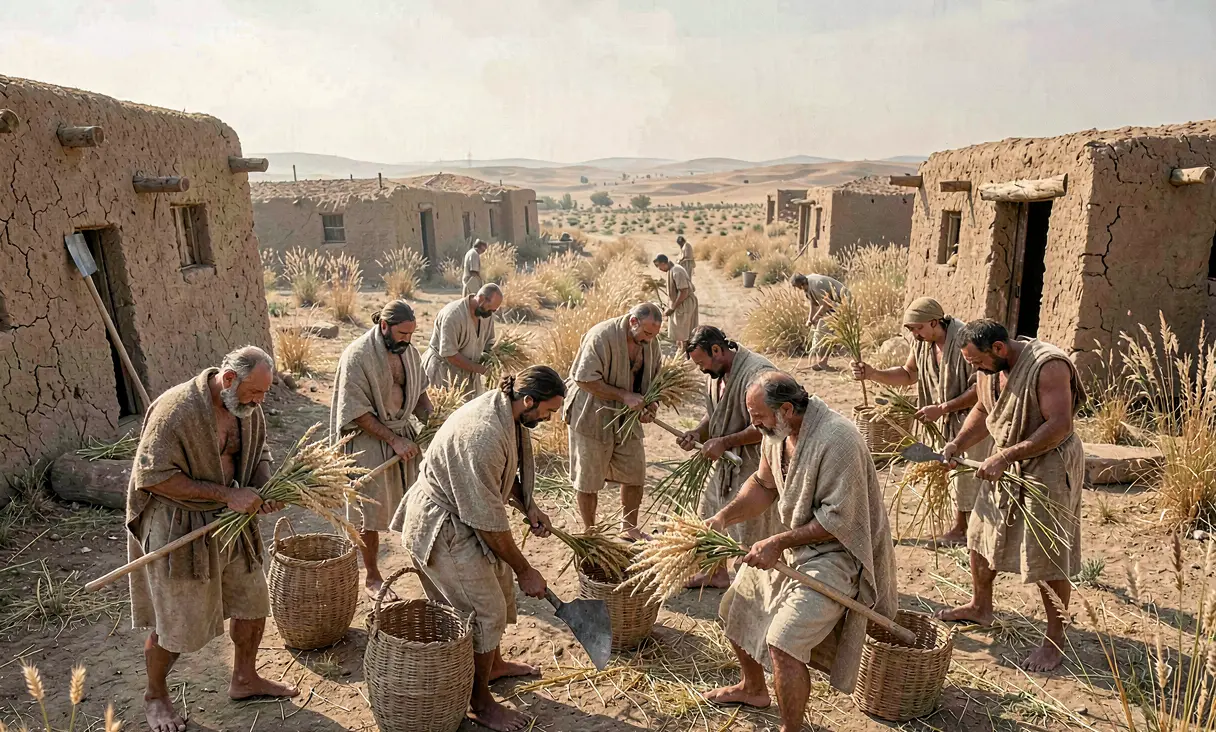
Around 9500 BCE, during the Pre-Pottery Neolithic A (PPNA) period, a silent revolution began in the Fertile Crescent. Archaeological evidence from sites such as Abu Hureyra in Syria and Göbekli Tepe in southeastern Turkey suggests that human groups started manipulating their environment rather than merely adapting to it. This was not an instantaneous discovery but a gradual process of unconscious selection followed by deliberate breeding. Farmers began sowing seeds collected from plants with non-shattering rachises—mutations that kept the grain attached to the stalk even when ripe, allowing for easier harvesting. Over generations, these traits became fixed in the population, transforming wild emmer into domesticated emmer wheat (Triticum turgidum subsp. dicoccum), a crop dependent on human intervention for its survival.
Mechanisms of Selection and Spread
The domestication process was driven by the unique biology of the grasses and the specific needs of early Neolithic communities. As humans harvested grain with sickles, they inadvertently favored plants that retained their seeds; those that shattered were lost to the ground before collection. By replanting these retained seeds, early farmers accelerated the evolution of a non-shattering phenotype. This genetic bottleneck is confirmed by modern genomic studies, which pinpoint a single origin event in the Karacadag Mountains region of southeastern Turkey and northern Syria around 10,500 years ago. From this cradle, domesticated wheat spread rapidly across the Fertile Crescent, carried by migrating populations and trade networks into Anatolia, Egypt, and eventually Europe and Asia, fundamentally altering the global genetic landscape of cereal crops.
From Surplus to Settlement
The shift to wheat cultivation catalyzed a demographic explosion that reshaped human society. Unlike wild foraging, which required constant mobility to follow game and seasonal plants, agriculture allowed for the storage of caloric surpluses in granaries. This security enabled the establishment of permanent settlements, such as Jericho and Çatalhöyük, where populations swelled from small bands to communities numbering in the thousands. The reliability of wheat harvests reduced the risk of starvation, supporting higher birth rates and denser living conditions. However, this new lifestyle also introduced novel challenges, including increased susceptibility to infectious diseases due to close proximity with humans and domesticated animals, as well as a more monotonous diet that occasionally led to nutritional deficiencies compared to the diverse foraging past.
The Ripple Effects of Grain
The ability to produce surplus food was the prerequisite for the specialization of labor. With not every individual required to procure daily sustenance, societies could support artisans, priests, administrators, and soldiers. This stratification laid the groundwork for complex social hierarchies and the eventual emergence of the first city-states in Sumer and Egypt by 4000 BCE. The management of grain stores necessitated record-keeping systems, which evolved from simple clay tokens into the cuneiform script of the Uruk period. Thus, the domestication of wheat did not merely change what humans ate; it engineered the political, economic, and intellectual structures that define civilization itself.
A Global Legacy
Today, wheat remains one of the world's three primary staple crops, providing roughly 20% of the global human calorie intake. The domestication event in the Fertile Crescent set a precedent for the independent domestication of other cereals, such as rice in China and maize in Mesoamerica, creating a worldwide agricultural network that supports over eight billion people. Yet, this legacy is double-edged; the monoculture farming practices born from this era have driven significant ecological changes, including soil degradation and biodiversity loss. Despite these modern challenges, the genetic and cultural footprint of those first Neolithic farmers in Syria and Iraq remains indelible, marking the moment humanity ceased to be a part of nature's cycle and began to engineer it.
Agriculture enabled population explosions and the rise of complex societies worldwide.

Where it happened
Fertile Crescent, Syria/Iraq — see it on the interactive map →
Explore related history
 PrehistoryFirst Human Settlement of Australiac. 65,000 BCE · Central AustraliaFirst humans arrive in Sahul via sea crossings, marking the earliest migration out of Africa into Oceania.
 PrehistoryCreation of Chauvet Cave Paintingsc. 30,000 BCE · Vallon-Pont-d'Arc, FranceEarly humans create sophisticated animal paintings in deep limestone caves.
 PrehistoryLascaux Cave Paintings Createdc. 17,000 BCE · Dordogne, FranceUpper Paleolithic artists create stunning animal frescoes deep inside limestone caves using natural pigments.
 PrehistoryConstruction of Gobekli Tepec. 9500 BCE · Sanliurfa, TurkeyHunter-gatherers build massive stone circles predating agriculture and pottery, challenging assumptions about civilization origins.
 CivilizationEmergence of Ubaid Culture in Southern Mesopotamiac. 6500 BCE · Tell al-Ubaid, Southern Mesopotamia (Iraq)The Ubaid culture establishes the first widespread agricultural settlement pattern in southern Iraq.
 CivilizationDomestication of Rice in the Yangtze Valleyc. 4000 BCE · Yangtze River Valley, ChinaRice cultivation begins in the Yangtze River valley, transforming East Asian agriculture and supporting massive population growth.
Discussion
Loading…