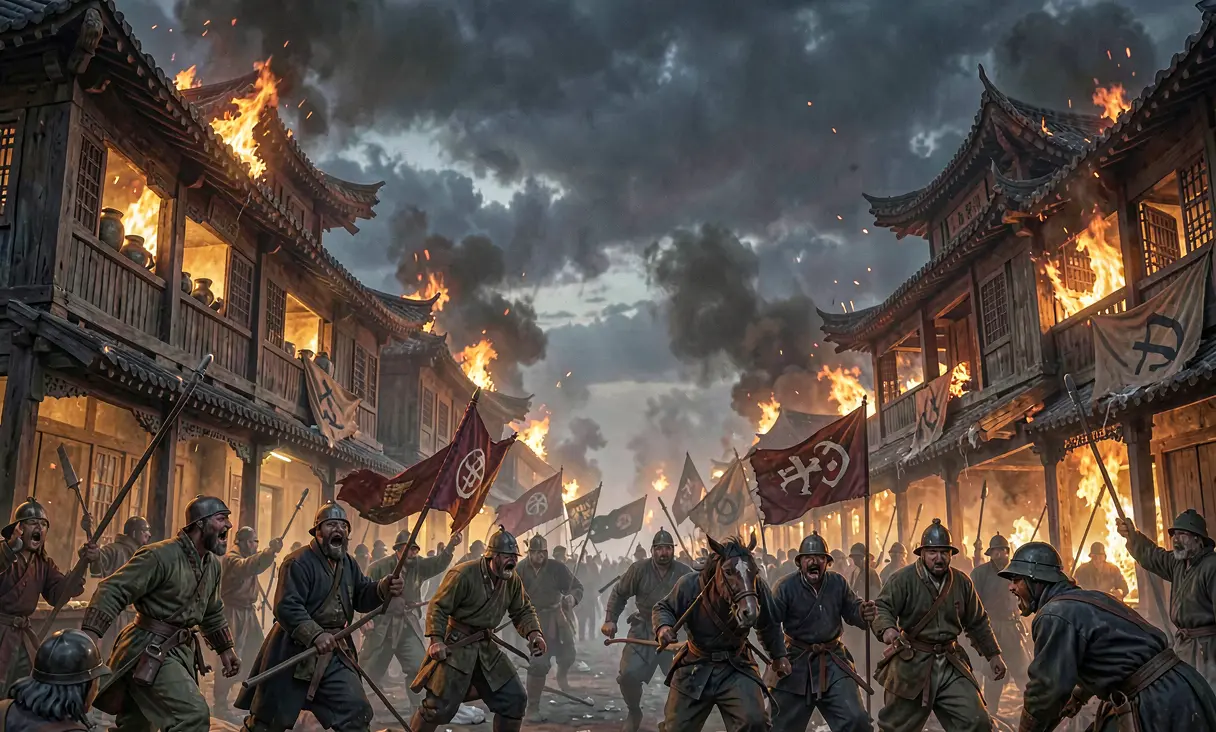
Huang Chao Rebellion and Fall of Tang
Huang Chao's peasant uprising shattered the Tang aristocracy and destroyed central authority, directly causing the dynasty's collapse and ushering in a century of feudal warlordism.
Crisis of the Late Tang
By the mid-9th century, the Tang Dynasty, once the zenith of Chinese civilization, was rotting from within. Decades of eunuch dominance and factional strife among scholar-officials had paralyzed the central court in Chang'an. Simultaneously, a catastrophic series of natural disasters struck the Yellow River basin; severe droughts followed by devastating floods in 874 CE precipitated a famine that left millions starving while local warlords hoarded grain. The imperial tax system, already strained by the An Lushan Rebellion a century prior, collapsed under the weight of corruption and the rise of powerful regional military governors (jiedushi) who withheld revenue from the capital. In this vacuum of authority, the salt trade—a state monopoly—became a flashpoint for social unrest, as desperate peasants turned to smuggling to survive.
The Rise of Huang Chao
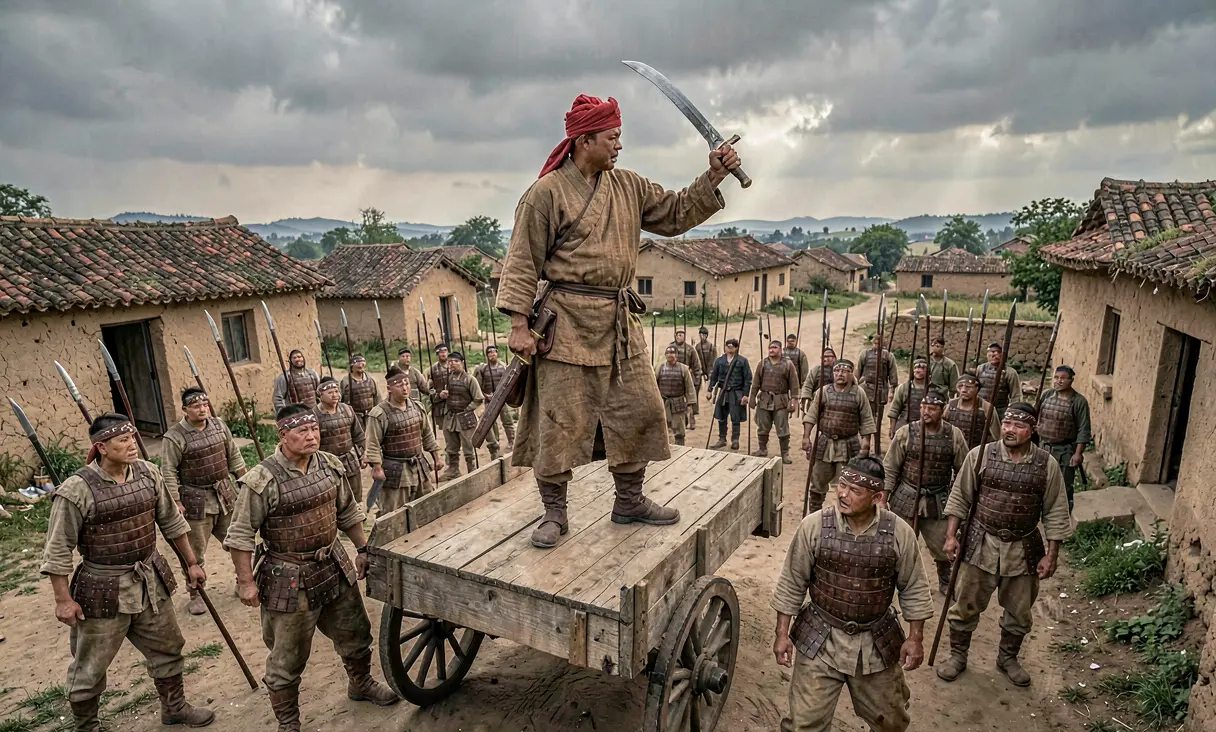
Huang Chao emerged from this turmoil not as a born revolutionary, but as a failed scholar and wealthy salt smuggler from Cao County in Shandong Province. Born into a family that had accumulated wealth through illicit trade, Chao was educated yet repeatedly failed the imperial civil service examinations, fueling his resentment toward the entrenched aristocracy. In 875 CE, following the death of his uncle Wang Xianzhi, who had already ignited a peasant revolt in Henan, Chao gathered thousands of followers and declared himself 'General Who Pacifies the Nation.' Unlike previous uprisings that sought local autonomy, Chao's ambition was total: he aimed to dismantle the Tang order entirely. His forces were a motley coalition of starving peasants, bandits, and disaffected soldiers, unified by a shared hatred for the elite.
The Great March Across China
Between 876 and 880, Chao's army executed one of the most audacious military campaigns in pre-modern history. Avoiding direct confrontation with strong Tang garrisons, they utilized superior mobility to sweep across northern China before turning south into the wealthy Yangtze River valley. In a stunning display of strategic daring, they crossed the formidable Qinling Mountains and seized the southern capital of Luoyang in late 879, only to continue their march westward. By late 880, having sacked Guangzhou and executed thousands of Arab and Persian merchants who had settled there, Chao's forces, now swollen to over 600,000 men, approached the capital Chang'an. The Tang court, paralyzed by internal purges and unable to raise an effective defense, watched in horror as the rebel vanguard breached the city gates.
The Sack of Chang'an and the Qi Dynasty
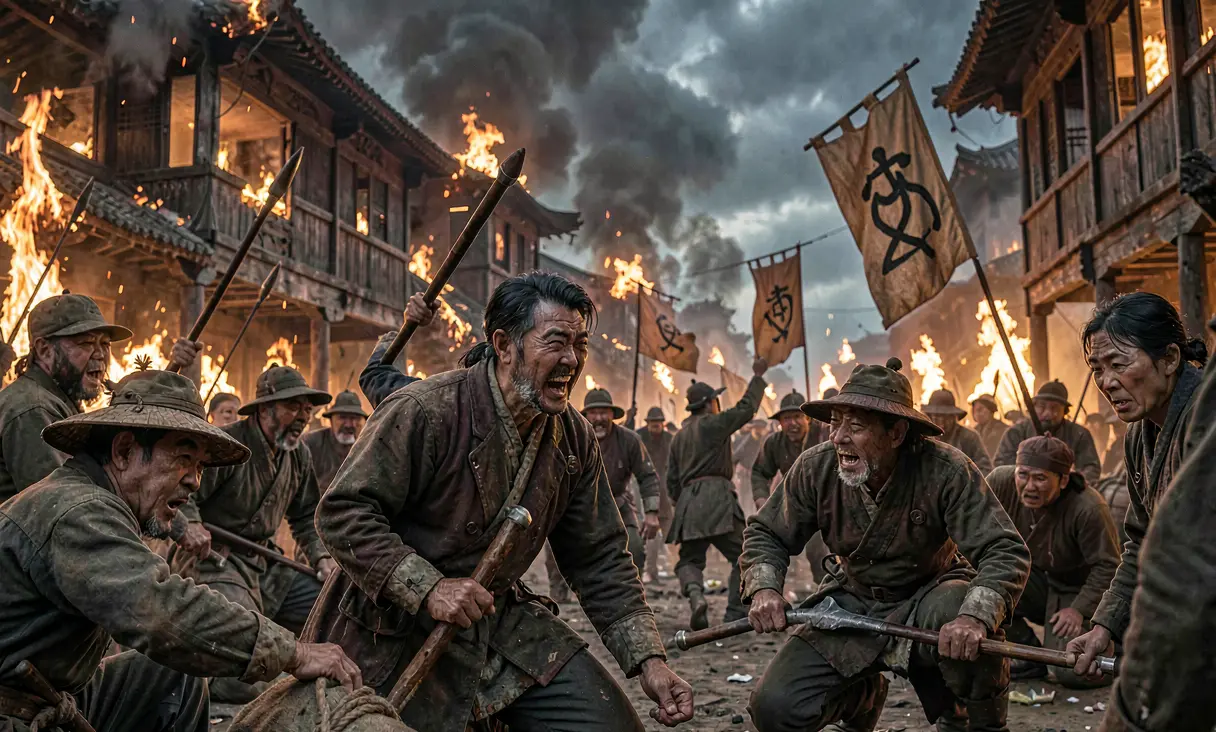
In December 880, Emperor Xizong fled Chang'an for Sichuan, leaving the city to Huang Chao. The rebels entered with a mix of initial popular support and brutal retribution; they systematically purged the aristocratic clans that had dominated Tang politics for centuries, executing thousands of officials and their families in what became known as the 'Great Purge.' In January 881, Chao proclaimed himself Emperor of the new Qi Dynasty, establishing his capital in Chang'an. However, his regime was short-lived and plagued by administrative incompetence. Cut off from the grain supplies of the south due to Tang loyalist blockades, the rebel army descended into famine-induced chaos within the city walls, turning the populace against them as they resorted to cannibalism and indiscriminate looting.
The Shatuo Intervention and Collapse
The tide turned when Li Keyong, a Shatuo Turkic warlord serving the Tang, answered the Emperor's call for aid. In 883, Li Keyong led a formidable cavalry force that broke the rebel siege lines and drove Huang Chao out of Chang'an. The retreat was disastrous; the Qi army disintegrated as they fled eastward, pursued by loyalist forces under Zhu Wen, another former rebel who had defected to the Tang side. In 884, cornered at the Wolf Mountain Pass in Henan, Huang Chao committed suicide rather than face capture, marking the end of his personal rebellion. Yet, the victory was hollow for the Tang; the central government had relied entirely on regional warlords like Li Keyong and Zhu Wen to save it, effectively ceding all real military power to them.
Legacy and the End of an Era
The Huang Chao Rebellion did not merely weaken the Tang Dynasty; it obliterated its foundations. The systematic destruction of the great aristocratic clans, which had served as the dynasty's administrative backbone for centuries, left a power vacuum that no central authority could fill. The warlordism that followed plunged China into the chaotic Five Dynasties and Ten Kingdoms period (907–960), a half-century of fragmentation before the Song Dynasty achieved reunification. Historically, this event marks the definitive end of classical Chinese aristocracy and the transition toward a more meritocratic but militarized society. The rebellion demonstrated that without effective central governance, even the most powerful empire could crumble under the weight of social inequality and regional ambition.
Huang Chao's uprising obliterated the old aristocratic order and accelerated the collapse of the Tang, reshaping China's social hierarchy permanently.
Where it happened
Shandong Province, China — see it on the interactive map →
Explore related history
 WarAlgerian War of Independence BeginsNovember 1, 1954 · Algiers, AlgeriaThe National Liberation Front launches coordinated attacks marking the start of the Algerian War against France.
 WarMau Mau Uprising Begins in KenyaOctober 20, 1952 · Nairobi, KenyaThe Kikuyu-led Mau Mau rebellion begins against British colonial rule and white settler land ownership.
 WarTurkish War of Independence BeginsMay 19, 1919 · Samsun, TurkeyMustafa Kemal Atatürk lands in Samsun to organize resistance against Allied occupation and the Ottoman Sultanate.
 ArtCarving of Olmec Colossal Headsc. 900 BCE · San Lorenzo Tenochtitlan, MexicoThe Olmec civilization carves massive basalt heads depicting rulers, establishing the first major complex society in Mesoamerica.
 ExplorationFoundation of Kilwa Kisiwani as a Major Trade Hubc. 900 CE · Kilwa Kisiwani, TanzaniaKilwa emerges as a dominant Swahili city-state controlling gold trade from Great Zimbabwe to the Indian Ocean.
 CivilizationConsecration of La Venta's Great Pyramidc. 900 BCE · La Venta, Tabasco, MexicoThe first major pyramid in Mesoamerica is completed at La Venta.
Discussion
Loading…