
Expansion of Transatlantic Cotton Trade
Eli Whitney's 1793 cotton gin revolutionized global textiles by making short-staple cotton profitable, inadvertently triggering an explosive expansion of slavery in the American South.
The Agrarian Bottleneck
By the late 18th century, the American South faced a critical economic paradox. While global demand for cotton was surging due to the nascent Industrial Revolution in Britain and New England, the region's agricultural potential remained stifled by biological constraints. Short-staple cotton, or 'upland' cotton, could thrive in the diverse climates of the interior Georgia and Carolinas, unlike the delicate Sea Island variety restricted to coastal zones. However, this hardy crop possessed a tenacious affinity for its green seeds; removing them required laborious manual extraction that yielded only one pound of clean fiber per day by a single enslaved worker. This inefficiency rendered short-staple cotton cultivation unprofitable, leaving the South reliant on tobacco and rice markets while the global textile industry starved for raw material.
The Savannah Workshop
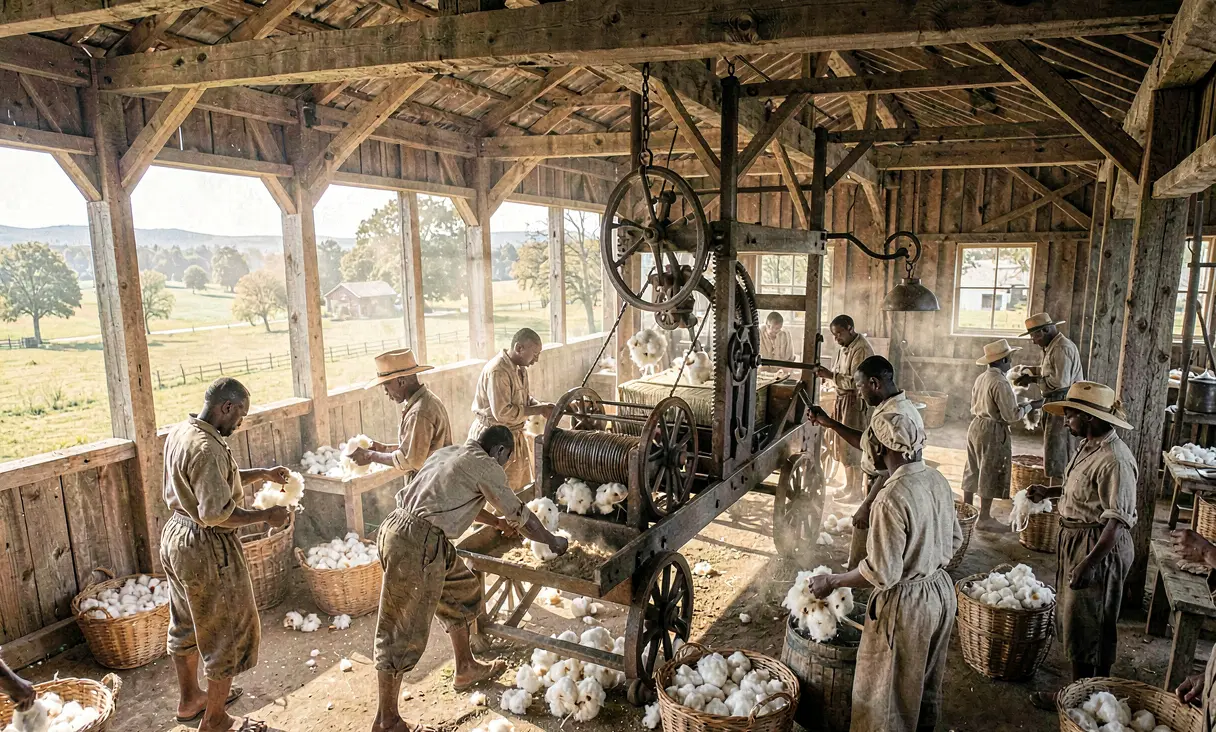
In the winter of 1793, Eli Whitney, a Yale graduate who had traveled to Georgia seeking employment as a tutor, found himself at the plantation of Catherine Littlefield Greene in Savannah. Following the death of her husband, General Nathanael Greene, Mrs. Greene offered Whitney hospitality and access to her workshop. Observing the desperate need for a solution to the seed-separation problem among local planters, Whitney applied his mechanical ingenuity to the challenge. Within weeks, he constructed a rudimentary but revolutionary device: a wooden cylinder studded with wire teeth that rotated against a stationary grid. As the cylinder turned, the teeth pulled the cotton fibers through the narrow slots of the grid, leaving the seeds behind, which were then scraped off by a rotating brush.
From Prototype to Profit
The impact of Whitney's invention was immediate and staggering. Prior to the gin, processing one pound of cotton required an entire day of labor; with the machine, a single worker could process fifty pounds in the same timeframe. This tenfold increase in efficiency transformed short-staple cotton from a marginal crop into the most lucrative commodity in the American South. Planters rapidly converted vast tracts of land in Georgia, Alabama, and Mississippi to 'King Cotton' cultivation. The technology spread with alarming speed; despite Whitney's attempts to secure patents, the design was easily replicated and pirated across the region, making the machine ubiquitous within a few years.
The Paradox of Liberation
Contrary to the hope that mechanization would reduce the need for human labor, the cotton gin had the opposite effect. By making the processing of cotton so cheap and fast, the invention shifted the economic bottleneck from processing to cultivation. The profitability of cotton skyrocketed, creating an insatiable demand for field hands to plant, tend, and harvest the expanding crop. Consequently, the domestic slave trade exploded as the Upper South sold enslaved people to the Deep South's new 'Cotton Kingdom.' Between 1790 and 1860, the number of enslaved people in the United States grew from approximately 700,000 to nearly four million, cementing slavery as the central engine of American economic growth.
Global Industrial Catalyst
The ripple effects of this technological shift extended far beyond Georgia's borders. The sudden abundance of cheap raw cotton fueled the textile mills of Manchester and Lowell, accelerating the pace of the Industrial Revolution in Europe and America. By 1820, cotton accounted for nearly half of all U.S. exports, earning the title 'King Cotton' and giving the Southern states disproportionate political power within the federal government. The global economy became inextricably linked to this agrarian slave system, creating a complex web where British industrial machinery depended entirely on American forced labor.
A Legacy of Conflict
The cotton gin did not merely change an agricultural method; it fundamentally altered the trajectory of Western history. By entrenching slavery more deeply into the economic fabric of a nation that professed liberty, it created an irreconcilable tension between the industrial North and the agrarian South. This economic divergence, rooted in the 1793 invention, fueled decades of political crisis, culminating in the American Civil War. The machine that promised efficiency ultimately forged the chains of a conflict that would redefine the nation's boundaries and its moral conscience.
The cotton gin mechanized agriculture on a massive scale, fueling the Industrial Revolution while tragically intensifying the transatlantic slave trade.

Where it happened
Savannah, Georgia, USA — see it on the interactive map →
Explore related history
 TechnologyIntroduction of the Tomato to Europec. 1520 CE · Rome, ItalyTomatoes arrive in Europe from the Americas, revolutionizing global cuisine.
 PoliticsAdoption of Marianne as French Symbolc. 1792 CE · Paris, FranceThe Republic adopts a female allegory representing Liberty and Reason.
 PoliticsHaitian Revolution BeginsAugust 22, 1791 · Saint-Domingue (Haiti)Enslaved people revolt in Saint-Domingue, leading to the first black republic.
 PoliticsStorming of the BastilleJuly 14, 1789 · Paris, FranceRevolutionaries storm the Bastille prison, symbolizing the start of the French Revolution.
Discussion
Loading…