
Invention of Cuneiform Script
Invented in Uruk around 3400 BCE, cuneiform transformed human history by enabling complex administration, preserving literature, and serving as the diplomatic lingua franca of the ancient Near East fo
The Genesis of Administration in Late Uruk
By the late fourth millennium BCE, the city-state of Uruk had emerged as the preeminent urban center in southern Mesopotamia, housing an estimated population exceeding 40,000 souls. This demographic explosion necessitated a radical departure from the egalitarian structures of earlier Neolithic villages toward a complex hierarchical society managed by temple bureaucracies. The sheer volume of agricultural surplus, livestock, and labor required for large-scale irrigation projects overwhelmed traditional mnemonic devices like clay tokens and bullae. In this crucible of urbanization, the need to track rations, allocate land, and manage trade networks became so acute that a new technology was born: not merely a tool for record-keeping, but the very mechanism that would allow human consciousness to transcend the limits of memory.
From Pictographs to Wedge-Shaped Abstraction
The evolution of writing in Uruk was not an instantaneous revelation but a gradual refinement occurring between 3400 and 3100 BCE. Initially, scribes employed reed styluses to carve simple pictographs—direct visual representations of objects like grain, sheep, or jars—into wet clay tablets. These early proto-cuneiform signs were largely logographic, where one symbol equaled one word or concept. However, the physical limitations of carving intricate pictures into soft clay led to a stylistic revolution; scribes began pressing the triangular tip of their stylus at an angle, creating wedge-shaped impressions that could be executed with remarkable speed and uniformity. This shift from drawing to pressing transformed the script from a visual aid into an abstract system capable of representing not just nouns, but also grammatical relationships and phonetic sounds.
The Anonymous Architects of Literacy
Unlike later historical epochs defined by great conquerors or kings, the invention of cuneiform was the collective achievement of anonymous temple scribes whose names have largely been lost to time. These early literati were likely attached to the Eanna district, the sacred precinct dedicated to the goddess Inanna, where the administrative heart of Uruk beat strongest. While no single individual can be credited with this invention, archaeological evidence from the Uruk IV and III levels reveals a standardized curriculum and a highly specialized scribal class. These individuals mastered a system that initially comprised roughly 1,500 distinct signs, eventually reducing this number through standardization to facilitate broader communication across the growing city-state.
The Mechanics of the First Written Records
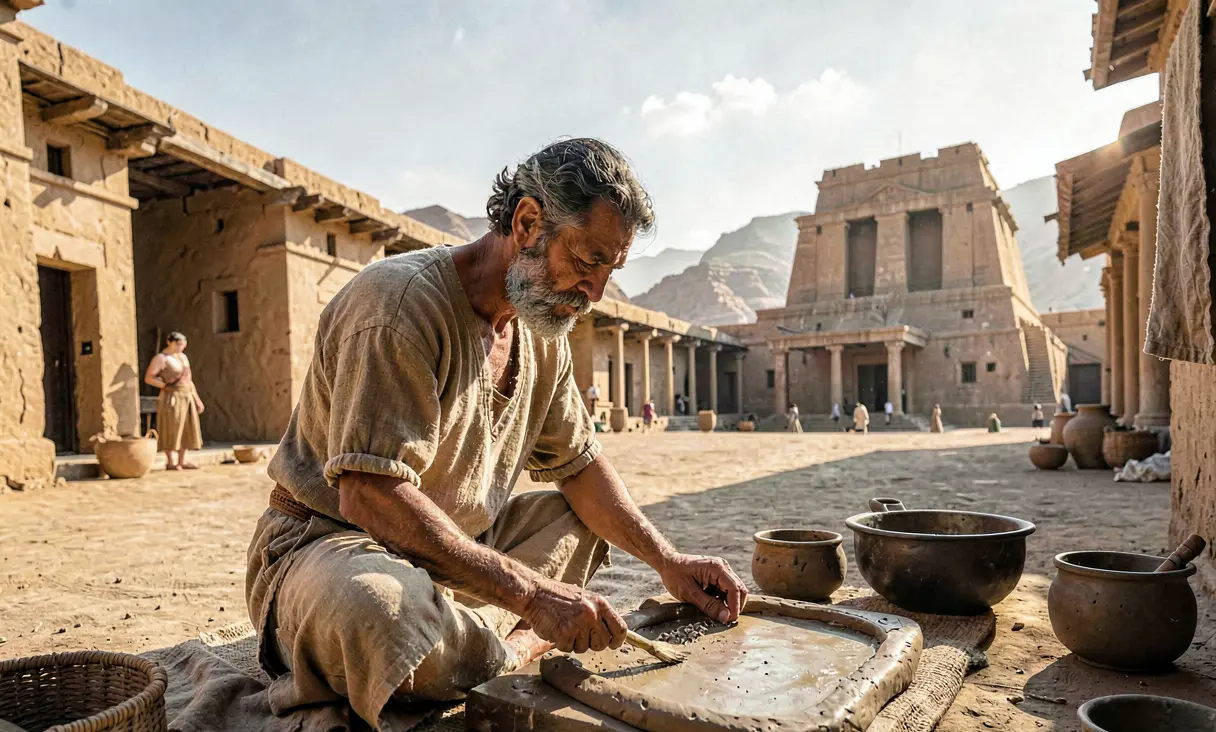
The earliest cuneiform tablets were utilitarian documents, devoid of poetry or philosophy. They served as the ledger books of the ancient world, recording detailed inventories of barley rations distributed to workers, lists of livestock owned by the temple, and records of land transactions. The process was efficient: a scribe would take a lump of damp clay, press it flat, and inscribe the necessary data using a reed stylus before the tablet was dried in the sun or fired in a kiln for permanence. Over time, the script expanded beyond mere accounting; by the Early Dynastic period (c. 2900–2350 BCE), the system had evolved to include syllabic values, allowing scribes to record proper names, dialects, and eventually complex narratives, laying the groundwork for literature.
Consolidation of Power and Cultural Expansion
The adoption of cuneiform fundamentally altered the political landscape of Mesopotamia. It allowed the central authority in Uruk to project power over vast distances, managing resources with a precision previously impossible. This administrative efficiency facilitated the rise of dynastic kingship, as rulers could now codify laws, record military campaigns, and maintain complex diplomatic correspondence. The script spread rapidly from Sumer to Akkad, Elam, and eventually Anatolia and Syria. By the third millennium BCE, cuneiform had become the lingua franca of the ancient Near East, used by the Hittites, Babylonians, and Assyrians alike, serving as the primary medium for international diplomacy and treaty-making for nearly three millennia.
The Enduring Echo in Clay
The legacy of cuneiform extends far beyond its utility as an administrative tool; it represents the dawn of recorded history itself. For over 3,000 years, this script preserved the legal codes of Hammurabi, the astronomical observations that formed the basis of Western astrology, and the epic poetry of Gilgamesh, which explored themes of mortality and heroism that remain relevant today. The thousands of clay tablets unearthed in modern Iraq provide an unbroken chain of human thought, offering direct access to the minds of people who lived five thousand years ago. Without this invention, the vast majority of ancient Mesopotamian civilization would have remained a silent enigma, known only through archaeology and later Greek accounts.
The invention of cuneiform marks the definitive beginning of recorded history and complex bureaucratic governance.

Where it happened
Uruk, Sumer (Modern Iraq) — see it on the interactive map →
Explore related history
 CivilizationEmergence of Ubaid Culture in Southern Mesopotamiac. 6500 BCE · Tell al-Ubaid, Southern Mesopotamia (Iraq)The Ubaid culture establishes the first widespread agricultural settlement pattern in southern Iraq.
 CivilizationDomestication of Rice in the Yangtze Valleyc. 4000 BCE · Yangtze River Valley, ChinaRice cultivation begins in the Yangtze River valley, transforming East Asian agriculture and supporting massive population growth.
 TechnologyAboriginal Fire-Stick Farming Practicesc. 5000 BCE onwards · Central AustraliaAboriginal Australians develop controlled burning techniques to manage landscapes and enhance biodiversity.
 ScienceCodification of Aboriginal Songlines Across Australiac. 5000 BCE onwards · Central AustraliaAboriginal peoples develop Songlines that map the continent through oral narratives and star paths.
 ScienceFinal Domestication of Maize from Teosinte in Mesoamericac. 5000 BCE · Balsas River Valley, MexicoIndigenous farmers selectively breed teosinte into modern maize (corn).
Discussion
Loading…