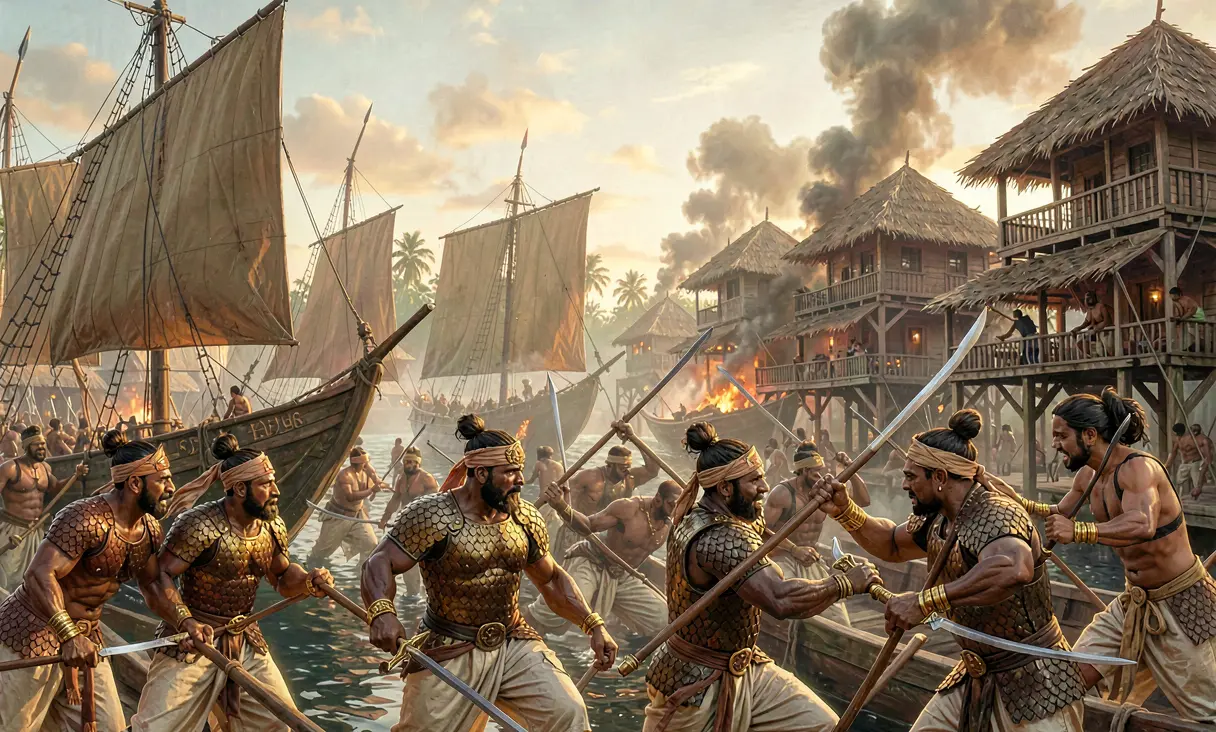
Chola Raid on Srivijaya
Rajendra Chola I's 1025 CE naval raid shattered Srivijaya's monopoly on the Malacca Strait, ending its hegemony and reshaping Southeast Asia's trade landscape forever.
The Maritime Hegemon and the Rising Sun
By the early 11th century, the Srivijaya Empire, centered in Palembang on Sumatra's eastern coast, had established an unchallenged monopoly over the strategic Malacca and Sunda Straits. Controlling the vital chokepoints between the Indian Ocean and the South China Sea, Srivijaya levied heavy tolls on merchant vessels carrying spices from the Indonesian archipelago to China and silk from the East to the West. This economic stranglehold threatened the burgeoning maritime ambitions of the Chola Empire in southern India. Under the dynamic rule of Rajendra Chola I (r. 1014–1044), the Cholas had transformed into a naval superpower, eager to secure direct access to Southeast Asian markets and eliminate the intermediaries who siphoned their profits.
Rajendra's Audacious Naval Strategy
Unlike previous Indian interactions with Southeast Asia, which were largely cultural or diplomatic, Rajendra Chola I orchestrated a massive military expedition designed to shatter Srivijaya's dominance. Historical records from the Tanjore inscriptions detail the assembly of a formidable fleet, likely comprising hundreds of warships and thousands of seasoned soldiers. The campaign was not merely a punitive raid but a calculated strategic maneuver to project Indian power across the Bay of Bengal. Rajendra personally oversaw the preparations, viewing the control of the straits as essential for the economic prosperity of his empire, marking one of the earliest instances of a South Asian power projecting force deep into Southeast Asia.
The Campaign of 1025 CE
In 1025 CE, the Chola armada sailed across the Bay of Bengal, striking with unexpected speed and ferocity. The primary target was Palembang, the capital of Srivijaya, but the raid extended to a dozen other key ports and strongholds throughout Sumatra and the Malay Peninsula. Inscriptions list the conquest of Kadaram (modern Kedah), Panai, and Langasuka, among others. The Chola forces overwhelmed the local defenses, sacking Palembang and seizing immense quantities of treasure, including gold, silver, and precious gems. The speed of the assault suggests a complete surprise to the Srivijayan leadership, who had not anticipated a naval threat from the Indian subcontinent.
The Shattering of Srivijaya
The immediate aftermath of the 1025 raid was catastrophic for the Srivijayan hegemony. While the Cholas did not establish a permanent colonial administration, the destruction of Palembang's infrastructure and the capture of its royal court effectively ended Srivijaya's ability to enforce trade monopolies. The empire fragmented into competing local principalities as regional governors declared independence in the power vacuum. This event marked the end of the 'Golden Age' of Srivijaya, transforming a unified maritime empire into a loose confederation of city-states vying for control over the lucrative spice routes.
Geopolitical Realignments and Trade Shifts
The raid fundamentally altered the balance of power in Southeast Asia. With Srivijaya's central authority broken, new powers such as the Malay kingdom of Dharmasraya and later the Javanese Singhasari and Majapahit empires rose to prominence. The disruption of the old trade routes forced merchants to adapt, often bypassing former Srivijayan toll stations or engaging directly with emerging local ports. For the Chola Empire, the campaign was a resounding success; it secured safer passage for Indian traders and established Rajendra's reputation as a conqueror whose reach extended beyond the Indian subcontinent.
Legacy of the Expedition
The Chola Raid on Srivijaya remains a pivotal moment in maritime history, demonstrating the sophisticated naval capabilities of medieval India. It serves as a testament to the interconnectedness of the ancient world, where political ambitions in South India could directly reshape the geopolitical landscape of Southeast Asia. The event is immortalized in the stone inscriptions at the Brihadeeswarar Temple in Thanjavur, which list the conquered territories with meticulous detail. While Srivijaya eventually recovered some influence, it never regained its former absolute dominance, paving the way for a more fragmented and competitive era of Southeast Asian maritime trade that would define the region for centuries.
The Chola raid broke Srivijaya's monopoly on the spice trade, fragmenting maritime power in the archipelago and altering regional economics for centuries.
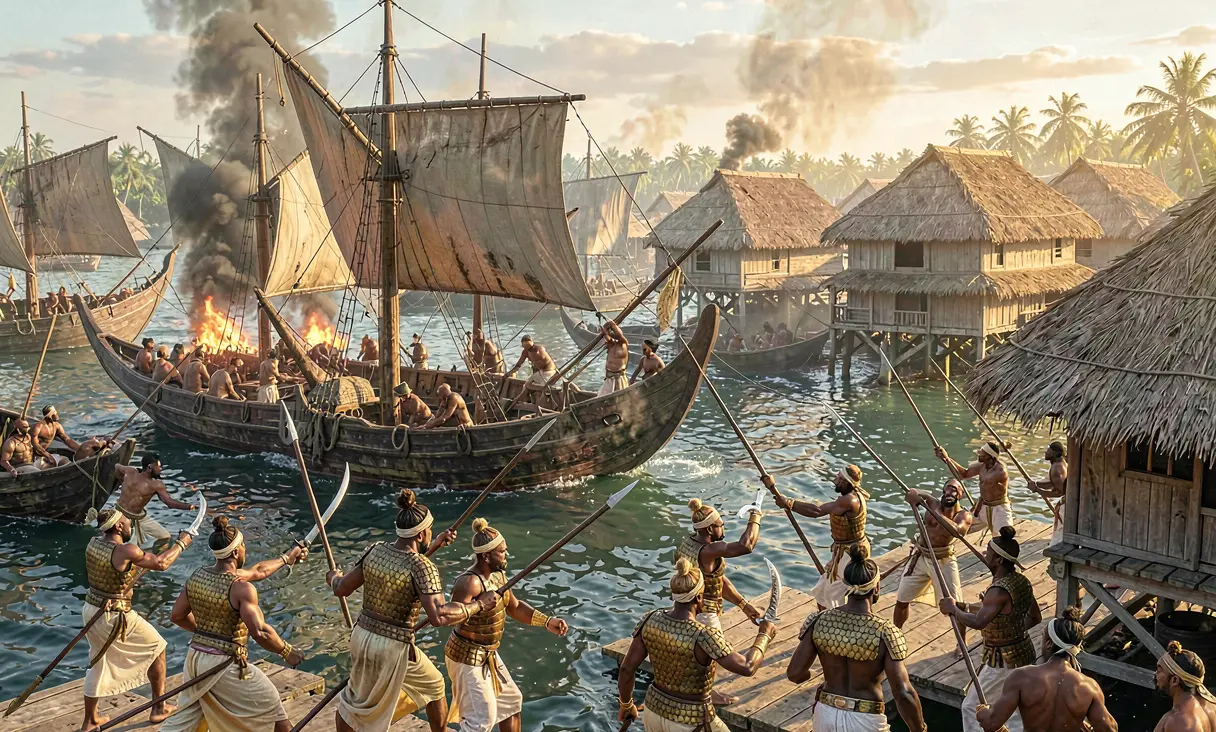

Where it happened
Palembang, Sumatra (Srivijaya) — see it on the interactive map →
Explore related history
 WarAlgerian War of Independence BeginsNovember 1, 1954 · Algiers, AlgeriaThe National Liberation Front launches coordinated attacks marking the start of the Algerian War against France.
 WarMau Mau Uprising Begins in KenyaOctober 20, 1952 · Nairobi, KenyaThe Kikuyu-led Mau Mau rebellion begins against British colonial rule and white settler land ownership.
 WarTurkish War of Independence BeginsMay 19, 1919 · Samsun, TurkeyMustafa Kemal Atatürk lands in Samsun to organize resistance against Allied occupation and the Ottoman Sultanate.
 WarGoryeo Repels Khitan Liao Invasion1018 CE · Pyongan Province, KoreaGeneral Gang Gam-chan defeats the Khitan Liao army at the Battle of Guichu River.
 PoliticsThe Birdman Burial at Cahokia Mound 72c. 1050 CE · Cahokia, Illinois, USAA high-status Mississippian leader is buried with hundreds of sacrificial victims.
 CivilizationConstruction of Monks Mound at Cahokiac. 1050 CE · Cahokia Mounds State Historic Site, Illinois, USAMississippian builders construct the largest pre-Columbian earthwork in North America.
Discussion
Loading…