Zhang Heng's Seismoscope Invention (Revised Context)
In 132 CE, Zhang Heng invented the world's first seismoscope in Luoyang, successfully detecting an earthquake hundreds of kilometers away before it was felt locally.
The Intellectual Climate of the Eastern Han
In the early second century CE, the Eastern Han Dynasty stood at the zenith of its scientific and cultural sophistication. The imperial court in Luoyang fostered an environment where astronomy, mathematics, and engineering were not merely practical arts but essential components of statecraft and cosmic order. Amidst this milieu served Zhang Heng (78–139 CE), a polymath whose genius spanned poetry, cartography, and mechanics. As the Director of Astronomical Observations, Zhang was acutely aware that natural disasters were often interpreted as celestial warnings to the Emperor; however, he sought to demystify these events through empirical observation rather than pure superstition.
The Invention of the Houfeng Didong Yi
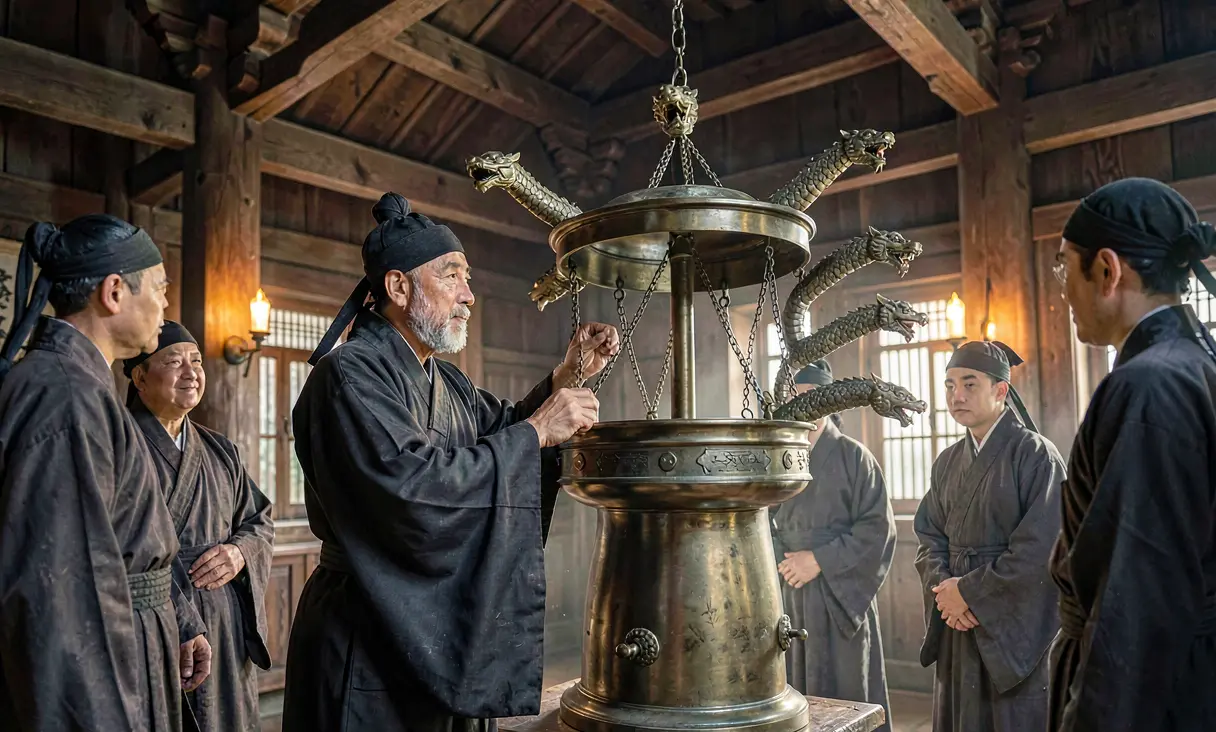
In 132 CE, during the reign of Emperor Shun, Zhang Heng unveiled his masterpiece: the 'Houfeng Didong Yi,' or 'Instrument for Measuring the Seismic Winds and Earth Movements.' This device was a marvel of bronze craftsmanship, standing approximately six feet tall with a cylindrical body resembling an ancient wine vessel. Its exterior was adorned with eight dragons positioned at the cardinal and intercardinal directions, each clutching a bronze ball in its mouth. Directly beneath each dragon sat a bronze toad with an open maw, poised to catch the falling sphere. The innovation lay not in its aesthetic grandeur but in its internal mechanism: a sophisticated inverted pendulum system that could detect minute ground vibrations from any of the eight directions.
The Mechanism and Its Operation
Although the precise engineering drawings were lost to time, historical records describe a central pillar acting as a trigger mechanism. When seismic waves reached Luoyang, they would cause the internal pendulum to sway, activating levers that corresponded to the direction of the tremor's origin. This action would release the ball from the specific dragon facing the epicenter into the waiting toad below, accompanied by a distinct clatter. The device was remarkably sensitive; historical texts note it could detect earthquakes occurring hundreds of kilometers away, distinguishing between distant quakes and local tremors that might be imperceptible to human senses in the capital.
The Longxi Verification
The efficacy of Zhang Heng's invention was dramatically proven shortly after its installation. In 138 CE, a single dragon released its ball, indicating an earthquake from the west-northwest. At that moment, no one in Luoyang felt any shaking, leading some skeptical courtiers to question the device's validity. However, messengers soon arrived from the Longxi commandery (modern-day Gansu province), approximately 400 kilometers away, reporting a devastating earthquake that had occurred on the very same day and hour as the ball fell. This event validated the seismoscope's ability to detect distant seismic activity before it could be felt locally, marking the first instance in recorded history of an instrument successfully detecting an earthquake.
Immediate Impact and Historical Record
The successful detection of the Longxi quake transformed the seismoscope from a curiosity into a vital tool for imperial administration. It allowed the Han government to dispatch relief efforts and assess damage in remote provinces with unprecedented speed, fundamentally changing disaster response protocols. The device was documented in detail by Fan Ye in the 'Book of the Later Han,' which remains the primary source for our understanding of its construction and operation. Despite its success, the technology did not spawn an immediate lineage of similar devices; the intricate craftsmanship required likely limited its replication to the imperial workshop.
Legacy and Modern Rediscovery
For centuries following the fall of the Han Dynasty, the internal mechanism of Zhang Heng's seismoscope remained a mystery, with later dynasties attempting but failing to reconstruct it accurately. It was not until 1936 that Japanese physicist Wadati, and subsequently Chinese scholars like Wang Zhenduo in the 1950s, proposed plausible models based on the surviving textual descriptions. Today, Zhang Heng is celebrated globally as the father of seismology. While his device could not predict earthquakes, its ability to detect them marked a paradigm shift from viewing disasters as purely divine retribution to understanding them as natural phenomena that could be measured and monitored.
This invention marked the first scientific attempt to measure and locate seismic activity, a precursor to modern seismology.

Where it happened
Luoyang, China — see it on the interactive map →
Explore related history
 TechnologyGrand Canal of China Connects North and South610 CE · Luoyang to Hangzhou, ChinaEmperor Yang completes the massive waterway linking the Yellow and Yangtze rivers for transport and grain.
 TechnologyMeroitic Iron Smelting Industry Flourishesc. 500 BCE · Meroe, SudanMeroe develops a massive iron smelting industry using abundant fuel and advanced furnace technology.
 TechnologyConstruction of the Great Cloaca Maxima in Romec. 500 BCE · Rome, ItalyEarly Romans build the massive Cloaca Maxima sewer system to drain marshes and manage waste.
 TechnologyRefinement of Papermaking by Cai Lun in Han China105 CE · Chang'an, ChinaCai Lun standardizes paper production using bark, hemp, rags, and fishing nets.
 ReligionSpread of Buddhism along the Silk Road to Chinac. 100 CE · Kashgar, China (Gateway)Buddhist monks and merchants transmit the religion from India to China via Central Asian trade routes.
 ReligionKanishka I Convenes the Fourth Buddhist Councilc. 100 CE · Kundalavana Monastery, KashmirEmperor Kanishka I sponsors the Fourth Buddhist Council in Kashmir, formalizing Mahayana Buddhism and commissioning massive stupa construction.
Discussion
Loading…