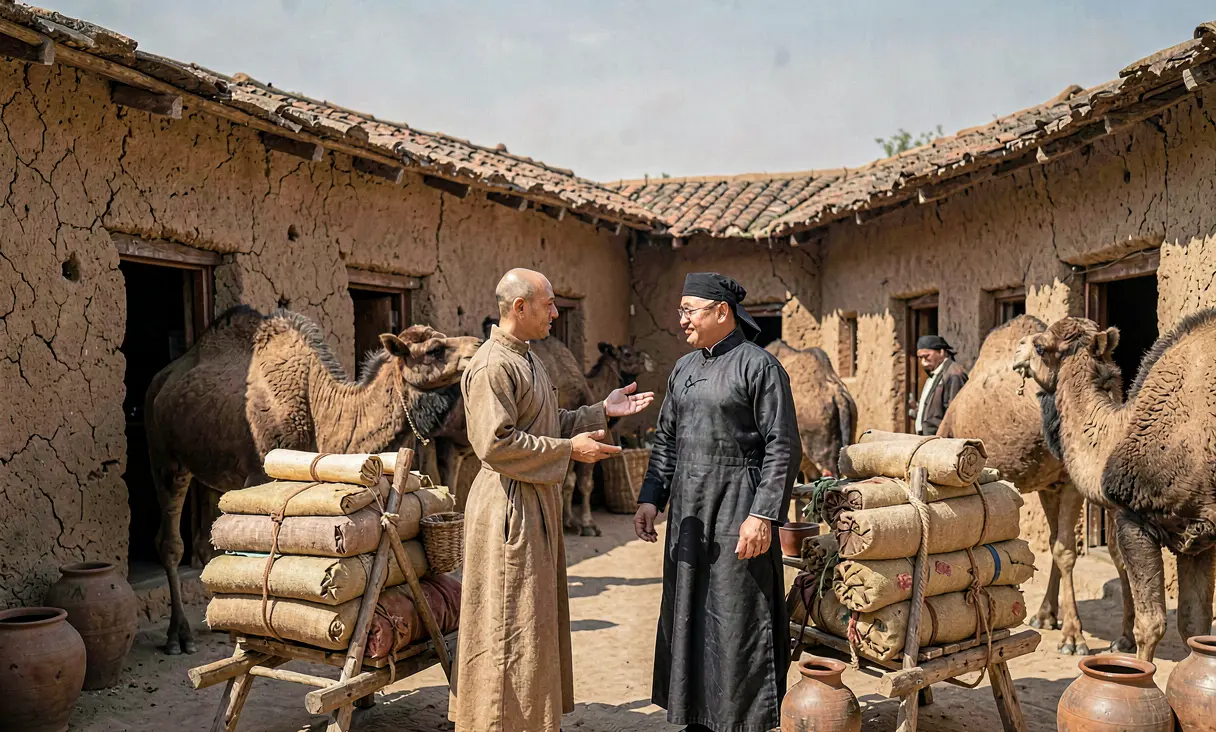
Spread of Buddhism along the Silk Road to China
Indian and Sogdian missionaries transformed Han China by introducing Mahayana Buddhism through Kashgar, sparking a philosophical and artistic revolution that synthesized Greek, Persian, and Indian tra
The Crossroads of Faith
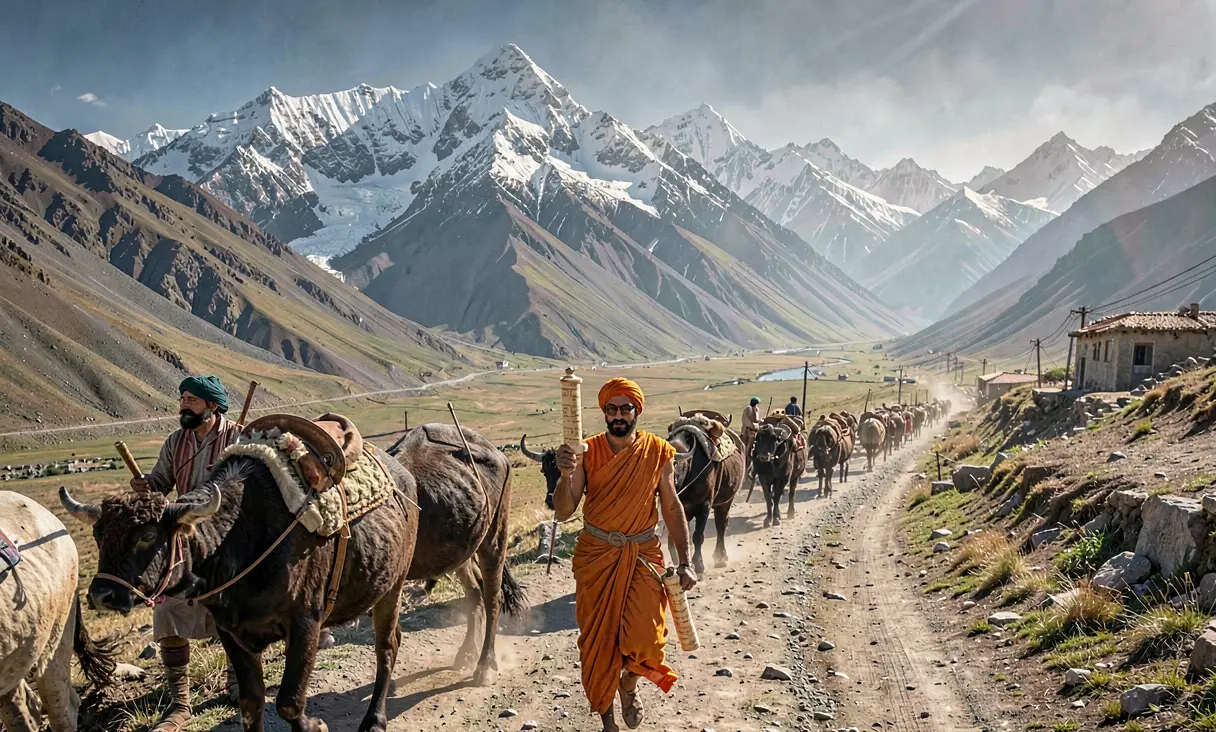
By the late first century CE, the Silk Road had evolved from a mere conduit for luxury goods into a dynamic artery of spiritual exchange. The oasis city of Kashgar, situated at the western edge of the Tarim Basin, served as the critical gateway where the Han Empire met the vast steppes and the Indian subcontinent. It was here that the rigid boundaries of cultural isolation began to dissolve under the weight of traveling merchants, soldiers, and ascetics. While Confucianism and Daoism dominated the Chinese intellectual landscape, a new philosophical current from the south—Mahayana Buddhism—began to seep into the region, carried by Indian monks and Sogdian intermediaries who navigated the treacherous Pamir passes.
The Arrival of Mahayana
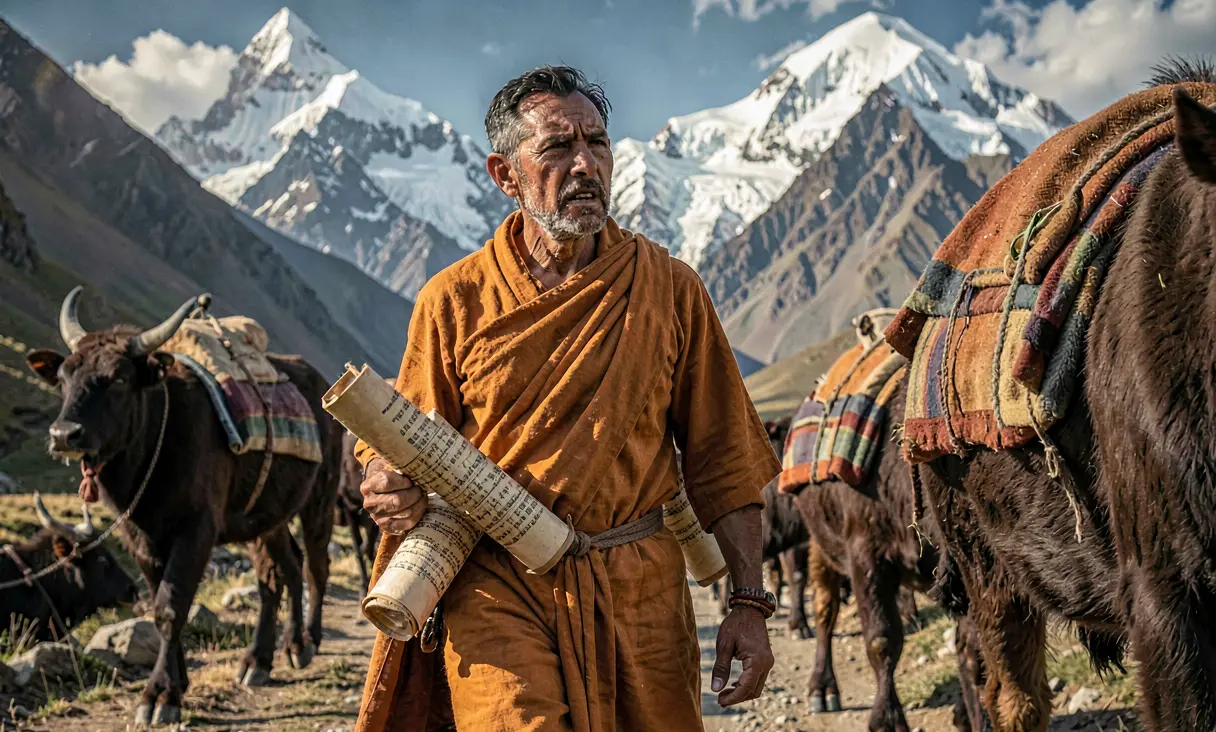
Unlike the earlier Theravada traditions that emphasized individual liberation, the emerging Mahayana school offered a path to universal salvation through the Bodhisattva ideal, a concept that resonated deeply with the Chinese emphasis on social harmony and filial piety. Missionaries such as An Shigao, a Parthian prince who arrived in Luoyang around 148 CE, were not merely preachers but scholars who recognized the necessity of linguistic adaptation. They began the monumental task of translating Sanskrit sutras into Classical Chinese, often employing Daoist terminology to bridge the conceptual gap between Indian metaphysics and Han thought. This was not a passive reception; it was an active, strategic cultural negotiation that required deep mutual understanding.
The Translation Bureau
The transmission of Buddhism relied heavily on the establishment of translation bureaus within imperial courts and major monastic centers. In Kashgar and later in Dunhuang, teams of foreign monks worked alongside Chinese scribes to render complex theological texts into a language that could be understood by the literati. These early translations were often rough, utilizing 'geyi' (matching meanings) to map Buddhist concepts onto existing Daoist ideas, such as equating Nirvana with Wuwei. Despite these initial linguistic hurdles, the core tenets of emptiness (Sunyata) and compassion began to take root, challenging the ancestral worship traditions that had defined Chinese spirituality for centuries.
Artistic Syncretism in Stone
As Buddhism took hold, it left an indelible mark on the visual culture of the Silk Road, giving rise to a unique artistic synthesis visible in the cave temples of Dunhuang and Kizil. The statues and murals found here reveal a fascinating blend of Hellenistic realism inherited from Greco-Buddhist traditions in Gandhara, Persian motifs of royal dress, and Indian iconography. The depiction of the Buddha himself evolved from aniconic symbols to anthropomorphic figures draped in flowing robes that echoed Greek statuary, yet possessed distinctively Chinese facial features by the fourth century. This visual language served as a universal scripture for the largely illiterate populace, communicating complex doctrinal narratives through color and form.
Monastic Networks and Oasis Cities
The spread of Buddhism was institutionalized through the establishment of monasteries that functioned as waystations along the Silk Road. In cities like Khotan, Turfan, and Dunhuang, these monastic complexes became centers of learning, trade, and diplomacy, often funded by wealthy merchant guilds and local rulers seeking spiritual merit. The caves at Mogao, begun around this era, expanded into vast libraries of manuscripts and sanctuaries for meditation. These institutions preserved not only Buddhist texts but also documents in Sogdian, Tocharian, and Chinese, creating a cosmopolitan archive that reflected the diverse populations traversing the desert routes.
Transformation of Chinese Thought
The integration of Buddhism into the Han Empire fundamentally altered the trajectory of Chinese philosophy. It introduced new metaphysical concepts regarding karma, rebirth, and the nature of consciousness that enriched Daoist speculation and eventually challenged Confucian orthodoxy. By the time of the Northern and Southern Dynasties, Buddhism had become one of the 'Three Teachings,' coexisting with Confucianism and Daoism in a complex triad that defined East Asian civilization for over a millennium. This intellectual expansion paved the way for the later development of Chan (Zen) Buddhism, a distinctly Chinese school that would eventually influence Japan, Korea, and Vietnam.
A Legacy of Cultural Fusion
The initial diffusion of Buddhism along the Silk Road stands as one of history's most profound examples of successful cultural synthesis. It demonstrated how a foreign religion could be indigenized without losing its core identity, adapting to local customs while simultaneously transforming them. The cave temples of Dunhuang remain today as testaments to this era, preserving the artistic and textual heritage of a time when the world was smaller, connected by camel caravans and shared spiritual aspirations. This event did not merely add a new religion to China; it fundamentally reshaped the Chinese worldview, creating a cultural bedrock that continues to influence billions.
It introduced a major world religion to East Asia, reshaping its spiritual landscape forever.
Where it happened
Kashgar, China (Gateway) — see it on the interactive map →
Explore related history
 ReligionConstruction of the Temple of Kukulcán at Chichén Itzác. 800 CE · Chichén Itzá, MexicoThe iconic pyramid dedicated to the feathered serpent god is built during the Puuc-Toltec fusion period.
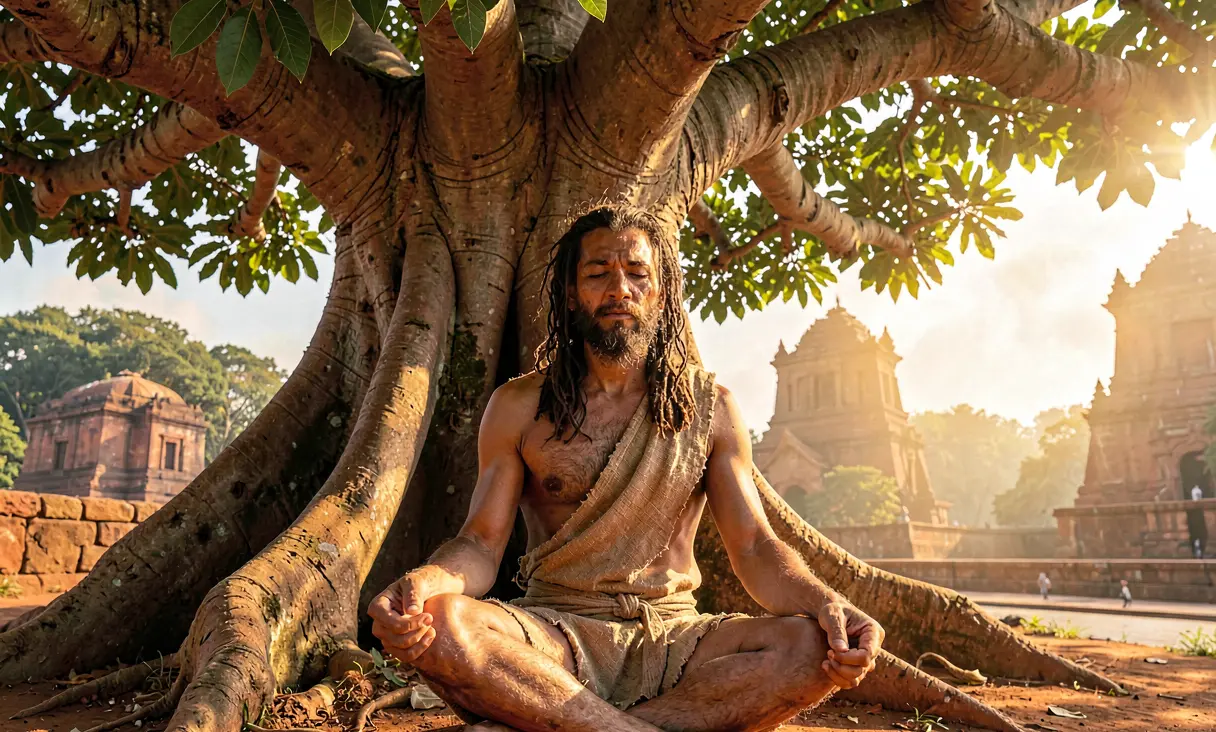 ReligionBuddha Attains Enlightenmentc. 528 BCE · Bodh Gaya, IndiaSiddhartha Gautama achieves nirvana under the Bodhi tree founding Buddhism.
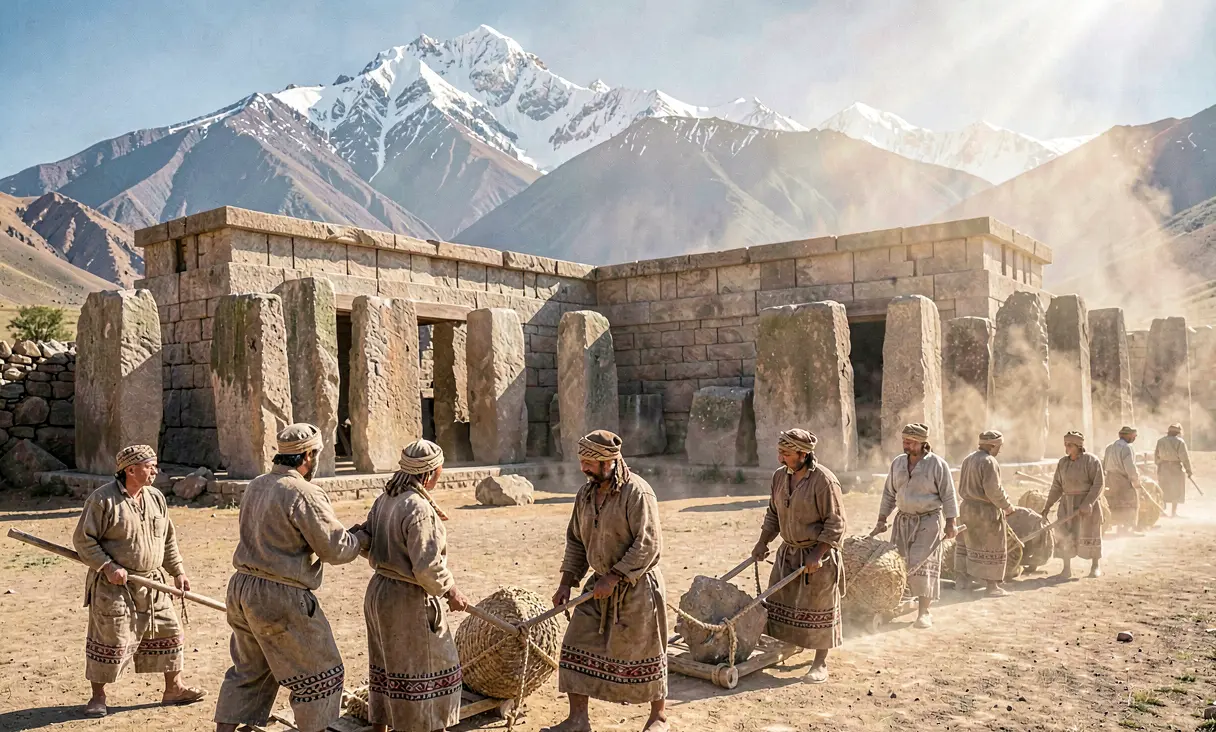 ReligionConstruction of Kalasasaya Temple at Tiwanakuc. 500 CE · Tiwanaku, BoliviaThe Kalasasaya temple is built with monolithic stones for solar observance.
 ReligionKanishka I Convenes the Fourth Buddhist Councilc. 100 CE · Kundalavana Monastery, KashmirEmperor Kanishka I sponsors the Fourth Buddhist Council in Kashmir, formalizing Mahayana Buddhism and commissioning massive stupa construction.
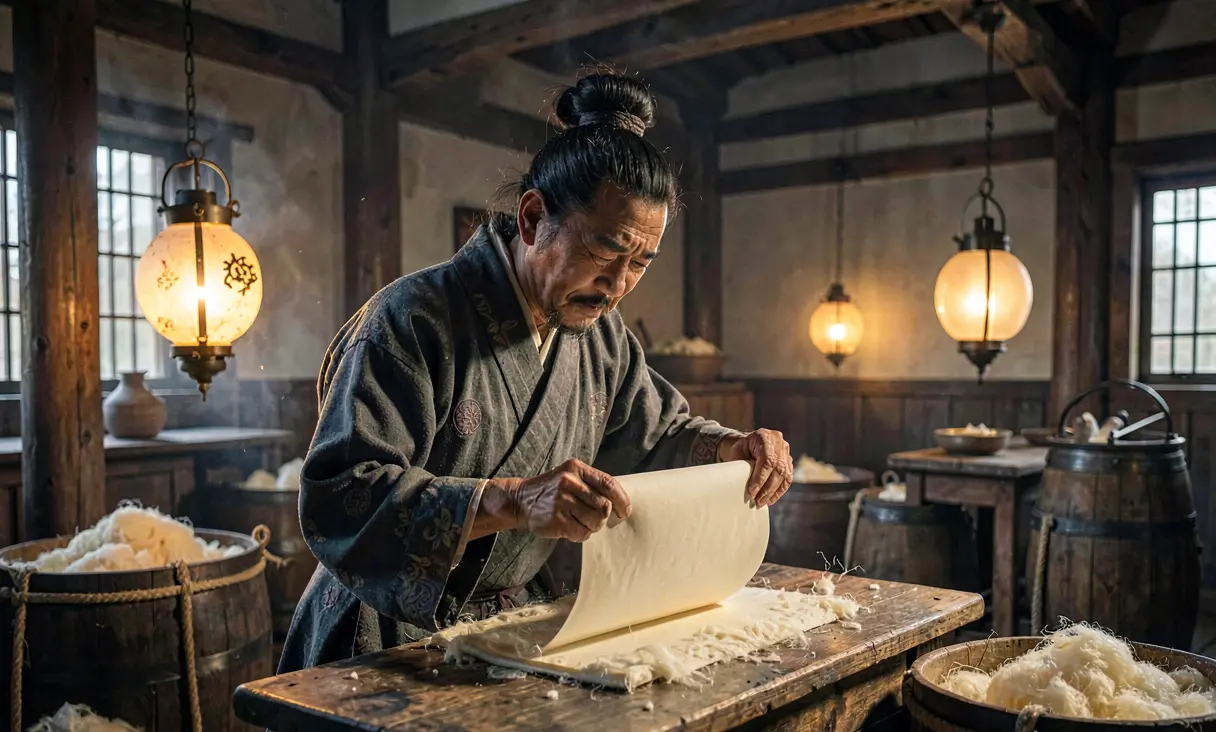 TechnologyRefinement of Papermaking by Cai Lun in Han China105 CE · Chang'an, ChinaCai Lun standardizes paper production using bark, hemp, rags, and fishing nets.
 DisasterEruption of Mount VesuviusAugust 24, 79 CE · Pompeii, ItalyVolcano destroys Roman cities preserving them in ash for modern discovery.
Discussion
Loading…