Battle of Nagashino: Introduction of Massed Firepower
The Battle of Nagashino revolutionized Japanese warfare by proving that massed arquebus fire could decisively defeat elite cavalry, shifting military dominance from traditional samurai charges to disc
The Clash of Titans
In the summer of 1575, the political landscape of feudal Japan hung in the balance at Nagashino Castle. The Takeda clan, under the command of Katsuyori, son of the legendary warlord Takeda Shingen, sought to crush their long-standing rival, Oda Nobunaga. For decades, the Takeda cavalry had been considered the most formidable fighting force in Japan, renowned for their speed, discipline, and terrifying shock tactics that had decimated armies across the province of Kai and beyond. Katsuyori, eager to prove his own mettle and secure his clan's dominance over the Tokugawa territories, laid siege to Nagashino Castle, held by a small but determined garrison loyal to Nobunaga. The situation was dire; without relief, the castle would fall within days, opening the door for a Takeda advance into Owari.
Strategic Preparations
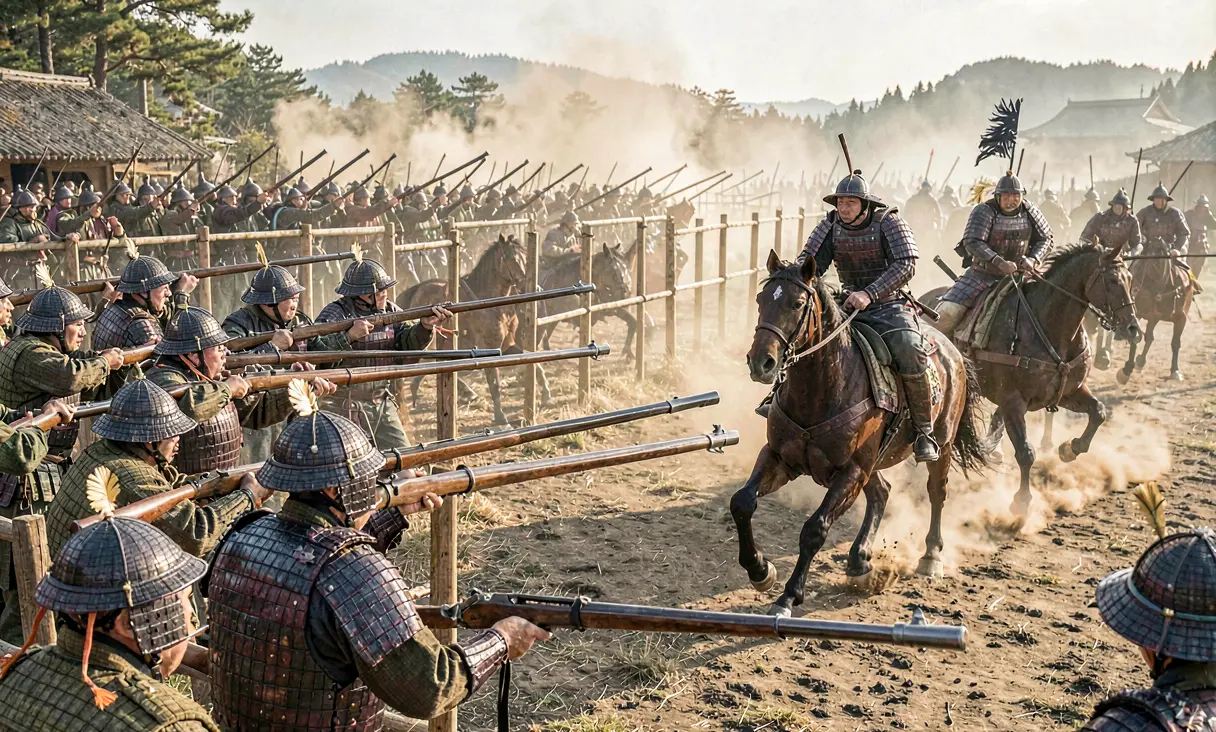
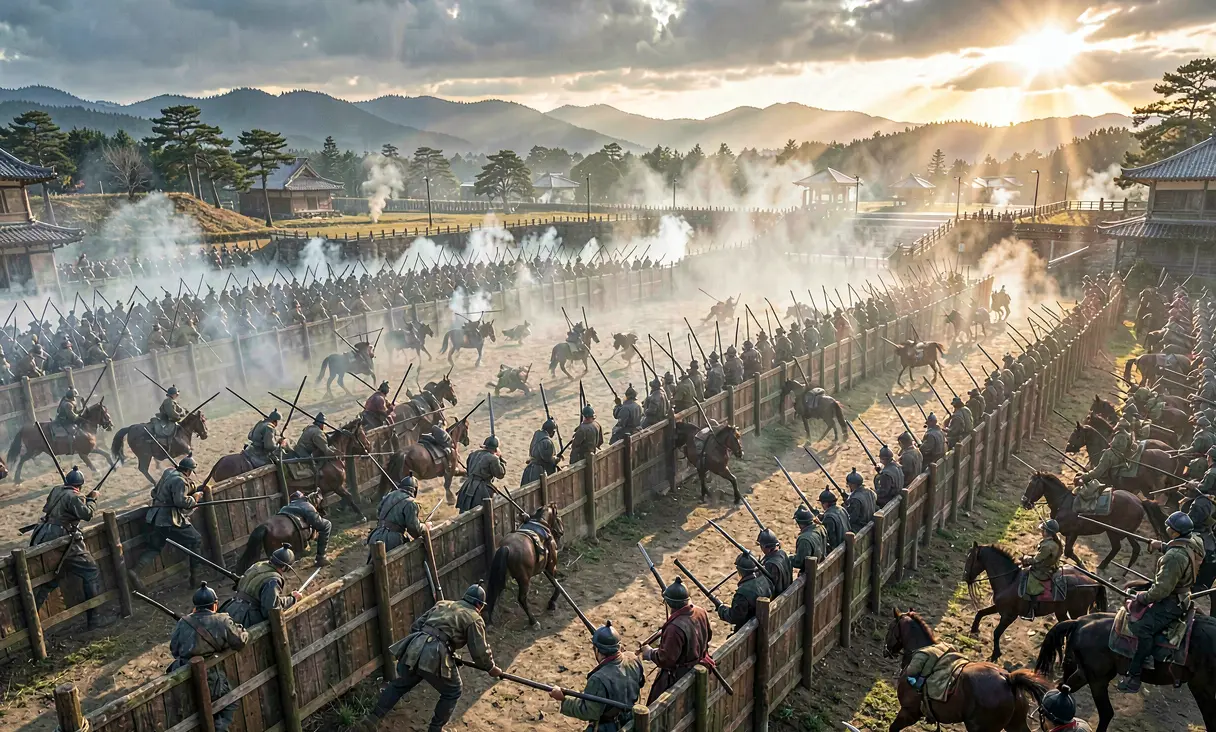
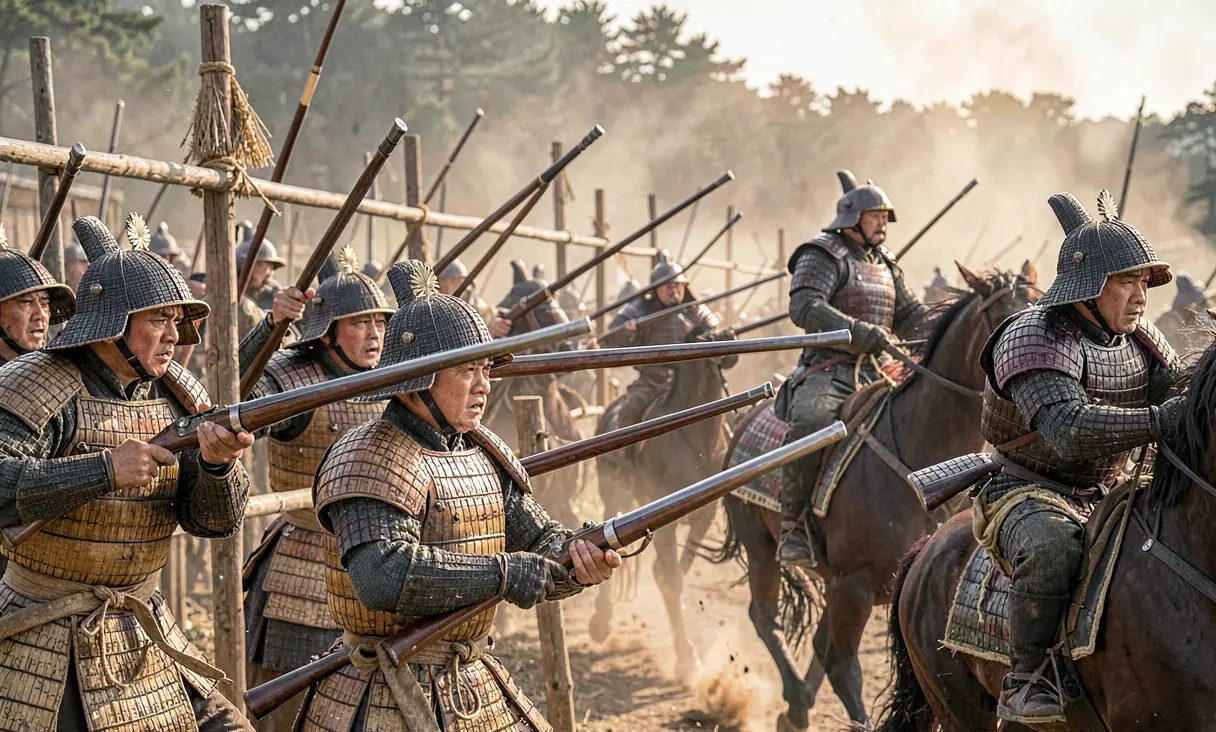
Nobunaga and his ally Tokugawa Ieyasu assembled a massive coalition force estimated at 38,000 men to relieve the siege. Rather than engaging in a traditional open-field duel that might favor Takeda mobility, Nobunaga chose a defensive posture on the banks of the Shinano River. He constructed elaborate wooden palisades and moats designed specifically to disrupt cavalry charges and funnel enemy troops into kill zones. Crucially, Nobunaga integrated over 3,000 arquebusiers (teppō) into his lines. While firearms had been present in Japan since their introduction by the Portuguese in 1543, they were typically used sporadically or as support weapons. Nobunaga's innovation lay not merely in the quantity of guns, but in the tactical organization: he divided his gunners into three rotating squads to ensure a continuous cycle of firing, reloading, and rest.
The Battle Unfolds
On June 29, 1575, Katsuyori launched a desperate assault against the fortified positions. The Takeda army, comprising roughly 15,000 men including their elite cavalry and the feared Yamagata Masakage's vanguard, charged across the shallow riverbed. As they approached the palisades, Nobunaga's arquebusiers unleashed a devastating barrage. Historical accounts suggest that the rotation system allowed for a near-constant stream of lead projectiles, shattering the momentum of the charging horsemen before they could reach the defensive lines. The Takeda cavalry, trained to rely on speed and shock, found themselves pinned down by heavy fire and unable to maneuver effectively against the static fortifications. The battle quickly devolved into a slaughter; prominent Takeda generals fell one after another, their ranks decimated within hours.
Key Figures in the Conflict
The battle was defined by the contrasting styles of its primary commanders. Oda Nobunaga, the architect of the victory, demonstrated a pragmatic willingness to abandon tradition in favor of technological efficiency and combined arms tactics. His ability to coordinate infantry, cavalry, and gunners under a unified command structure proved decisive. Opposing him was Katsuyori Takeda, who, despite his lineage, struggled with strategic rigidity. He failed to adapt his clan's signature cavalry tactics to the new reality of firearms, leading to the catastrophic loss of his veteran commanders. The death of legendary figures like Yamagata Masakage and Baba Nobufusa during the charge marked the effective end of the Takeda clan as a major power, as these irreplaceable leaders were lost in a single afternoon.
The Aftermath
The consequences of Nagashino were immediate and catastrophic for the Takeda. The clan lost nearly 10,000 men, including its most experienced generals, effectively breaking its military backbone. Katsuyori fled the battlefield in disgrace, retreating to Kai where his authority rapidly crumbled; he would commit suicide just six years later as Nobunaga's forces closed in. Conversely, the victory cemented Oda Nobunaga's status as the preeminent warlord in Japan, accelerating his campaign toward national unification. The battle also solidified the alliance between Nobunaga and Tokugawa Ieyasu, a partnership that would shape Japanese history for centuries to come.
Legacy and Military Revolution
The Battle of Nagashino is frequently cited as the moment firearms became the dominant force in Japanese warfare. It demonstrated the efficacy of massed firepower over traditional samurai cavalry, fundamentally altering the nature of combat across the archipelago. Following 1575, daimyos throughout Japan rushed to equip their armies with arquebuses and adopted similar defensive fortification tactics. While modern historians debate the exact mechanics of the rotation system described in later chronicles, the core reality remains: Nagashino proved that disciplined infantry equipped with gunpowder could defeat elite cavalry. This shift marked a turning point in military history, signaling the decline of the individual warrior-hero and the rise of centralized, industrialized warfare.
Nagashino proved that massed firearm volleys could defeat elite cavalry, fundamentally changing Japanese military tactics and accelerating the unification process.
Where it happened
Nagashino, Japan — see it on the interactive map →
Explore related history
 WarAlgerian War of Independence BeginsNovember 1, 1954 · Algiers, AlgeriaThe National Liberation Front launches coordinated attacks marking the start of the Algerian War against France.
 WarMau Mau Uprising Begins in KenyaOctober 20, 1952 · Nairobi, KenyaThe Kikuyu-led Mau Mau rebellion begins against British colonial rule and white settler land ownership.
 WarTurkish War of Independence BeginsMay 19, 1919 · Samsun, TurkeyMustafa Kemal Atatürk lands in Samsun to organize resistance against Allied occupation and the Ottoman Sultanate.
 WarOda Nobunaga's Battle of Okehazama1560 CE · Okehazama, Aichi, JapanOda Nobunaga defeats a massive army of Imagawa Yoshimoto in a surprise attack.
 WarHideyoshi's First Invasion of Korea (Imjin War)1592 CE · Seoul (Hanyang), KoreaToyotomi Hideyoshi launches a massive invasion of Joseon Korea to conquer Ming China.
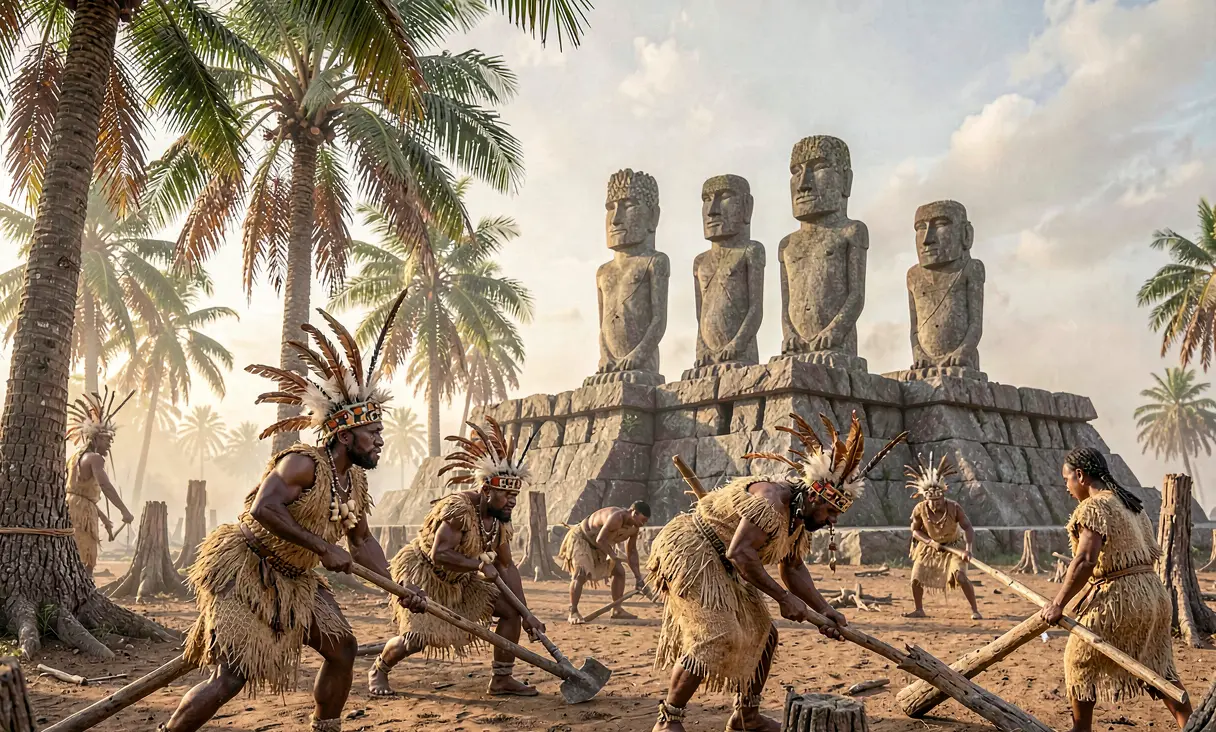 DisasterEcological Collapse and Deforestation of Rapa Nuic. 1600 CE · Rapa Nui (Easter Island), ChileOverexploitation of resources leads to deforestation and societal transformation on Rapa Nui.
Discussion
Loading…