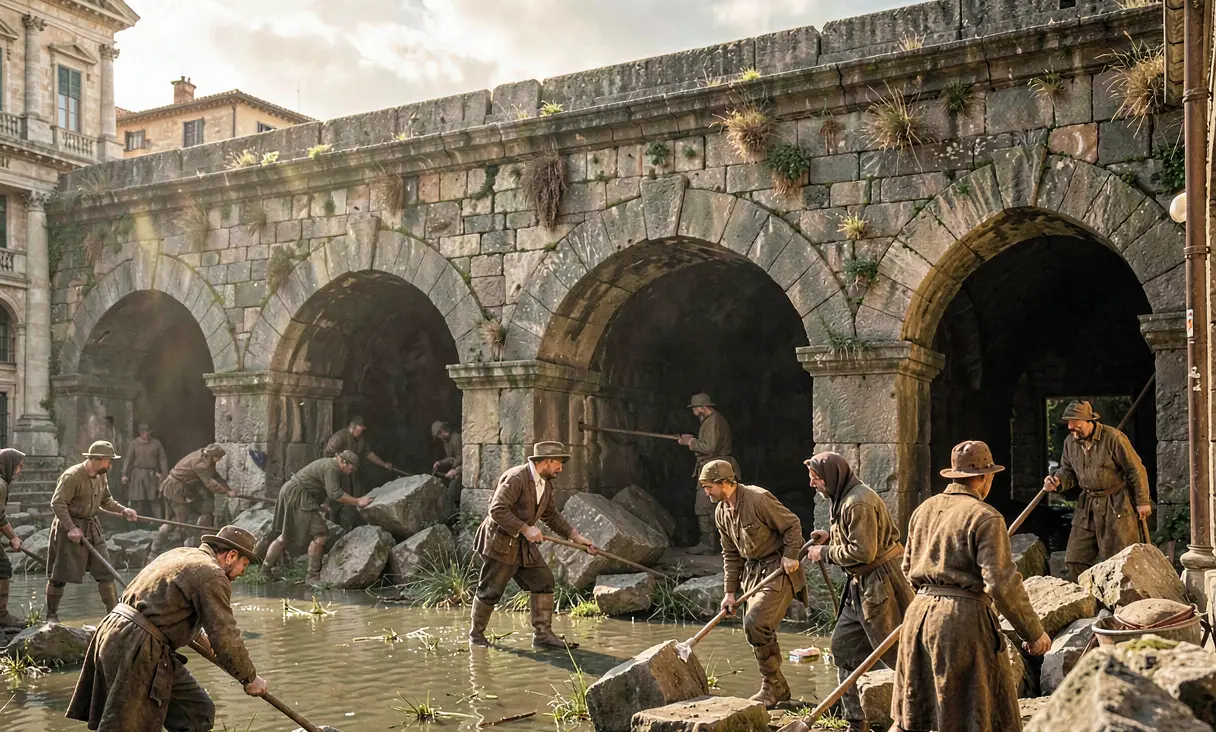
Construction of the Great Cloaca Maxima in Rome
Built by Etruscan kings around 500 BCE, the Cloaca Maxima drained Rome's marshy Forum, enabling urban expansion and establishing a two-millennia precedent for global sanitation infrastructure.
The Marshy Origins of the Forum
In the early archaic period of Rome, the site destined to become the political and spiritual heart of Western civilization was a treacherous wetland. Located at the confluence of the Velabrum and the Subura valleys, the area between the Palatine and Capitoline hills collected rainwater and runoff from the surrounding seven hills, creating a stagnant marsh that bred disease and impeded urban expansion. Before the 7th century BCE, this natural depression served primarily as a burial ground for the earliest Latin communities, but as Rome's population swelled under the influence of Etruscan culture, the need to reclaim this land became paramount. The geography dictated that without significant hydraulic intervention, the city could not grow beyond its hilltop settlements.
Etruscan Engineering and Royal Initiative
The transformation of Rome's landscape is attributed largely to the Tarquin dynasty, specifically King Tarquinius Priscus (reigned c. 616–579 BCE) and his successor Tarquinius Superbus (reigned c. 535–509 BCE). Drawing upon advanced hydraulic techniques mastered by their Etruscan ancestors in cities like Veii, the kings initiated a massive public works project to drain the valley. The primary objective was not merely sanitation but urban planning; by lowering the water table, they aimed to create dry, stable ground for the construction of temples, markets, and administrative buildings. This initiative marked a shift from ad-hoc village infrastructure to state-sponsored engineering on an unprecedented scale.
The Construction of the Great Sewer
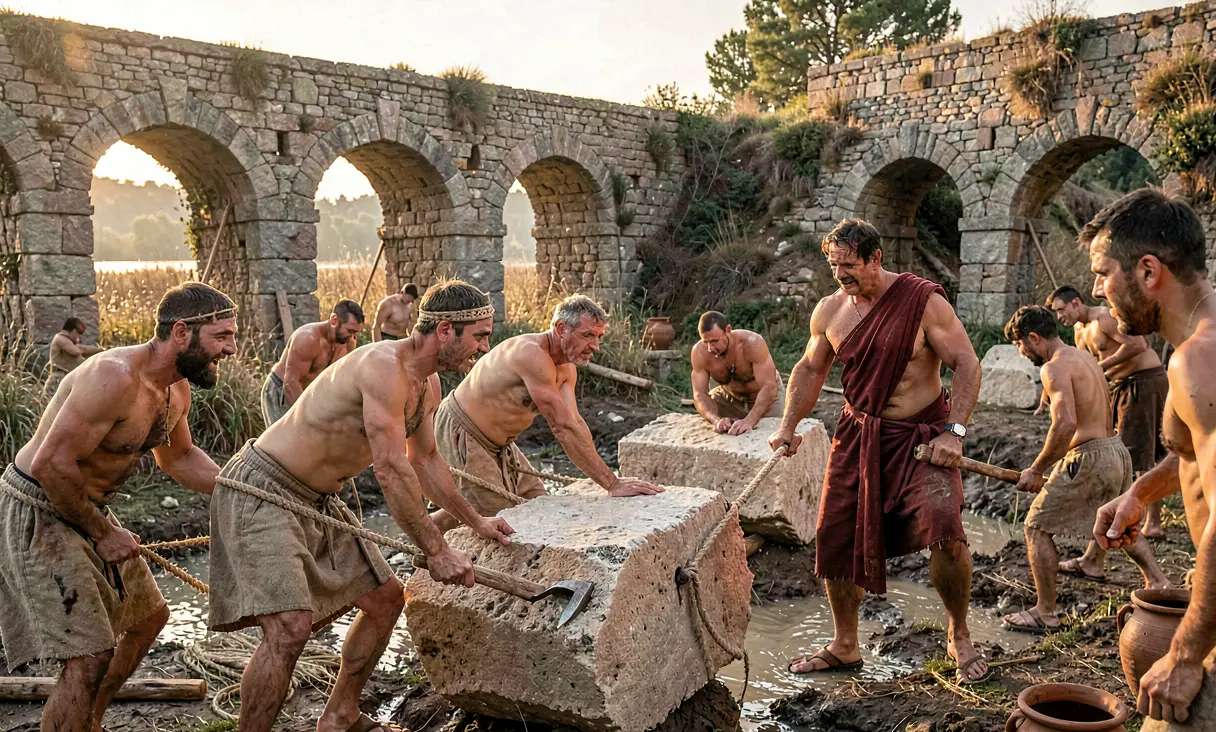
The Cloaca Maxima was not built as a single continuous trench but rather as a complex system of channels that were eventually consolidated into one monumental conduit. Workers excavated deep trenches through solid rock and alluvial soil, lining them with massive blocks of tufa and later reinforcing the structure with brickwork and mortar. The engineering marvel lies in its vaulted ceiling, constructed using true arches—a technique borrowed from the Etruscans—which allowed the sewer to bear the immense weight of the Forum built above it while maintaining a consistent gradient for gravity-fed flow. The main channel, originally about 3.2 meters wide and 4 meters high, was large enough in its early iterations for a cart to pass through, facilitating maintenance by workers who could walk inside.
Hydraulic Mastery and Urban Integration
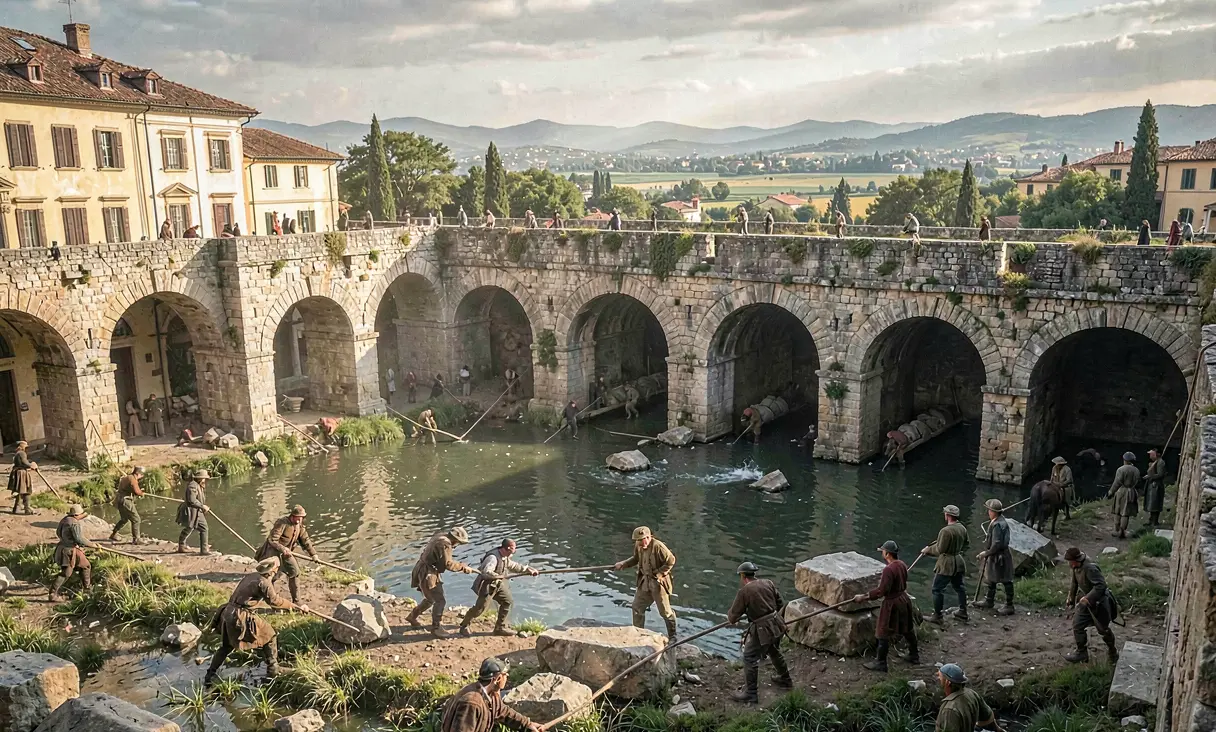
The system functioned on the principle of gravity, channeling wastewater from private homes and public baths, as well as storm runoff from the hillsides, into the main collector. The Cloaca Maxima emptied directly into the Tiber River near the Forum Boarium, utilizing the river's natural flow to carry waste away from the city center. This integration required precise surveying to ensure that the slope remained constant over several kilometers without causing erosion or stagnation. By effectively draining the marshes, the project transformed a plague-ridden bog into the Forum Romanum, allowing for the construction of the Temple of Vesta and the Regia, thereby physically manifesting the power of the state over nature.
Immediate Impact on Public Health and Society
The completion of the Cloaca Maxima around 500 BCE had an immediate and profound effect on Roman public health and social organization. The elimination of standing water drastically reduced the prevalence of malaria and other waterborne diseases, which had previously decimated the lower-class populations living in the valley. Furthermore, the reclaimed land provided the necessary space for the assembly of large crowds for political assemblies (the Comitia) and religious festivals, centralizing civic life. The sewer became a symbol of Roman order and civilization, distinguishing Rome from its neighbors who lacked such sophisticated urban planning.
Enduring Legacy and Engineering Precedent
Remarkably, the Cloaca Maxima remained in continuous use for over two millennia, surviving the fall of the Western Roman Empire, medieval neglect, and modern urbanization. Its durability is a testament to the quality of Roman concrete (opus caementicium) and the foresight of its original architects. While later emperors, such as Agrippa under Augustus, expanded and renovated the system, the core structure laid down in the 6th century BCE remained intact. The project set a global precedent for urban sanitation, influencing the development of sewer systems from London to New York, proving that infrastructure is as critical to a civilization's longevity as its laws or armies.
Historical Significance in Urban Development
The construction of the Cloaca Maxima represents one of the earliest examples of large-scale civil engineering serving public welfare rather than solely military or religious purposes. It demonstrated that a state could mobilize resources to solve environmental challenges, creating a habitable urban core that would support Rome's growth into an empire. The sewer stands today not just as a relic of antiquity but as a foundational element of the modern concept of the city, illustrating how the manipulation of the natural environment through technology is essential for the survival and flourishing of complex societies.
The Cloaca Maxima was a pioneering feat of civil engineering that enabled the sanitation and expansion of ancient Rome.
Where it happened
Rome, Italy — see it on the interactive map →
Explore related history
 TechnologyGrand Canal of China Connects North and South610 CE · Luoyang to Hangzhou, ChinaEmperor Yang completes the massive waterway linking the Yellow and Yangtze rivers for transport and grain.
 TechnologyMeroitic Iron Smelting Industry Flourishesc. 500 BCE · Meroe, SudanMeroe develops a massive iron smelting industry using abundant fuel and advanced furnace technology.
 TechnologyDevelopment of the Polynesian Star Compass Systemc. 500 BCE · Society Islands, French PolynesiaPolynesian navigators memorize star paths to traverse the Pacific without instruments.
 ReligionConstruction of Kalasasaya Temple at Tiwanakuc. 500 CE · Tiwanaku, BoliviaThe Kalasasaya temple is built with monolithic stones for solar observance.
 PoliticsExpulsion of Tarquinius Superbus from Romec. 509 BCE · Rome, Latium (Italy)The Roman monarchy is overthrown, leading to the establishment of the Republic.
 ReligionParinirvana of the Buddhac. 483 BCE · Kushinagar (modern Uttar Pradesh/India)Siddhartha Gautama passes away, entering final Nirvana and leaving his disciples with the Dharma to guide them.
Discussion
Loading…