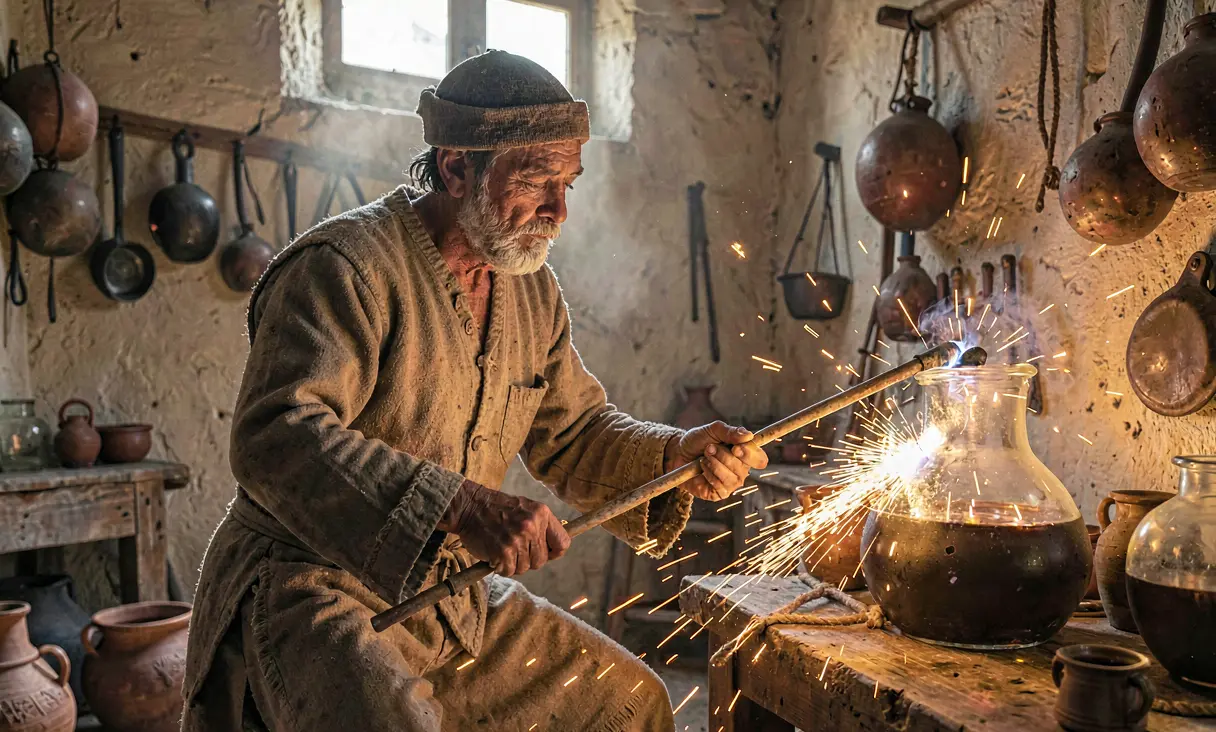
Invention of Glassblowing in the Roman Levant
Invented c. 1 BCE in Sidon, glassblowing democratized glassware by slashing costs, transforming it from an elite luxury into a ubiquitous utility that revolutionized global trade and material culture.
The Stagnant Craft of Antiquity
Prior to the turn of the Common Era, glass production in the Mediterranean world was a labor-intensive and exclusive industry. Techniques such as core-forming, where molten glass was wound around a clay core, or mold-blowing, were slow and yielded thick-walled, often asymmetrical vessels. These objects were prohibitively expensive, reserved almost exclusively for the aristocracy and royal courts of Egypt and Rome. The material itself remained a curiosity rather than a utility; it was treated with the same reverence as gold or silver, limiting its application to small cosmetic jars, amulets, and luxury tableware.
The Sidonian Breakthrough
Circa 1 BCE, in the bustling coastal city of Sidon within the Roman province of Syria, a revolutionary shift occurred that would permanently alter the material culture of the ancient world. While archaeological evidence points to earlier experiments in glass manipulation, it was here that artisans perfected the technique of free-blowing using an iron blowpipe. By introducing air into a gather of molten glass through a hollow tube, craftsmen could inflate the viscous material into a bubble, allowing gravity and centrifugal force to shape thin, symmetrical walls with unprecedented speed. This innovation transformed glass from a solid mass requiring carving or casting into a pliable fluid that could be blown into virtually any form.
The Mechanics of Innovation
The technical leap was not merely about the tool, but the process it enabled. The blowpipe allowed the artisan to separate the shaping phase from the cooling phase more effectively than previous methods. A skilled glassblower could gather a small amount of molten glass, roll it on a marver (a flat stone or metal surface) to shape it, and then blow it into a mold or freehand to create a vessel in minutes rather than hours. This efficiency drastically reduced the fuel consumption per unit and minimized waste. The resulting vessels were remarkably thin-walled yet durable, capable of holding liquids without leaking, a feat difficult to achieve with cast glass.
Rapid Dissemination Across the Empire
The spread of this technology was meteoric. Within a few decades of its inception in Sidon, glassblowing workshops appeared across the Roman Empire, from Alexandria and Antioch to Pompeii and Cologne. The technique required relatively simple equipment—a furnace, a blowpipe, and basic tools—making it accessible to small guilds and independent artisans rather than just state-sponsored factories. By the 1st century CE, the production of glassware had exploded in volume. Archaeological strata from this period reveal a sudden abundance of common glass fragments, including bottles, jugs, and bowls that were previously unknown in such quantities.
Democratization of Material Culture
The societal impact was immediate and profound. Glass ceased to be a symbol of extreme wealth and became a commodity for the masses. The price of glass vessels dropped precipitously, allowing even modest households in the provinces to own items that were once the exclusive domain of emperors. This democratization fueled new industries; glass containers became the standard packaging for oil, wine, perfume, and medicine, revolutionizing trade and storage. The ability to produce standardized, airtight containers facilitated the expansion of long-distance commerce within the Roman Empire, as goods could be transported more safely and efficiently.
A Legacy That Shaped Modernity
The invention of glassblowing in Sidon stands as one of the most significant technological advancements of antiquity. It laid the foundational methodology for all subsequent glass production, a technique that remains largely unchanged in its fundamental principles to this day. The ripple effects extended beyond the Roman world; the technology survived the empire's collapse and was refined during the Middle Ages, eventually leading to the scientific instruments of the Renaissance and the industrial manufacturing of the modern era. Without this singular innovation in the Levant, the trajectory of material science, trade, and daily life would have followed a vastly different path.
Glassblowing democratized glass production, transforming it from a rare luxury into a common material for daily life.


Where it happened
Sidon, Lebanon — see it on the interactive map →
Explore related history
 TechnologyGrand Canal of China Connects North and South610 CE · Luoyang to Hangzhou, ChinaEmperor Yang completes the massive waterway linking the Yellow and Yangtze rivers for transport and grain.
 TechnologyMeroitic Iron Smelting Industry Flourishesc. 500 BCE · Meroe, SudanMeroe develops a massive iron smelting industry using abundant fuel and advanced furnace technology.
 TechnologyConstruction of the Great Cloaca Maxima in Romec. 500 BCE · Rome, ItalyEarly Romans build the massive Cloaca Maxima sewer system to drain marshes and manage waste.
 PoliticsEmperor Guangwu Restores the Han Dynasty (Eastern Han)25 CE · Luoyang, ChinaLiu Xiu defeats rival warlords and re-establishes Han rule from the new capital at Luoyang.
 ReligionFourth Buddhist Council in Sri Lanka29 BCE · Anuradhapura (Sri Lanka)Theravada canon is committed to writing for the first time.
 PoliticsKujula Kadphises Unifies the Kushansc. 30 BCE · Kabul Valley, AfghanistanKujula Kadphises unites the Yuezhi tribes to form the Kushan Empire, conquering the Indo-Greek territories and establishing control over Central Asia.
Discussion
Loading…