
Construction of the Aqua Appia: Rome's First Aqueduct
In 312 BCE, Censor Appius Claudius Caecus commissioned Rome's first aqueduct, pioneering gravity-fed hydraulics that transformed urban sanitation and established the blueprint for imperial engineering
The Urban Crisis of the Early Republic
By the early fourth century BCE, Rome was rapidly transforming from a collection of hilltop settlements into a sprawling urban center, yet its infrastructure remained woefully inadequate to support this growth. The city's population relied heavily on the Tiber River and shallow wells, sources frequently contaminated by sewage and runoff, leading to recurrent health crises and limiting the expansion of public amenities. As Rome consolidated power over Latium following the Gallic sack of 390 BCE, the need for a reliable, clean water supply became not merely a matter of convenience but a strategic imperative for urban stability and civic pride.
Appius Claudius Caecus and the Censorial Mandate
The initiative to solve this crisis fell to Appius Claudius Caecus, a patrician of immense ambition who was elected censor in 312 BCE. Unlike his predecessors, who focused primarily on traditional religious duties or minor road repairs, Claudius envisioned a monumental public works project that would redefine the city's relationship with its environment. Although he faced significant political opposition from the Senate, which viewed his spending as populist overreach and his bypassing of the consulship for road construction as unconstitutional, Claudius utilized his censorial authority to fund the project through the treasury, effectively launching a new era of state-sponsored infrastructure.
Engineering the Aqua Appia
The resulting structure, known as the Aqua Appia, was a feat of subterranean engineering that stretched approximately 16.4 kilometers (roughly 11 Roman miles) from its source springs near the Via Praenestina to the city's interior. The aqueduct was almost entirely buried underground, with only its terminal fountain and distribution tank visible above ground, a design choice likely intended to protect the water from contamination and enemy sabotage during times of war. Surveyors employed precise groma instruments to calculate a gentle gradient of roughly 0.2 meters per kilometer, ensuring a consistent flow velocity that prevented stagnation without causing erosion within the channel.
Construction Techniques and Hydraulic Mastery
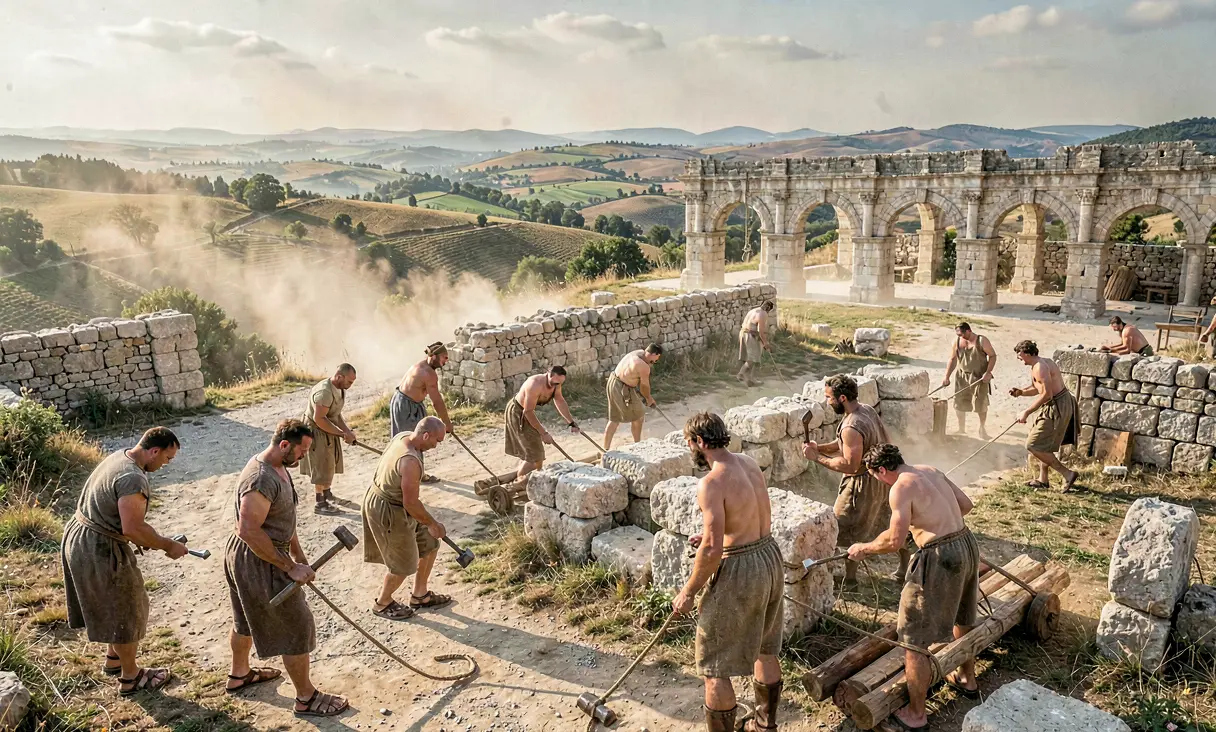
Excavating the Aqua Appia required advanced tunneling techniques, as workers had to bore through varying geological strata while maintaining the exact slope necessary for gravity-fed flow. The channel was lined with a waterproof concrete mixture known as *opus signinum*, composed of crushed tile and lime, which created an impermeable barrier against leaks. This project demonstrated that Roman engineers could manage complex hydrological challenges without mechanical pumps, relying instead on mathematical precision and manual labor to transport water from the Alban Hills' foothills into the heart of the city, delivering an estimated 75,000 cubic meters of water daily.
Immediate Impact on Roman Life
Upon its completion around 310 BCE, the Aqua Appia fundamentally altered the daily rhythm of Roman life by providing a steady supply of potable water to public fountains and the first public baths. The availability of clean water reduced the incidence of waterborne diseases and allowed for the development of more sophisticated urban sanitation systems. Furthermore, the aqueduct served as a powerful symbol of state capability; it was not just a utility but a political statement that the Republic could marshal resources and technical expertise to improve the welfare of its citizens, thereby strengthening social cohesion.
Legacy and the Hydraulic Network
The Aqua Appia established the precedent for Rome's subsequent hydraulic network, which would eventually expand to include eleven major aqueducts supplying over a million cubic meters of water daily by the third century CE. It set the standard for Roman civil engineering, proving that large-scale public infrastructure was essential for imperial expansion and urban management. Although the original structure fell into disrepair during the barbarian sieges of the fifth century, its route remained partially in use until modern times, serving as a tangible link to the Republic's earliest technological triumphs and the visionary leadership of Appius Claudius Caecus.
The Aqua Appia initiated Rome's revolution in public water supply, setting standards for urban infrastructure worldwide.

Where it happened
Rome, Italy — see it on the interactive map →
Explore related history
 TechnologyGrand Canal of China Connects North and South610 CE · Luoyang to Hangzhou, ChinaEmperor Yang completes the massive waterway linking the Yellow and Yangtze rivers for transport and grain.
 TechnologyMeroitic Iron Smelting Industry Flourishesc. 500 BCE · Meroe, SudanMeroe develops a massive iron smelting industry using abundant fuel and advanced furnace technology.
 TechnologyConstruction of the Great Cloaca Maxima in Romec. 500 BCE · Rome, ItalyEarly Romans build the massive Cloaca Maxima sewer system to drain marshes and manage waste.
 WarMauryan Conquest of Gandharac. 305 BCE · Peshawar Valley, Gandhara, PakistanChandragupta Maurya defeats Seleucus Nicator, securing the vital Gandhara region and expanding the Mauryan Empire westward to the Hindu Kush.
 PoliticsChandragupta Maurya Founding the Mauryan Empirec. 321 BCE · Pataliputra (modern Patna/India)Chandragupta Maurya defeats the Nanda Dynasty with the help of Chanakya, establishing India's first pan-continental empire.
 ReligionBurial of the Royal Tombs at Sipán (Later Phase)c. 300 CE · Sipán, PeruElite Moche burials continue with elaborate rituals involving human sacrifice and gold offerings.
Discussion
Loading…