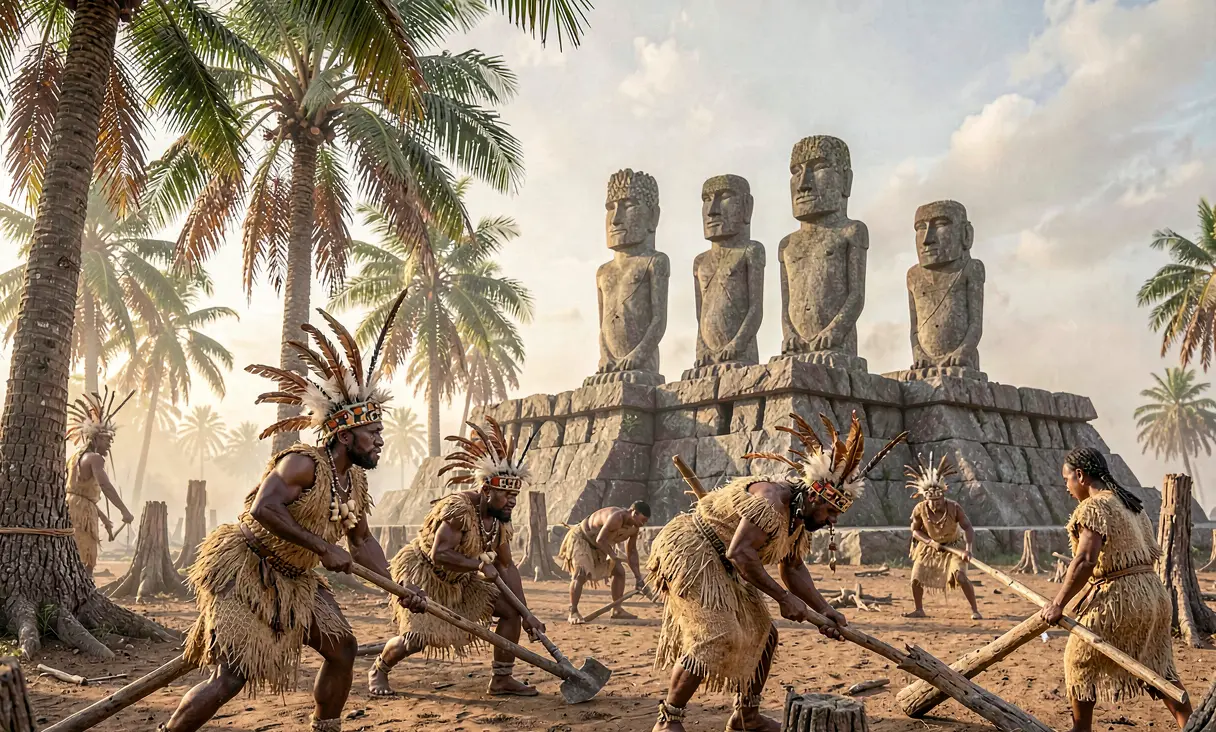
Ecological Collapse and Deforestation of Rapa Nui
By 1600 CE, Rapa Nui's deforestation triggered a catastrophic collapse of its ecosystem and society, ending the moai era and forcing a violent shift to the Birdman cult amid famine and isolation.
A Fragile Paradise
Prior to the arrival of Polynesian settlers around 1200 CE, Rapa Nui (Easter Island) was a lush subtropical paradise dominated by the towering Paschalococos disperta, a now-extinct species of palm tree that once covered nearly the entire island. This dense forest provided essential resources: timber for constructing deep-sea fishing canoes, fuel for cooking and firing pottery, and fibrous bark for rope-making used in the transportation of the massive stone moai statues. The isolation of the island, situated over 2,000 kilometers from Chile and 3,700 kilometers from Tahiti, created a closed ecological system where resource regeneration was slow and finite. Early Rapa Nui society flourished under this abundance, developing complex social hierarchies centered on clan chiefs (ariki) who commissioned the construction of over 900 moai to honor ancestors and assert territorial dominance.
The Descent into Scarcity
By approximately 1600 CE, centuries of intensive resource extraction had pushed the island's ecosystem past its tipping point. The combination of a growing population, estimated to have peaked between 7,000 and 15,000 individuals, and the relentless demand for timber drove the rapid deforestation of the island. Archaeological evidence, including pollen analysis from sediment cores in Lake Rano Raraku, reveals a dramatic shift in vegetation composition during this period, with the disappearance of palm pollen and a corresponding rise in grassland species. The removal of the forest canopy led to catastrophic soil erosion, reducing agricultural yields of sweet potato and taro while simultaneously eliminating the raw materials necessary for maritime navigation.
The Collapse of Maritime Capability
The most immediate and devastating consequence of deforestation was the inability to construct seagoing canoes. Without large timber, the Rapa Nui people could no longer build the vessels required to access deep-water fishing grounds or engage in inter-island trade. This ecological bottleneck severed a critical food source, forcing a reliance on near-shore fishing and terrestrial agriculture that could not sustain the existing population density. The loss of maritime mobility also meant cultural isolation; the island was cut off from the wider Polynesian world just as its internal resources were being exhausted. As famine became endemic, the social contract underpinning the moai-building era fractured, leading to a breakdown in the authority of the traditional clan chiefs.
Social Upheaval and the Birdman Cult
In response to the crisis, Rapa Nui society underwent a radical transformation around 1600 CE, shifting from a static, ancestor-worshipping culture to a dynamic, competitive system centered on the Tangata manu (Birdman) cult. Power moved away from hereditary chiefs to rival clans competing annually at Orongo, a ceremonial village perched on the cliffs of the Rano Kau crater. The ritual involved swimming to the islet of Motu Nui to retrieve the first egg of the sooty tern; the winner's clan would gain political supremacy for the year. This shift reflects a desperate adaptation to scarcity, where status was no longer derived from the ability to mobilize labor for stone monuments but from the capacity to secure food and maintain social cohesion through ritualized competition.
Violence and Demographic Decline
The post-1600 period is marked by archaeological evidence of widespread violence, including mass graves containing dismembered skeletons and defensive fortifications known as 'pa' constructed on hilltops. The scarcity of resources fueled inter-clan warfare, leading to a significant population decline that likely reduced the island's inhabitants to fewer than 2,000 individuals by the time Europeans arrived in 1722. The cultural practice of toppling moai statues, which had once been symbols of unity and power, became common during this era as rival clans sought to erase the prestige of their enemies. The society that emerged was a shadow of its former self, characterized by chronic malnutrition, social fragmentation, and a profound loss of technological capability.
Legacy and Global Significance
The ecological collapse of Rapa Nui serves as a potent, isolated case study for the relationship between human activity and environmental limits. While earlier interpretations by Jared Diamond and others framed it as a cautionary tale of 'ecocide' driven solely by indigenous mismanagement, modern scholarship emphasizes a more complex interplay of factors, including the introduction of invasive species like the Polynesian rat (Rattus exulans) which accelerated deforestation, and later contact with European diseases. Nevertheless, the event remains a critical historical reference point for understanding how closed systems can fail under pressure, offering lessons on sustainability, resource management, and social resilience that resonate deeply in contemporary discussions about climate change and global ecological stability.
The Rapa Nui case study illustrates the potential consequences of environmental mismanagement on isolated island societies.
Where it happened
Rapa Nui (Easter Island), Chile — see it on the interactive map →
Explore related history
 DisasterCatastrophic Flooding at Mohenjo-Daroc. 1900 BCE · Mohenjo-Daro, Sindh, PakistanDevastating floods from the Indus River repeatedly buried and destroyed layers of Mohenjo-Daro, signaling the decline of the urban phase.
 DisasterRebuilding of the Palace at Knossos after Earthquakec. 1700 BCE · Knossos, Crete (Greece)Minoans rebuild the Palace of Knossos after a massive earthquake destroys the old structure.
 DisasterMinoan Eruption of Thera (Santorini)c. 1600 BCE · Santorini (Thera), Aegean SeaA massive volcanic eruption devastates the Minoan civilization and alters the Mediterranean climate.
 WarEscalation of Inter-Tribal Warfare in New Zealandc. 1600 CE · North Island, New ZealandIntensified warfare leads to the construction of massive pā and the development of new weapons like the taiaha.
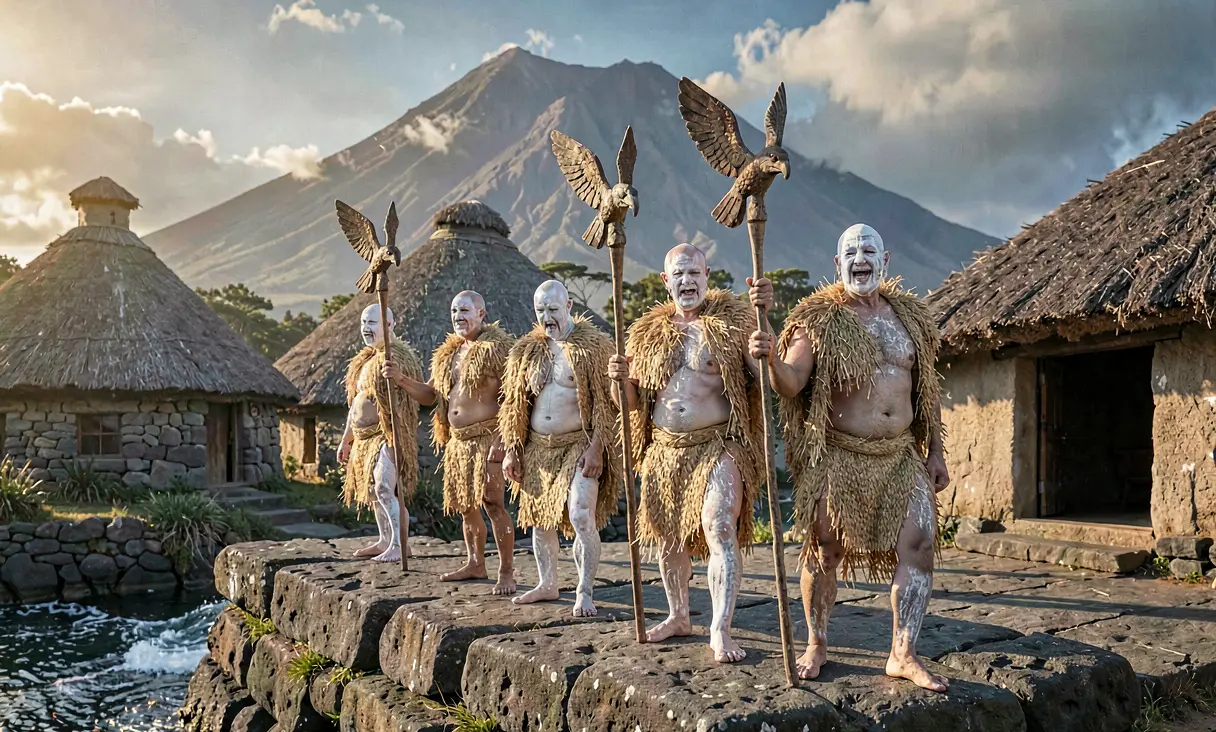 ReligionRise of the Birdman Cult on Rapa Nuic. 1600 CE · Orongo, Rapa NuiThe Birdman cult replaces moai worship as the central religious and political institution on Rapa Nui.
 DisasterVolcanic Ash Burial of Akrotiri on Therac. 1600 BCE · Akrotiri, Thera (Santorini), GreeceThe city of Akrotiri is perfectly preserved under volcanic ash from the Minoan eruption.
Discussion
Loading…