
Luther Posts Ninety-Five Theses
In 1517, Martin Luther's posting of the Ninety-Five Theses ignited the Protestant Reformation, fracturing Western Christendom and reshaping global religion, politics, and literacy through the power of
The Crisis of Indulgences
By the early 16th century, the spiritual and economic fabric of Western Christendom was under severe strain. The sale of indulgences, a practice wherein the Catholic Church granted remission of temporal punishment for sins in exchange for monetary contributions, had become rampant. This system was exploited with particular vigor by Archbishop Albrecht of Mainz to finance his debts and the construction of St. Peter's Basilica in Rome. The Dominican friar Johann Tetzel was dispatched to Germany to sell these indulgences with aggressive rhetoric, famously declaring that 'as soon as the coin in the coffer rings, the soul from purgatory springs.' This commodification of salvation deeply troubled Martin Luther, an Augustinian monk and theology professor at the University of Wittenberg. Luther's study of Scripture, particularly Romans 1:17, had led him to conclude that salvation came through faith alone (sola fide) rather than through works or financial transactions, creating a theological chasm between his views and the prevailing ecclesiastical authority.
The Act of October 31
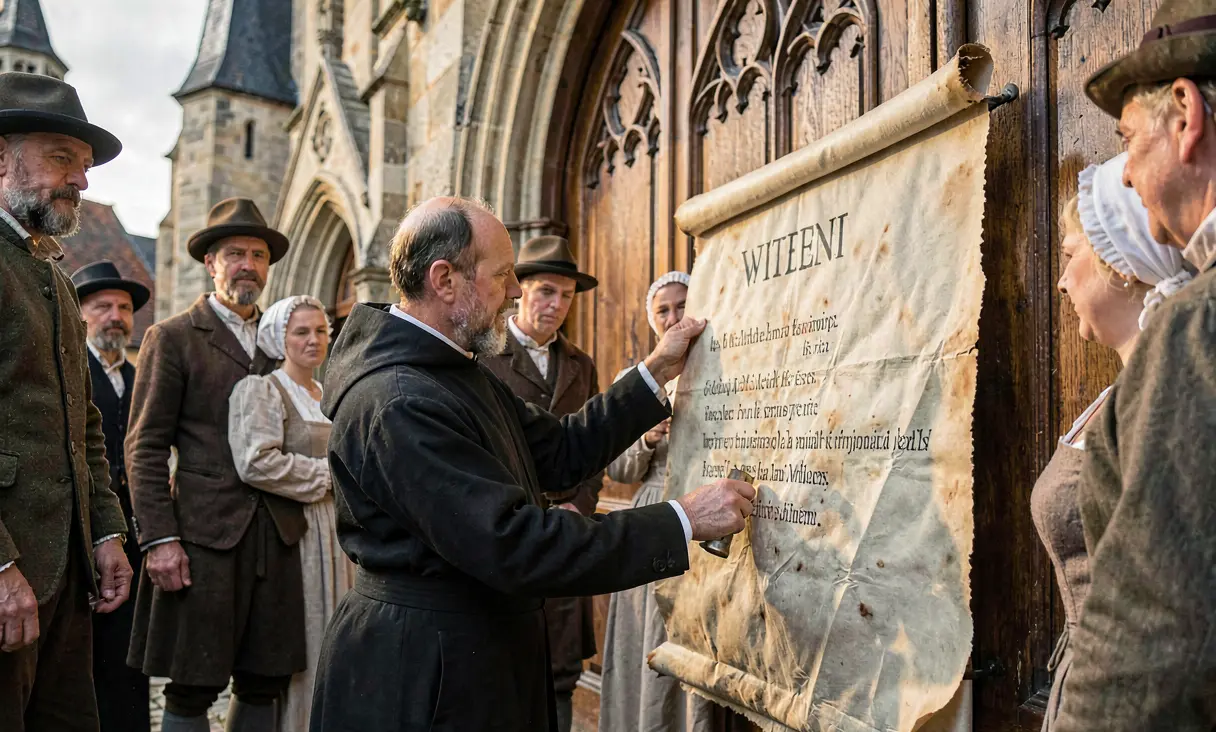
On All Saints' Eve, October 31, 1517, Martin Luther took decisive action to address these theological grievances. According to traditional accounts, though some modern historians debate the precise mechanics, Luther nailed a document titled 'Disputation on the Power and Efficacy of Indulgences'—later known as the Ninety-Five Theses—to the door of the Castle Church (Schlosskirche) in Wittenberg. In the German academic tradition of the time, church doors served as public bulletin boards for announcing debates; thus, this act was initially intended as an invitation to scholarly disputation rather than a declaration of schism. The document, written in Latin, contained ninety-five propositions critiquing the sale of indulgences and questioning the Pope's authority over purgatory. Luther argued that the Pope had no intention or power to remit any penalties other than those imposed by his own authority, effectively dismantling the theological justification for the indulgence trade.
The Role of the Printing Press
While Luther's posting of the Theses was a localized academic event, its impact was exponentially amplified by the recently invented movable type printing press. Within weeks, the text was translated from Latin into German and printed in pamphlet form, circulating rapidly across the Holy Roman Empire. By 1520, over 300,000 copies of Luther's works had been distributed, a circulation rate unprecedented for any single author in history. This technological dissemination bypassed traditional ecclesiastical censorship and allowed the ideas to take root among the urban middle class, the nobility, and even segments of the peasantry. The rapid spread transformed a theological debate into a public movement, as the Theses were not merely read but debated in town squares and universities, turning Wittenberg into the epicenter of a spiritual revolution that no single bishop or pope could contain.
Escalation to Schism
The initial academic debate quickly spiraled into an existential crisis for the Catholic Church. Pope Leo X, initially dismissing Luther as a 'drunken German,' issued the papal bull Exsurge Domine in June 1520, demanding that Luther recant forty-one of his propositions within sixty days or face excommunication. When Luther publicly burned the bull and the canon law books in Wittenberg on December 10, 1520, the breach became irreparable. In January 1521, he was formally excommunicated. The subsequent Diet of Worms in April 1521 saw Emperor Charles V summon Luther to recant; instead, Luther famously declared, 'Here I stand, I can do no other,' refusing to renounce his convictions unless convinced by Scripture or reason. This defiance solidified the break from Rome, leading to the establishment of independent Lutheran churches and fracturing the religious unity of Europe that had existed for a millennium.
Societal Transformation and Literacy
The Reformation triggered by the Theses extended far beyond theology, fundamentally altering European society. The emphasis on 'sola scriptura' necessitated that laypeople read the Bible for themselves, driving a massive surge in literacy rates across Protestant regions. Luther's translation of the New Testament into vernacular German in 1522 standardized the language and made Scripture accessible to millions who could not read Latin. This shift democratized religious knowledge, undermining the clergy's monopoly on spiritual interpretation and fostering a culture of individual conscience. Furthermore, the fragmentation of Christendom led to decades of religious wars, including the Thirty Years' War, which reshaped the political map of Europe and established the principle of state sovereignty in matters of religion through the Peace of Augsburg (1555) and later the Peace of Westphalia.
Enduring Legacy
Martin Luther's Ninety-Five Theses marked the beginning of the Protestant Reformation, a movement that permanently divided Western Christianity into Catholic and Protestant branches. The event catalyzed the rise of new denominations such as Calvinism, Anglicanism, and Anabaptism, creating a pluralistic religious landscape that defines much of the modern world. Beyond religion, the Reformation accelerated the decline of feudalism by empowering secular rulers and encouraged the development of capitalism through the Protestant work ethic. The event stands as a pivotal turning point in human history, comparable to the fall of Rome or the rise of nation-states, demonstrating how a single act of intellectual courage, amplified by technology, can dismantle ancient institutions and forge new paths for civilization.
It permanently altered Western Christianity and accelerated the rise of individualism.

Where it happened
Wittenberg, Germany — see it on the interactive map →
Explore related history
 ReligionBirth of Bulleh Shahc. 1680 CE · Uch (modern Pakistan)The birth of Bulleh Shah, a pivotal Sufi poet who challenged religious orthodoxy and promoted universal love.
 TechnologyIntroduction of the Tomato to Europec. 1520 CE · Rome, ItalyTomatoes arrive in Europe from the Americas, revolutionizing global cuisine.
 ArtCompletion of Sistine Chapel CeilingOctober 31, 1512 CE · Vatican City, ItalyMichelangelo finishes frescoes depicting Genesis scenes transforming Renaissance art.
 ArtMichelangelo Completes the Sistine Chapel CeilingOctober 31, 1512 · Vatican City, RomeMichelangelo finishes the monumental fresco cycle depicting Genesis.
Discussion
Loading…