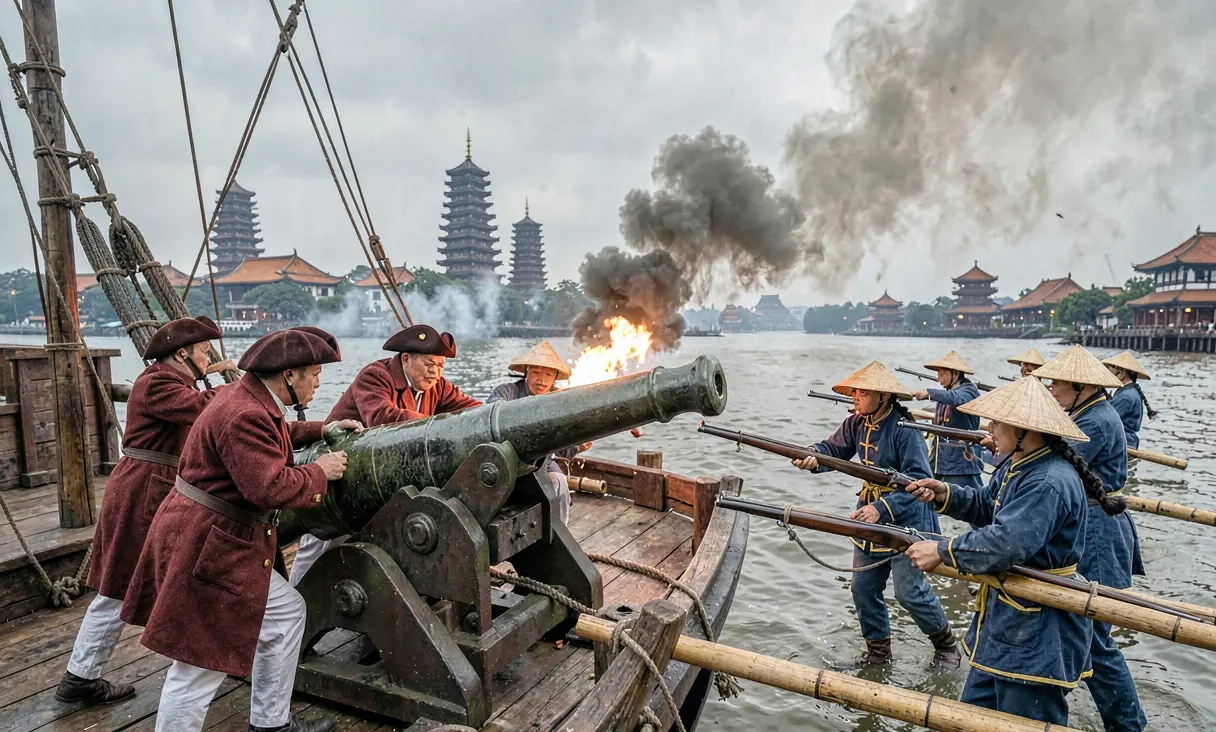
First Opium War Begins
The First Opium War shattered China's isolationist rule, forcing the Treaty of Nanking which ceded Hong Kong and ignited a century of foreign domination.
The Opium Crisis and Diplomatic Deadlock
By the late 1830s, the Qing Dynasty faced a catastrophic economic imbalance driven by the British East India Company's massive opium exports from Bengal. While China exported tea, silk, and porcelain to Britain, the influx of addictive opium reversed the trade flow, draining silver reserves essential for the Chinese monetary system. The social cost was equally devastating, with addiction rates soaring among the populace and even government officials. In 1839, the Daoguang Emperor appointed Lin Zexu as Imperial Commissioner to Guangzhou with a mandate to eradicate the drug trade. Lin's decisive actions, including the blockade of foreign factories and the confiscation of over 20,000 chests of opium, culminated in their public destruction at Humen in June 1839. This act of sovereignty was viewed by London not as law enforcement but as a violation of free trade principles and diplomatic immunity.
Escalation to Open Hostilities
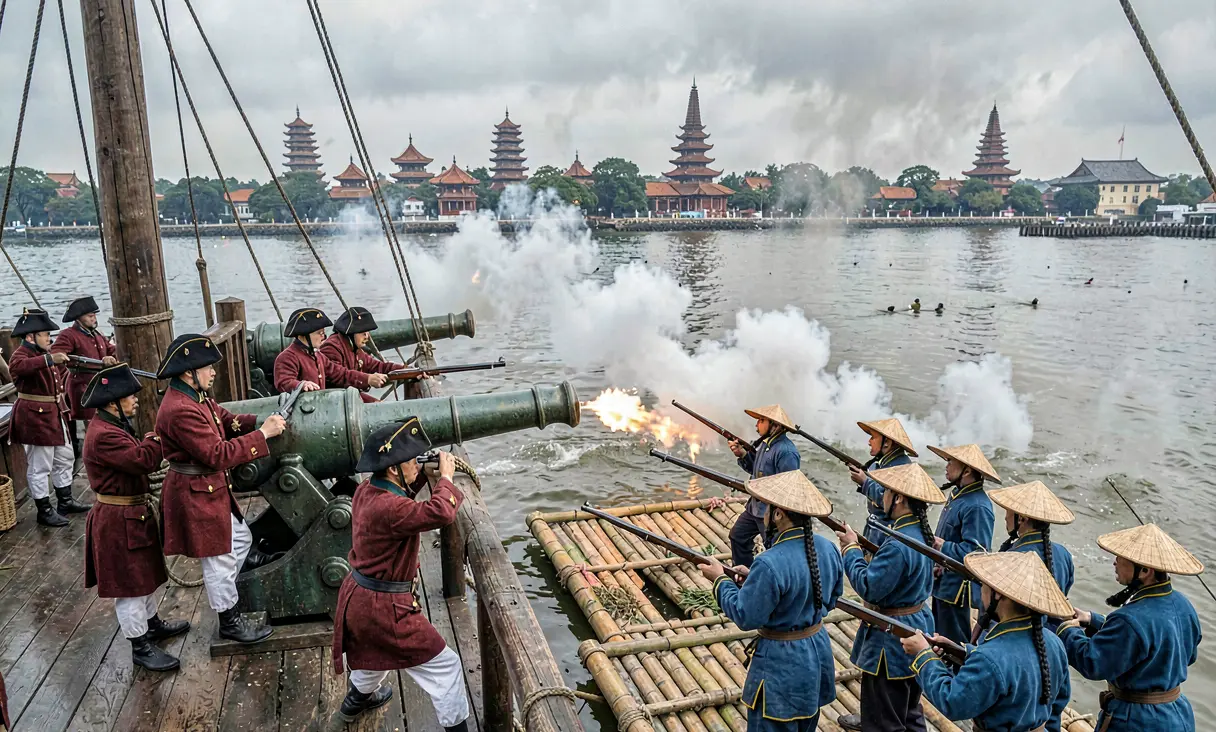
Tensions reached a breaking point in the summer of 1839 following the Kowloon Incident, where British sailors killed a Chinese villager, an event the British refused to surrender for trial under their consular jurisdiction. The conflict formally ignited on September 4, 1839, at the Battle of Chuanbi Island near Guangzhou. A British squadron led by Captain Charles Elliot engaged Qing river defenses, marking the first major naval engagement between a Western power and the Chinese Empire in modern history. Although skirmishes had occurred earlier, this date signifies the transition from diplomatic standoff to active warfare. The British Royal Navy, equipped with steam-powered vessels and heavy carronades, demonstrated an overwhelming technological disparity against the aging Qing fleet, which relied on traditional junks and fixed coastal batteries.
Key Architects of Conflict
The war was shaped by the contrasting visions of two pivotal figures: Lin Zexu and Lord Palmerston. Lin Zexu, a Confucian scholar-official, represented the Qing's desperate attempt to restore moral order and economic stability through rigorous prohibition, famously declaring that if opium were not banned, 'in a few decades there will be no people who can resist the enemy.' Conversely, Charles Elliot, the British Superintendent of Trade, initially sought a diplomatic resolution but was eventually superseded by the more hawkish stance of Foreign Secretary Lord Palmerston in London. Palmerston framed the conflict as a defense of British commercial rights and national honor, dispatching the China Expeditionary Force under Admiral George Elliott to enforce what he termed 'the dignity of the flag.' The war also saw the rise of Chinese commanders like Guan Tianpei, who died heroically defending the Humen forts in 1841.
The Campaign and Military Disparity
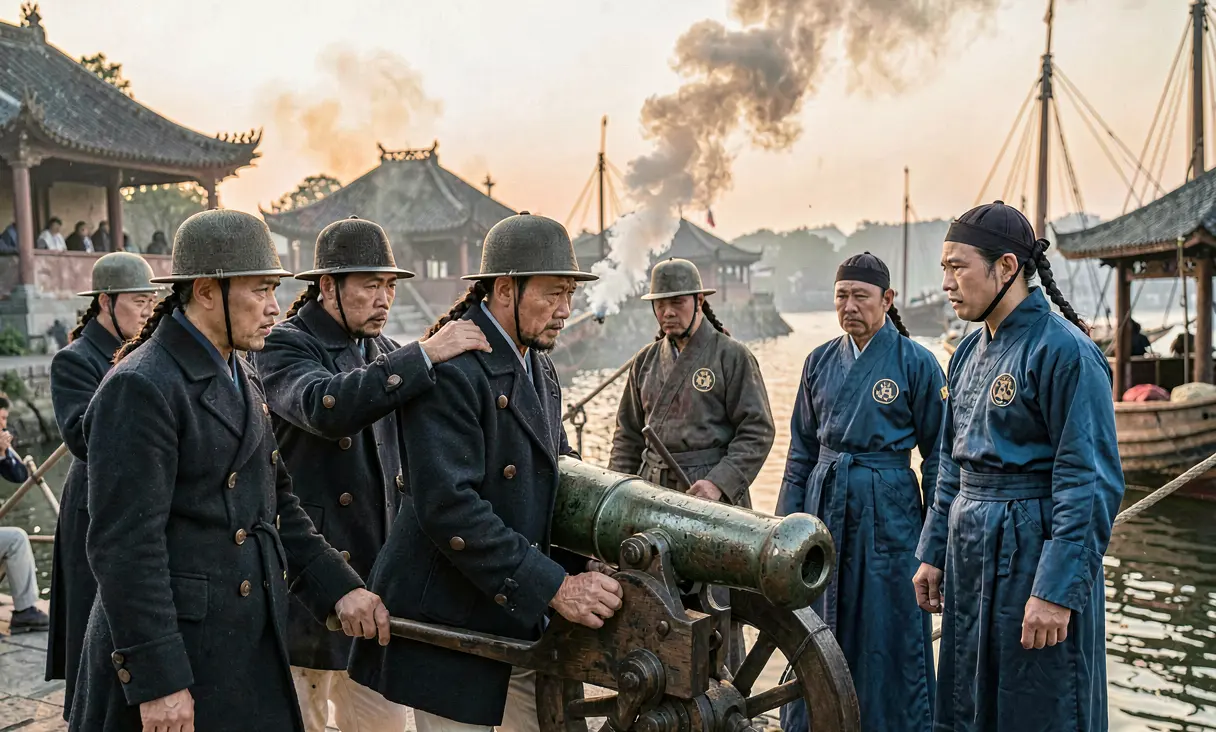
Following the initial skirmishes at Chuanbi, the war expanded into a campaign of British naval mobility. The Royal Navy utilized its superior firepower and maneuverability to bypass Chinese coastal defenses, capturing strategic ports including Xiamen, Ningbo, and Shanghai by 1842. The Qing military, plagued by corruption, outdated tactics, and fragmented command structures, struggled to respond to the fluid British strategy. Despite localized acts of bravery, such as the defense of the Bogue forts, the Qing forces were systematically outmatched. The conflict was not merely a series of battles but a demonstration of industrial warfare against agrarian imperial defense. The British advance up the Yangtze River in 1842 threatened the Grand Canal, China's economic lifeline, forcing the Qing court to sue for peace.
The Treaty of Nanking and Its Terms
The war concluded on August 29, 1842, with the signing of the Treaty of Nanking aboard the HMS Cornwallis. This document was the first of the 'Unequal Treaties' that would define Sino-foreign relations for a century. The terms were draconian: China ceded the island of Hong Kong to Britain in perpetuity, opened five treaty ports (Guangzhou, Xiamen, Fuzhou, Ningbo, and Shanghai) to British residence and trade, and agreed to pay an indemnity of 21 million silver dollars. Crucially, the treaty established the principle of extraterritoriality, exempting British subjects from Chinese law, and fixed import duties at a low rate, stripping China of its right to set independent tariff policies. The Qing Dynasty's authority was fundamentally compromised as it was forced to recognize diplomatic equality with a foreign power for the first time.
Legacy: The Century of Humiliation
The First Opium War serves as the definitive starting point of China's 'Century of Humiliation,' a period characterized by foreign domination, territorial dismemberment, and internal instability. The defeat shattered the myth of Qing invincibility and exposed the dynasty's technological and institutional obsolescence, sparking a series of rebellions, most notably the Taiping Rebellion, which further weakened the state. For the West, the war validated the doctrine of gunboat diplomacy and opened China to aggressive imperialist expansion by other powers, including France, the United States, and Russia. The conflict fundamentally altered global geopolitics, shifting the balance of power in East Asia and setting the stage for the modern nation-state system's contentious entry into Chinese history.
It forced China open to Western imperialism, ending its isolation and beginning the 'Century of Humiliation'.
Where it happened
Guangzhou, China — see it on the interactive map →
Explore related history
 WarBattle of WaterlooJune 18, 1815 · Waterloo, BelgiumNapoleon Bonaparte is defeated, ending the Napoleonic Wars.
 WarSecond Boer War BeginsOctober 11, 1899 · Pretoria, South AfricaBritish Empire fights Boer republics, introducing concentration camps.
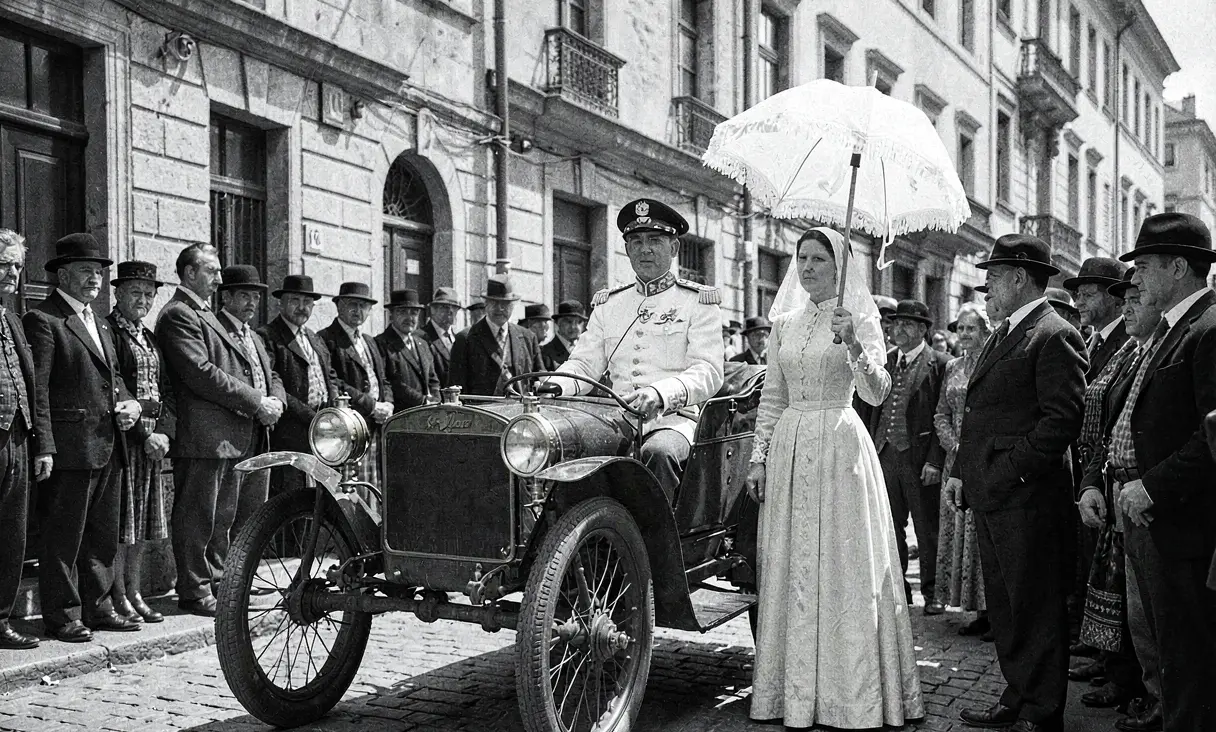 WarOutbreak of World War IJuly 28, 1914 CE · Sarajevo, BosniaAssassination of Archduke Franz Ferdinand triggers a global conflict involving major powers.
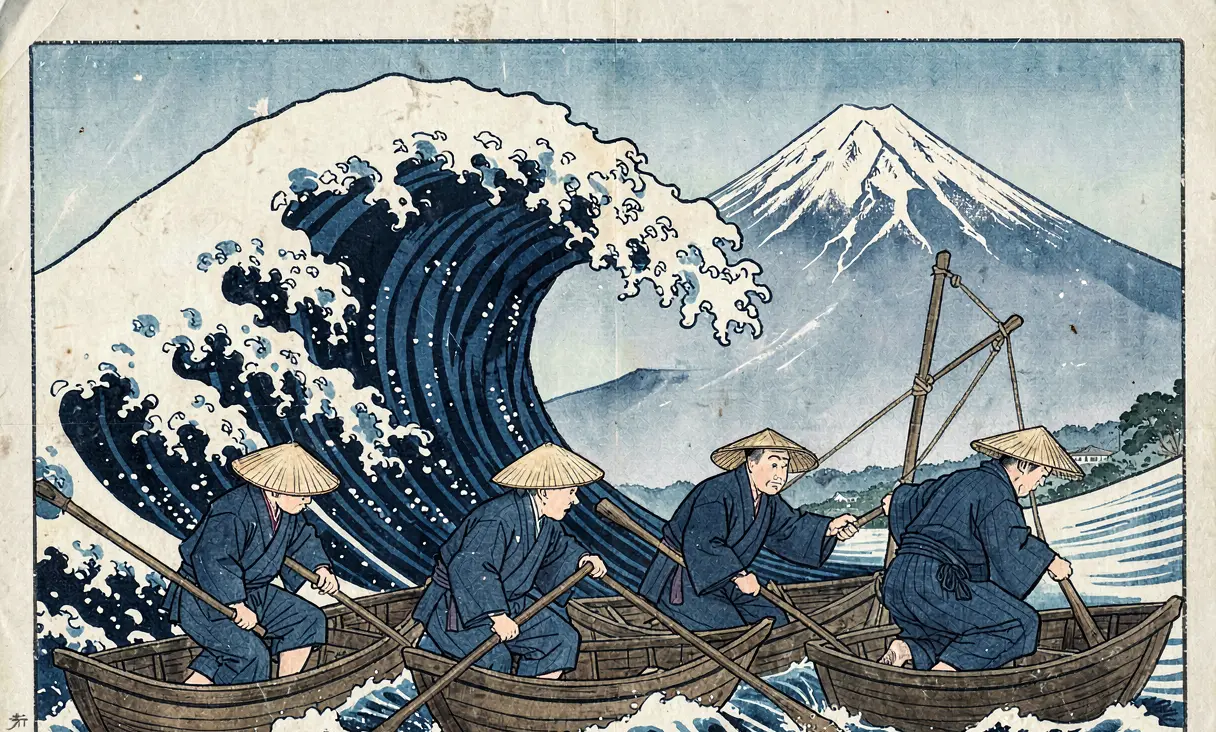 ArtCreation of The Great Wave off Kanagawac. 1831 CE · Kanagawa, JapanHokusai produces iconic woodblock print influencing Western art movements.
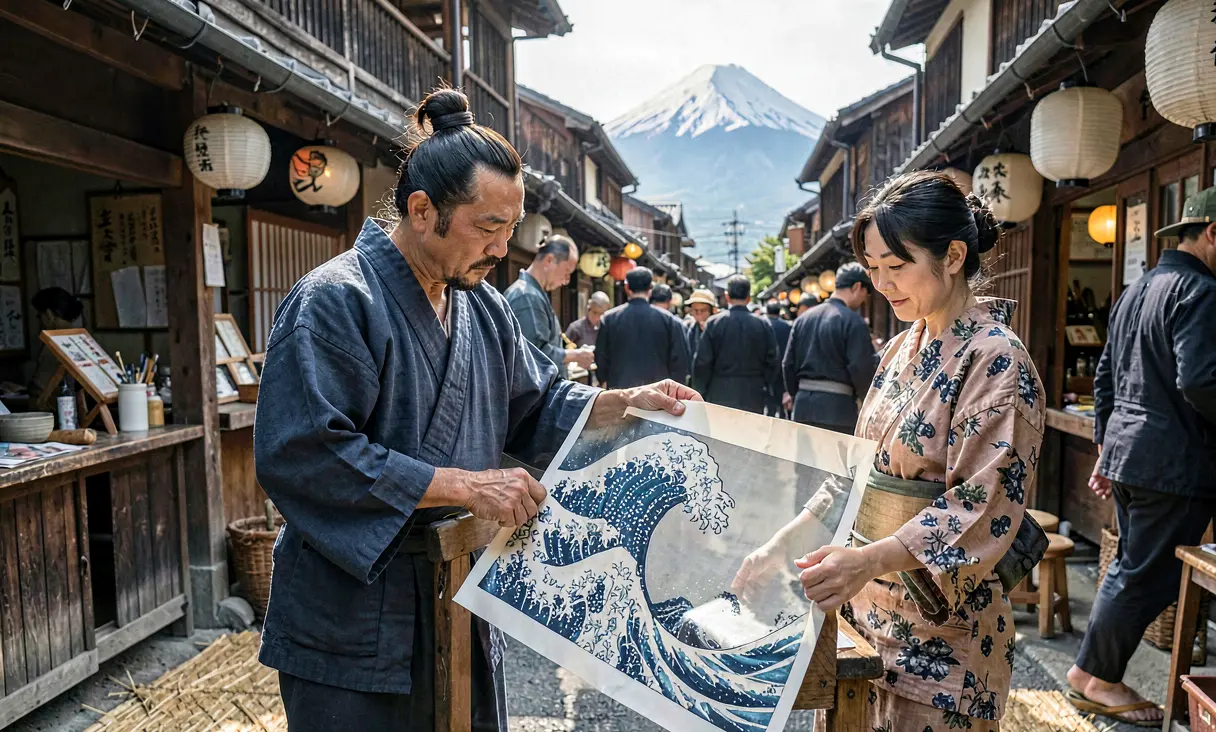 ArtPublication of Hokusai's Great Wavec. 1831 CE · Edo (Tokyo), JapanKatsushika Hokusai releases the iconic woodblock print of Mount Fuji.
 SciencePublication of Origin of SpeciesNovember 24, 1859 CE · London, EnglandCharles Darwin proposes natural selection as the mechanism for evolution of life.
Discussion
Loading…