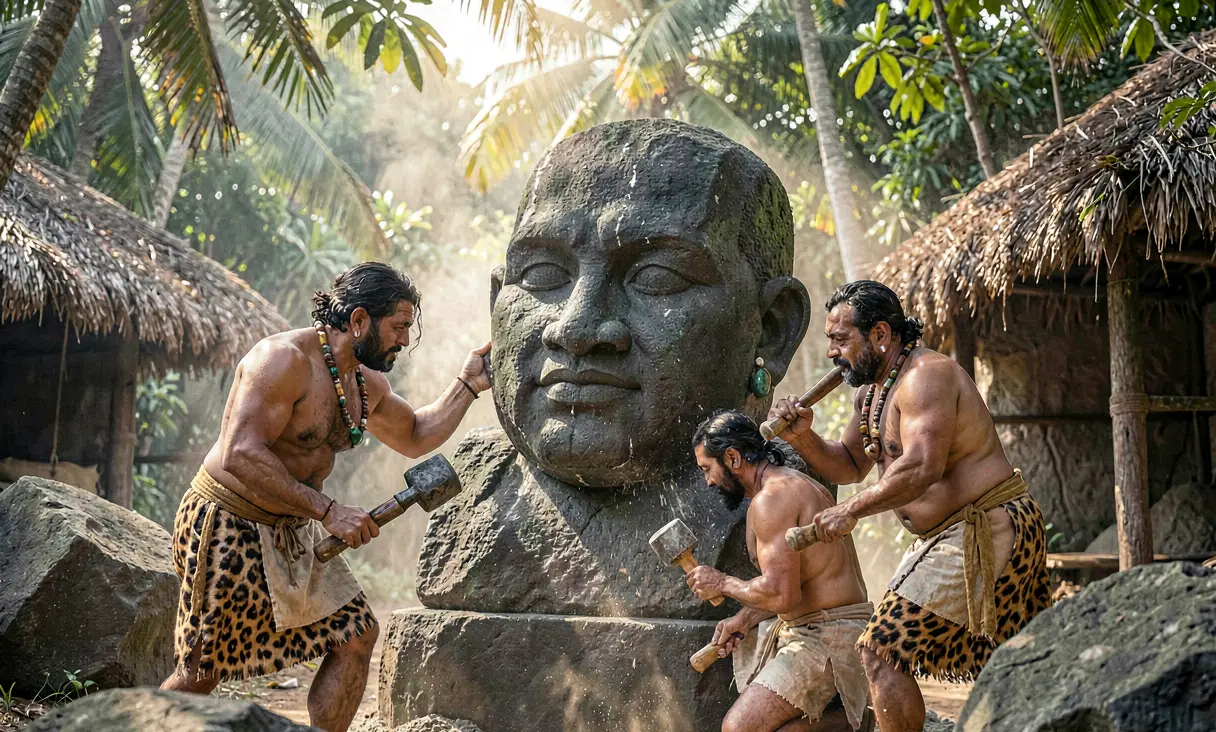
Carving of Olmec Colossal Heads
Around 900 BCE, the Olmec elite at San Lorenzo commissioned massive basalt portraits of rulers, demonstrating unprecedented logistical power and establishing the Mesoamerican tradition of divine kings
The Rise of San Lorenzo
By the early second millennium BCE, the Olmec civilization had established itself as the 'Mother Culture' of Mesoamerica, with its primary political and religious center at San Lorenzo Tenochtitlan in the modern-day state of Veracruz. Situated on a high plateau overlooking the Coatzacoalcos River basin, this site flourished between 1400 and 900 BCE, characterized by complex social stratification and an unprecedented capacity for resource mobilization. The environment was rich in alluvial soils supporting intensive agriculture, which generated the surplus necessary to sustain a large non-farming elite class of artisans, priests, and administrators.
The Colossal Heads: A Monumental Tradition
Beginning around 1200 BCE and continuing until roughly 900 BCE, the San Lorenzo rulers commissioned a series of sixteen colossal basalt heads, the largest of which stands over three meters tall and weighs an estimated 25 tons. Carved from single blocks of volcanic stone sourced from the Tuxtla Mountains, located approximately 80 kilometers away across difficult terrain, these sculptures represent the earliest known large-scale portrait art in the Americas. Unlike later Mesoamerican art that often depicted deities or mythological scenes, these heads are widely interpreted as realistic portraits of specific, individual rulers, distinguished by their unique facial features, flattened noses, thick lips, and distinctive helmet-like headdresses.
Logistics of Stone and Labor
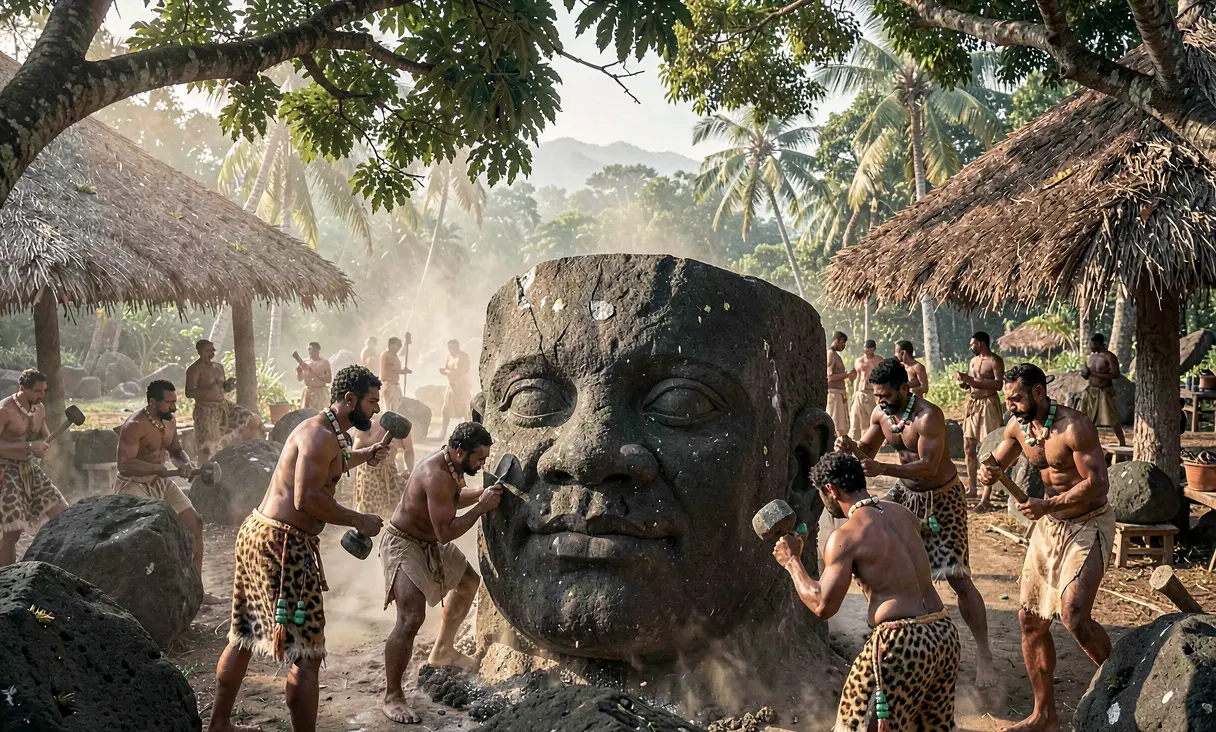
The creation and transportation of these monuments required a level of centralized organization previously unseen in the region. Archaeological evidence suggests that the basalt blocks were quarried using stone tools, then dragged on wooden sledges or rolled on logs to the riverbanks, where they were likely floated on rafts down the Coatzacoalcos River system before being hauled overland to San Lorenzo. This feat implies a powerful political authority capable of commanding thousands of laborers for months at a time, coordinating food supplies, and managing complex engineering challenges without the use of the wheel or draft animals.
The Era of Rulership
While no written records survive to name the specific individuals depicted, the uniformity in style yet distinctiveness in features suggests a dynastic succession. Scholars such as Michael Coe and Mary Pohl have analyzed the headdresses, noting that they often bear glyphs or symbols associated with jaguar imagery, linking the rulers to supernatural power and shamanistic transformation. The sheer number of heads found at San Lorenzo indicates a period of intense political consolidation where each ruler sought to legitimize their authority through these enduring stone monuments, effectively creating a visual lineage of divine kingship.
Decline and Ritual Termination
Around 900 BCE, the San Lorenzo complex experienced a rapid and violent decline. Many of the colossal heads were deliberately defaced, toppled, and buried in organized pits or mounds, suggesting a ritual termination of power rather than simple abandonment. This systematic destruction may have been carried out by a rival faction, an internal revolt, or as part of a religious rite to neutralize the spiritual power of former rulers. Following this event, the political center shifted to La Venta, where the tradition of colossal heads continued but with different stylistic nuances and a reduced number of monuments.
Legacy of Stone Kings
The Olmec colossal heads established a paradigm for Mesoamerican political art that would influence civilizations for over two millennia. The concept of the ruler as a divine figure, immortalized in stone to project authority across generations, became a staple of Maya and Aztec iconography. Furthermore, the engineering feats required to move these massive stones demonstrated a mastery of logistics and labor organization that set a precedent for future monumental construction projects throughout the region, cementing San Lorenzo's place as the cradle of complex society in the New World.
Modern Rediscovery
Lost to the jungle for centuries, the heads were first brought to global attention in the 19th century by local farmers and later systematically excavated by archaeologists Matthew Stirling and Philip Drucker in the mid-20th century. Today, they stand as iconic symbols of pre-Columbian history, with several originals displayed at museums in Mexico City and on-site at San Lorenzo, while others remain buried or fragmented, serving as silent witnesses to a civilization that mastered stone before the arrival of Europeans.
These heads are the earliest known large-scale portraits in the Americas, defining Olmec cultural identity.
Where it happened
San Lorenzo Tenochtitlan, Mexico — see it on the interactive map →
Explore related history
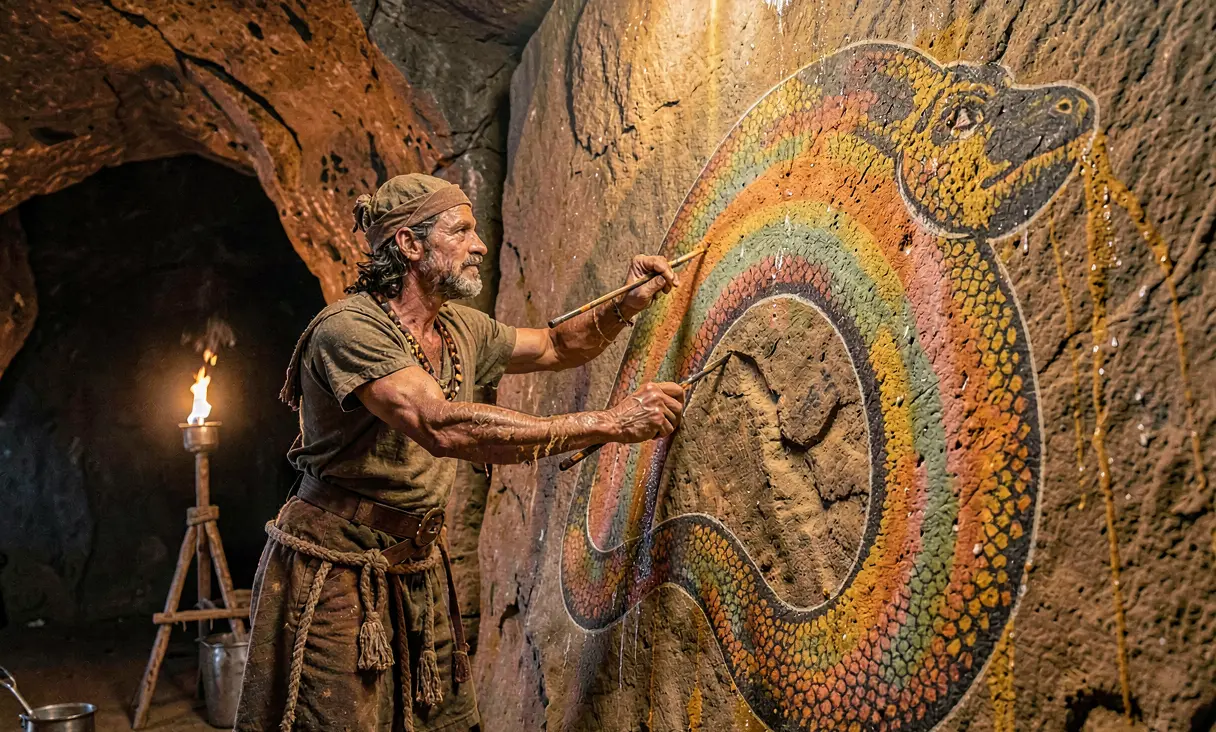 ArtPeak Period of Australian Aboriginal Rock Artc. 3000 BCE to 1500 CE · Kakadu National Park, AustraliaAboriginal artists create vast galleries of rock paintings depicting ancestral beings and hunting scenes.
 ArtCreation of the Benin Bronzes under Oba Ewuarec. 1450 CE · Benin City, NigeriaOba Ewuare commissions the famous bronze and ivory plaques documenting court life and military victories.
 ArtMass Production of Moai Statues at Rano Rarakuc. 1400 CE · Rano Raraku Quarry, Rapa NuiThe peak period of moai carving begins at the Rano Raraku quarry under the direction of clan chiefs.
 ExplorationFoundation of Kilwa Kisiwani as a Major Trade Hubc. 900 CE · Kilwa Kisiwani, TanzaniaKilwa emerges as a dominant Swahili city-state controlling gold trade from Great Zimbabwe to the Indian Ocean.
 CivilizationConsecration of La Venta's Great Pyramidc. 900 BCE · La Venta, Tabasco, MexicoThe first major pyramid in Mesoamerica is completed at La Venta.
 WarHuang Chao Rebellion and Fall of Tang874 CE · Shandong Province, ChinaHuang Chao leads a massive peasant uprising that sacks Chang'an and destroys Tang authority.
Discussion
Loading…