
Kushite Conquest of Egypt Establishes 25th Dynasty
King Piye's conquest unified Egypt and Nubia under the 25th Dynasty, sparking a cultural renaissance before Assyrian pressure eventually forced a retreat to Sudan.
Context of Fragmentation and Nubian Ascendancy
By the mid-8th century BCE, Egypt was a fractured landscape, divided among competing local dynasts and warlords who held nominal allegiance to no central authority. The Third Intermediate Period had eroded the power of the pharaohs, leaving Lower Egypt in the hands of rival rulers like Tefnakht of Sais and Osorkon IV, while Upper Egypt remained under the influence of the High Priests of Amun at Thebes. Simultaneously, south of the First Cataract, the Kingdom of Kush had risen from a vassal state to a formidable imperial power centered in Napata. Under a succession of capable kings, the Kushites had not only consolidated control over Nubia but also deeply absorbed Egyptian religious culture, viewing themselves as the true guardians of Amun's orthodoxy against what they perceived as the spiritual decay of Egypt.
The Campaign of King Piye
Around 744 BCE, King Piye (also known as Piankhi) initiated a decisive military campaign northward to restore order and unify the Two Lands under Kushite rule. Unlike previous invasions driven solely by plunder, Piye's expedition was framed as a holy war to liberate Egypt from chaos and re-establish the worship of Amun. The conflict culminated in a series of intense battles where Piye's forces systematically dismantled the coalition led by Tefnakht. Historical records, preserved on the famous Victory Stele at Gebel Barkal, detail how Piye besieged Hermopolis and Memphis, eventually forcing the submission of the northern delta rulers who had previously resisted his authority.
The Stela of Victory and Strategic Submission
The narrative of the conquest is preserved with remarkable detail on a limestone stela erected at Gebel Barkal, which serves as both a military report and a theological manifesto. Piye describes how he accepted the surrender of defeated kings who came to his camp barefoot and weeping, offering tribute that included gold, silver, horses, and cattle. Notably, despite his total victory, Piye did not permanently occupy Lower Egypt; instead, he returned to Napata, leaving local rulers in place as vassals provided they acknowledged his suzerainty and maintained the proper religious rites. This unique approach highlighted a distinct Kushite political philosophy that prioritized spiritual hegemony over direct administrative occupation.
Establishment of the 25th Dynasty
Piye's conquest marked the formal beginning of the 25th Dynasty, often referred to as the Kushite or Nubian Dynasty. Although Piye ruled from Napata, his successors, particularly Shabaka and Taharqa, would move the administrative center closer to Egypt, ruling as pharaohs who adopted full Egyptian titulary and iconography. This era witnessed a deliberate revival of Old Kingdom artistic styles, architecture, and religious practices, earning the dynasty its reputation as a 'Renaissance' of Egyptian culture. The Kushite kings positioned themselves not as foreign occupiers but as the legitimate restorers of Ma'at (cosmic order), effectively merging Nubian military might with Egyptian theological tradition.
Imperial Consolidation and Trade Dominance
Under the 25th Dynasty, Egypt and Nubia were unified into a single empire that stretched from the Mediterranean Sea to the Fourth Cataract of the Nile. This vast territory controlled critical trade routes connecting the gold-rich interior of Africa with the markets of the Near East and the Mediterranean world. The dynasty fostered a period of relative stability and economic prosperity, facilitating the construction of monumental temples at sites like Karnak, Kawa, and Meroë. However, this expansion inevitably brought the Kushite empire into direct conflict with the rising Neo-Assyrian Empire, which sought to dominate the Levant and viewed a unified Egypt-Nubia as a strategic threat.
Legacy of the Black Pharaohs
The 25th Dynasty ruled for nearly a century before Assyrian invasions under Esarhaddon and Ashurbanipal forced the Kushites to retreat south to Napata and eventually Meroë in the mid-7th century BCE. Despite their eventual expulsion from Egypt, the legacy of Piye and his successors endured profoundly. They left an indelible mark on Egyptian art and religion, revitalizing the cult of Amun and setting a precedent for later dynastic restorations. The era stands as a testament to the fluidity of ancient power dynamics, demonstrating how a 'peripheral' kingdom could successfully conquer and culturally transform one of history's most enduring civilizations.
This event marked the first time an African dynasty ruled all of Egypt, revitalizing Egyptian culture before its eventual decline.


Where it happened
Napata, Nubia (Modern Sudan) — see it on the interactive map →
Explore related history
 WarAn Lushan Rebellion Begins755 CE · Chang'an, ChinaGeneral An Lushan revolts against Emperor Xuanzong, devastating the Tang Dynasty and population.
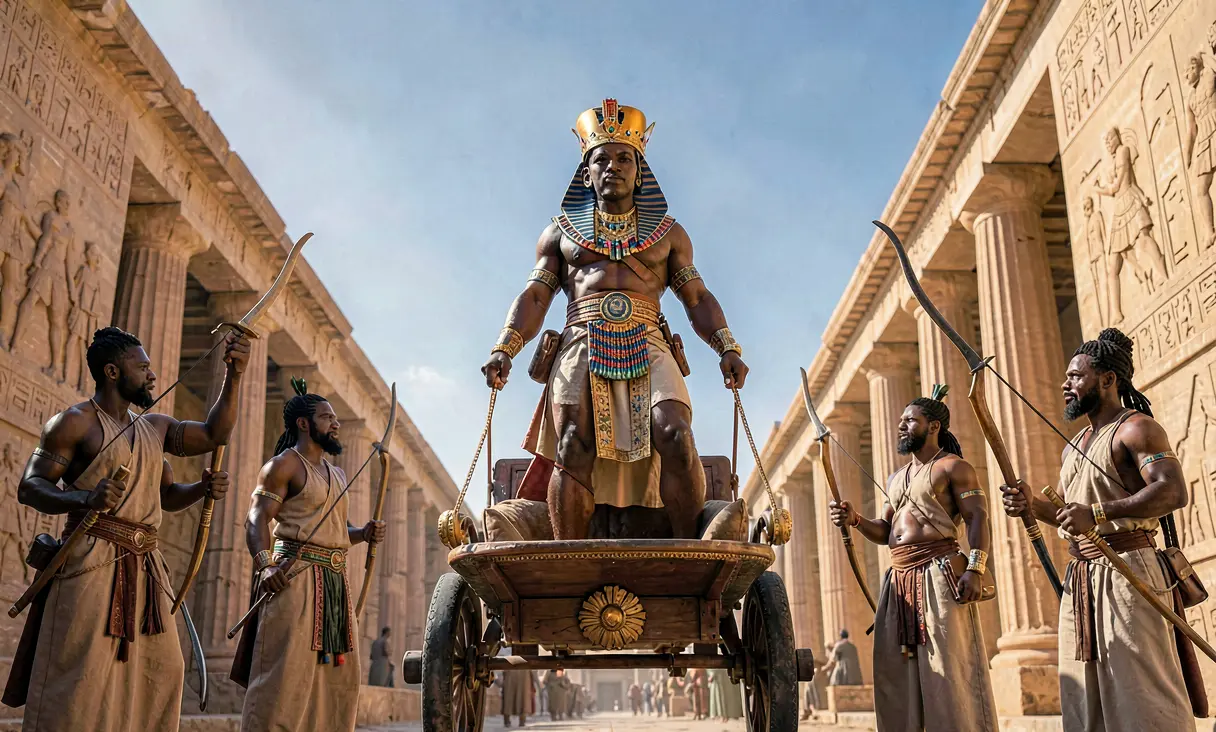 WarKushite Conquest of Egypt (25th Dynasty)c. 747 BCE · Thebes, EgyptKing Piye of Kush conquers Upper and Lower Egypt, establishing the first African-led dynasty in Egyptian history.
 WarDeath of Ah Cacao and Fall of Copán's Dynasty738 CE · Copán, HondurasThe king of Copán is captured and executed by his rival from Quiriguá, ending a golden age.
 ScienceEstablishment of the Babylonian Astronomical Observatoriesc. 747 BCE · Babylon, IraqBabylonian priests begin systematic nightly recording of planetary movements and eclipses.
 DisasterCatastrophic Floods and Collapse of Moche San José de Moroc. 750 CE · Lambayeque Valley, PeruEl Niño floods devastate Moche infrastructure leading to societal transformation.
 CivilizationRise of the Etruscan League in Central Italyc. 750 BCE · Tarquinia (Cerveteri), ItalyEtruscan city-states form a powerful confederation dominating central Italy and influencing Rome.
Discussion
Loading…